
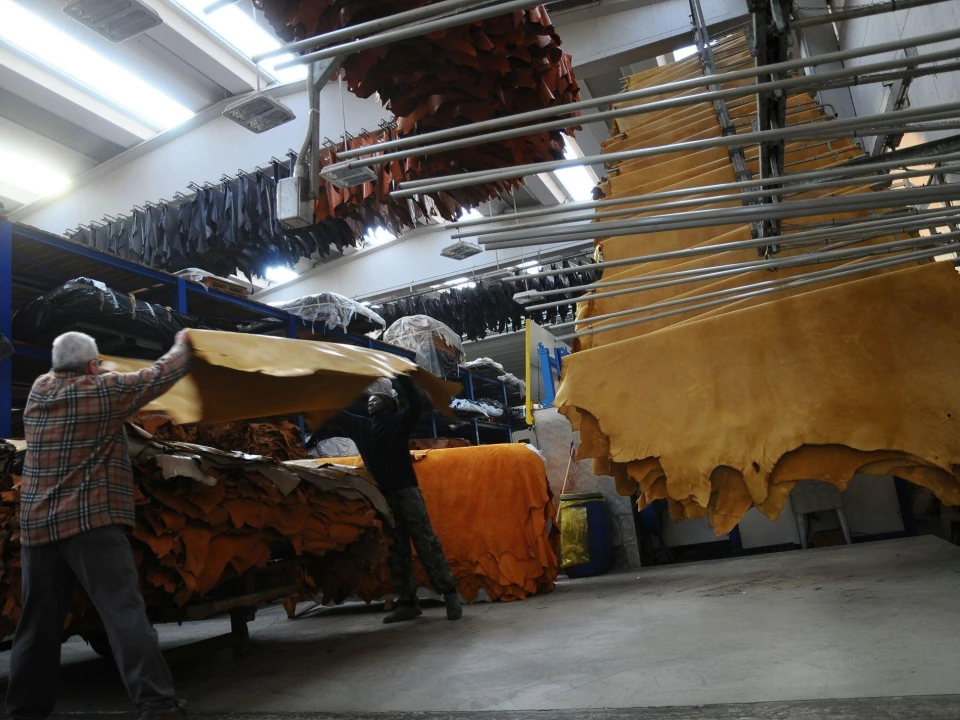

Between Florence and Pisa, in the heart of Tuscany, lies one of the most sophisticated leather manufacturing ecosystems in Europe. The Santa Croce sull'Arno industrial district has built an international reputation through its extraordinary concentration of tanneries, specialized manufacturers, technological expertise, and entrepreneurial talent. Although its products often reach consumers under the labels of prestigious international fashion houses, the industrial knowledge behind them is deeply rooted in this relatively small Italian territory.
The district extends across seven municipalities, including Santa Croce sull'Arno, San Miniato, Fucecchio, Castelfranco di Sotto, and Montopoli in Val d'Arno. Together, they form a production system in which hundreds of businesses contribute to different stages of leather manufacturing.
According to figures published in 2026, the district includes approximately 600 companies and employs more than 8,000 people. It accounts for around 35% of Italy's leather production and nearly all of the country's leather used for shoe soles. These numbers illustrate the extraordinary importance of a manufacturing area that occupies only a small portion of Tuscany.
The origins of leather processing in this territory stretch back centuries. Its proximity to the Arno River provided access to water, an essential resource for traditional tanning. Over time, local workshops developed specialized skills that gradually evolved into an integrated industrial system.
The district's modern expansion accelerated during the twentieth century, particularly as Italian footwear and leather goods gained international recognition.
One of its greatest strengths is specialization. Rather than requiring every company to perform the entire production process, businesses concentrate on specific operations, including tanning, dyeing, finishing, mechanical processing, and quality control.
This organization creates a remarkably flexible manufacturing network. Companies can collaborate with nearby specialists, respond to demanding orders, and develop customized products for fashion and luxury brands.
The connection with international fashion is particularly significant. High-quality leather produced in Santa Croce can become handbags, footwear, accessories, clothing, or furniture sold in markets around the world.
However, the district's contribution extends beyond the material itself. Its expertise includes selecting hides, developing colors and textures, improving durability, and producing finishes that meet precise technical and aesthetic requirements.
Technological innovation has become increasingly important. Modern machinery, computerized controls, and advanced chemical processes allow companies to achieve consistent quality while developing new types of leather.
Environmental management represents another central challenge. Tanning requires substantial quantities of water and involves chemical treatments, making wastewater purification and responsible waste management essential.
The district has responded through collective infrastructure and shared investments. Industrial wastewater treatment facilities, research projects, and initiatives to recover resources demonstrate how cooperation between companies can address problems that individual businesses would struggle to manage alone.
According to the district's own reporting, more than €1.8 billion has been invested in research, innovation, and training over approximately four decades.
One particularly important objective is increasing the reuse of treated wastewater, reducing pressure on underground water resources.
The transition toward more sustainable production is also influencing product development. Manufacturers are exploring ways to reduce chemical consumption, improve traceability, and recover useful materials from industrial byproducts.
These developments are increasingly relevant to international customers seeking reliable information about environmental performance and supply chains.
The district also demonstrates the importance of preserving technical skills. Experienced workers remain essential for evaluating the characteristics of leather, controlling production processes, and ensuring that finished materials meet demanding standards.
Santa Croce sull'Arno represents a distinctive Italian industrial model in which small and medium-sized companies achieve international competitiveness through specialization and cooperation.
Its success demonstrates that the strength of Made in Italy manufacturing does not depend exclusively on famous brands. Behind many of the world's most desirable fashion products stands an interconnected network of businesses whose expertise has developed over generations.
From traditional tanning workshops to advanced industrial facilities, Tuscany's leather district continues to connect local manufacturing knowledge with the global luxury economy.
Questo sostituisce integralmente l'articolo numero 6 di novembre, mantenendo invariata la regione Toscana e la rubrica Industrial districts.