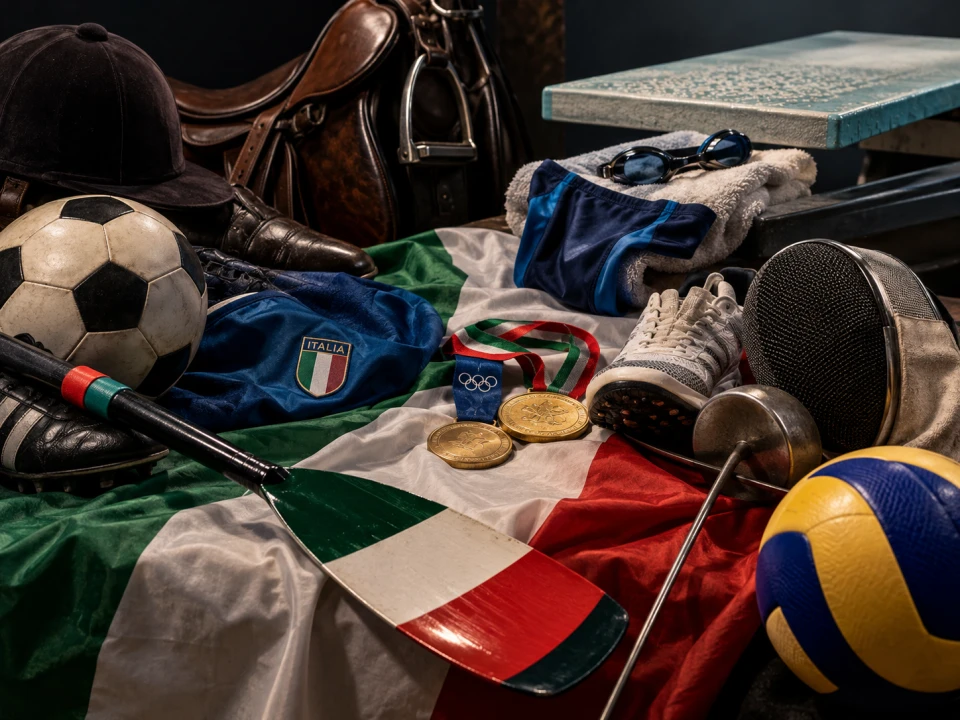

In Italian sports, some families have turned talent into a tradition: surnames that span generations, brothers divided by crosstown rivalries or united in an Olympic competition, fathers and daughters connected by the same dive into the water. From soccer dynasties to Olympic triumphs in rowing and diving, these stories reveal an Italy built on heritage, discipline, and passions passed down at home, in the gym, and on the playing field.
Few names embody this tradition as powerfully as Maldini, a true soccer dynasty. Cesare Maldini, a defender and captain of AC Milan, won the European Cup in 1963 and later coached the Italian national team. His son Paolo became one of the most celebrated defenders in world soccer history, an icon of the Rossoneri and winner of five Champions League titles. With Daniel Maldini, Cesare's grandson and Paolo's son, the family wrote another extraordinary chapter. His debut for the Italian national team in 2024 marked the first time three generations of the same family had worn the Azzurri jersey. Daniel had already made history in 2021, when his first Serie A start for Milan was celebrated as the first time three generations of the same family had started matches in Italy's top division.
Soccer also has the two Buffons: Gianluigi, a World Cup champion with Italy in 2006 and a Juventus legend who won 10 domestic league titles, and his son Louis Thomas, who plays for Pisa in Serie B.
Then there are the stories of countless soccer-playing brothers. Perhaps the most famous is that of Giuseppe and Franco Baresi, two brothers raised in Travagliato, near Brescia, who became symbols of opposing sides of Milan. Giuseppe spent much of his career with Inter, while Franco became AC Milan's captain and defining figure, widely regarded as one of the greatest defenders in soccer history. Their sporting rivalry never weakened their family bond: two brothers, two captains, the same stadium, and two opposing colors. Both were called up to the Italian national team for the 1980 European Championship, although they never played together for the senior Azzurri.
Other famous brothers include Simone and Filippo Inzaghi, both of whom represented Italy; Gianluigi and Antonio Donnarumma; Cristiano and Alessandro Lucarelli; Fabio and Paolo Cannavaro; twins Cristian and Damiano Zenoni; and, more recently, Pio and Sebastiano Esposito, who have played together for the Azzurri.
The most remarkable example, however, is that of the Sentimenti brothers, who represented an extraordinary rarity in the 1940s and 1950s. Five soccer-playing brothers – Ennio, Arnaldo, Vittorio, Lucidio, and Primo – carried the family name into Italy's major national competitions, with four of them reaching Serie A. The most exceptional chapter unfolded at Lazio, where Vittorio, Lucidio, and Primo formed a genuine "Sentimenti trio," with three brothers playing for the same team. It remains one of the most unusual stories in Italian soccer, from an era when family talent was not yet a social media phenomenon but something fans could witness every Sunday on stadium fields.
Beyond soccer, Italian sports history is filled with champion brothers and relatives. From the 1960s through the 1980s, the country's most famous sporting brothers were Piero and Raimondo D'Inzeo, two military officers who dominated Italian equestrian sports for nearly three decades. Officers and accomplished riders, they competed in eight consecutive Olympic Games, from London 1948 to Montreal 1976, a record that made them two of the most recognizable figures in Italian sports. Their greatest moment came at the 1960 Rome Olympics, when Raimondo won gold and Piero silver in individual show jumping. It was an all-Italian triumph, with two brothers nicknamed "the Invincibles" sharing the podium.
During the 1980s and 1990s, the most famous brothers were Giuseppe, Carmine, and Agostino Abbagnale, three rowing champions who wrote one of the most glorious chapters in Italian sports history. Giuseppe and Carmine formed a legendary crew in the coxed pair, winning two Olympic gold medals and seven world titles between 1981 and 1993. Their younger brother Agostino surpassed even his older brothers' Olympic medal count, winning three gold medals in the quadruple sculls and double sculls. At the 1988 Seoul Olympics, all three Abbagnale brothers reached the Olympic podium on the same day, just minutes apart: Giuseppe and Carmine won the coxed pair, while Agostino triumphed in the quadruple sculls.
The world of diving has produced two famous Italian families. The first and best known is the Cagnotto family. Giorgio was one of the world's leading divers during the 1970s, winning two Olympic silver medals and two bronze medals. His daughter Tania transformed that legacy into an extraordinary career, becoming the first Italian female diver to win an Olympic medal. For years, Giorgio also served as her coach, creating a father-daughter relationship that became both the technical and emotional foundation of one of the longest and most successful careers in Italian diving history.
In the new millennium, another diving dynasty emerged: the Marconi siblings. Nicola became a leading individual competitor for the Italian national team, while his brother Tommaso joined him to form one of the most important men's synchronized diving partnerships in Italian history. Their sister Maria also enjoyed a successful career representing Italy. At the 2008 Beijing Olympics, all three competed, becoming the only three siblings in the discipline to participate simultaneously in the same Olympic Games.
From the swimming pool to the pavement, the most famous brothers in Italian track and field are Giorgio and Maurizio Damilano, two legends of racewalking. Maurizio became Olympic champion at the 1980 Moscow Games, won two world championships, and set a world record, while Giorgio competed for the Italian national team for nearly 20 years.
Then there are the fencing dynasties. The first was the Mangiarotti family, with three brothers introduced to the fencing strip by their father Giuseppe, who had himself represented Italy at the 1908 London Olympics. Edoardo, the most decorated fencer of all time with 13 Olympic medals and 26 World Championship medals, and his brothers Dario and Mario won a combined total of 55 medals between the Olympics and World Championships.
The second great fencing dynasty was the Montano family. It began with Aldo, who won two Olympic silver medals in team saber during the 1930s and 1940s, along with several gold and silver medals at the World Championships and Italian national titles. The tradition continued with his son Mario Aldo, who won an Olympic gold medal in team saber and two silver medals during the 1970s and 1980s. The next generation brought another Aldo Montano, who won individual saber gold at the 2004 Athens Olympics, along with several Olympic and World Championship silver and bronze medals, including team silver at Tokyo 2020.
Finally, volleyball has the Bovolenta family. The father, Igor, a talented player whose life was tragically cut short at the age of 38, won an Olympic silver medal at Atlanta 1996. His son Alessandro became a professional player in Italy's SuperLega and won a silver medal at the 2023 European Championships.
These dynasties are much more than a collection of medals and records. They tell stories of fathers who become coaches and role models for their children, of brothers who push one another beyond their limits, and of family names that become synonymous with an entire sport. And while talent is not automatically inherited, passion can certainly be passed down. More than any collection of trophies and medals, that passion is the true legacy of the families that have helped make Italian sports great.