
In the Italy that grew up with the revolution brought by the television, its theme songs (“sigle”) were never merely background music attached to opening credits. They announced that everyone should come into the room, turn toward the television, and prepare to enter a shared world. Children, parents, and grandparents heard the same melody. Soon, everyone was singing it.
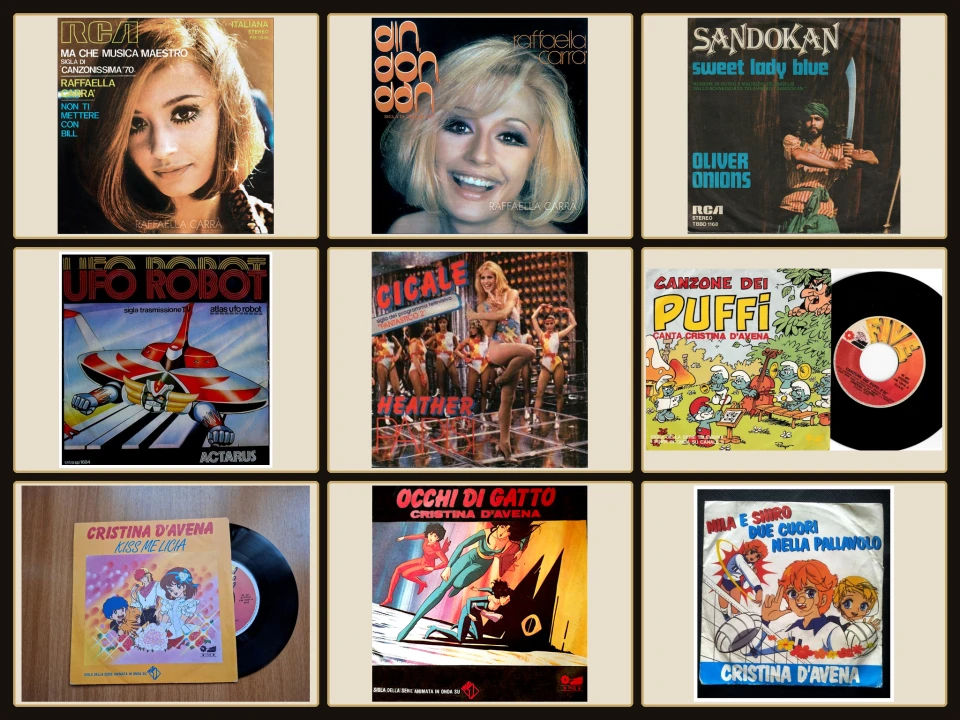
This phenomenon grew especially powerful when national television still gathered enormous audiences. Canzonissima, which began on radio in 1956 and adopted its famous name in 1958, became a Saturday-night ritual. In 1970, Corrado joked about presenting the show before 22 million viewers. Its opening number, Ma che musica maestro, introduced a young Raffaella Carrà and instantly joined choreography, fashion, personality, and melody. The song was not disposable packaging – it was polished popular music, written and arranged by accomplished professionals, recorded for television, and released commercially.
Carrà’s career demonstrates how naturally television and records reinforced each other. Chissà se va accompanied Canzonissima in 1971, Din don dan opened Milleluci in 1974, and Tanti auguri became inseparable from Ma che sera in 1978. Mina’s Non gioco più, the closing theme of Milleluci, offered another standard altogether: sophisticated orchestration, an unforgettable harmonica part, and the authority of Italy’s greatest pop voice.
The sigla could also turn drama into national mythology. Sandokan, the six-part 1976 miniseries directed by Sergio Sollima, arrived with the Oliver Onions’ pounding title song. Written by Guido and Maurizio De Angelis with collaborators, it reached number two on the Italian hit parade. Its opening cry remains instantly recognizable because the composition did more than identify a program – it created adventure before the story had even begun.
The funny thing is that, for those of us who loved America, some American television series effectively had two theme songs. Alongside the original American theme, which many of our American readers of a certain age will remember, there was an Italian one. These were not simply rewritten versions of the originals, but entirely new songs. Dallas was one example: when I heard the original theme from the first time I couldn’t believe my ears, I had been listening to another theme song for years!
Then cartoons transformed the tradition into a cultural industry. When Japanese animation entered Italian homes, local composers often created entirely new songs rather than simply translating Japanese openings. Ufo Robot, written by Luigi Albertelli, Vince Tempera, and Ares Tavolazzi and performed by Actarus, sold more than 1 million copies in 1978, reached number four on the singles chart, and became that year’s eighteenth-best-selling single. Those figures belong to mainstream pop, not a musical footnote for children.
The 1980s expanded the soundtrack. Italian American Heather Parisi’s Disco bambina and Cicale gave Fantastico the pulse of contemporary dance music. Lorella Cuccarini’s La notte vola, created for Odiens in 1988, outlived the variety show and became a permanent party anthem. These recordings used major arrangers, studio musicians, orchestras, emerging electronic sounds, memorable bass lines, and precisely engineered choruses. Their quality explains their survival.
For younger viewers, Cristina D’Avena became the defining voice. From La canzone dei Puffi to Kiss Me Licia, Occhi di gatto, Mila e Shiro, and Piccoli problemi di cuore, she built a repertoire spanning generations. Published career figures credit her with roughly 750 recorded songs and about 7 million records sold. Adults still sing those refrains at concerts because they are hearing both music and childhood.
Italian sigle mattered because broadcasting once created synchronized memory. A song heard weekly by millions moved from television to 45 rpm singles, cassettes, schoolyards, summer vacations, and family cars. We did not passively recognize these themes – we learned every word and sang them together.
Streaming has multiplied choices and weakened that collective rhythm, but the songs remain. They offer a vivid route into everyday Italian life: not museum culture, but evenings on the sofa, voices from the kitchen, and melodies shared across regions and classes. These were real songs, made by serious musicians. Television introduced them, but Italians carried them into history. Their choruses still turn nostalgia into a living, communal Italian language.