
In the heart of Naples, just steps from Piazza del Plebiscito and the Royal Palace, stands a magnificent institution that has witnessed nearly three centuries of musical history. The Teatro di San Carlo is recognized as the oldest opera house in the world still in operation, a remarkable distinction that places the Campanian capital at the very origins of modern theatrical culture.
Its story began on November 4, 1737, when King Charles of Bourbon inaugurated an extraordinary new theater intended to celebrate the prestige and cultural ambitions of his kingdom. Naples was already one of Europe’s great musical capitals, and the sovereign wanted a venue capable of matching its international reputation.
Designed by architect Giovanni Antonio Medrano, with Angelo Carasale overseeing its realization, the theater was completed in approximately eight months. The original auditorium featured 184 boxes arranged across six levels, a spectacular royal box, and an architectural configuration that would influence generations of European opera houses.
The inaugural performance was Achille in Sciro, composed by Domenico Sarro with a libretto by Pietro Metastasio. The occasion established the San Carlo as an essential destination for composers, singers, aristocrats, and music enthusiasts from across Europe.
Its extraordinary historical record becomes even clearer through comparison. The San Carlo opened 41 years before Milan’s Teatro alla Scala, inaugurated in 1778, and 55 years before Venice’s Teatro La Fenice, which opened in 1792.
But the distinction is not simply about age. Other opera venues existed earlier, particularly in Venice, where public opera performances began in the 17th century. The San Carlo’s record rests on its exceptional longevity as a functioning opera house, preserving its artistic identity through political upheavals, architectural transformations, and changes in musical taste.
During the 19th century, Naples became a central destination for the greatest figures of Italian opera. Gioachino Rossini maintained a particularly important relationship with the theater, producing major works for its stage during the years when impresario Domenico Barbaja transformed the institution into an international artistic powerhouse.
Gaetano Donizetti also contributed significantly to its reputation. His masterpiece Lucia di Lammermoor premiered at the San Carlo in 1835, adding another milestone to the theater’s extraordinary history.
The building itself survived a dramatic catastrophe. On February 13, 1816, a devastating fire destroyed much of the auditorium. Rather than allowing the disaster to end its story, the Bourbon monarchy ordered an immediate reconstruction.
Architect Antonio Niccolini directed the rebuilding, and the theater reopened on January 12, 1817, less than a year after the fire. The reconstruction preserved its distinctive horseshoe-shaped auditorium while introducing architectural and decorative improvements.
The result was so impressive that the French writer Stendhal, visiting Naples in 1817, expressed extraordinary admiration for its magnificence.
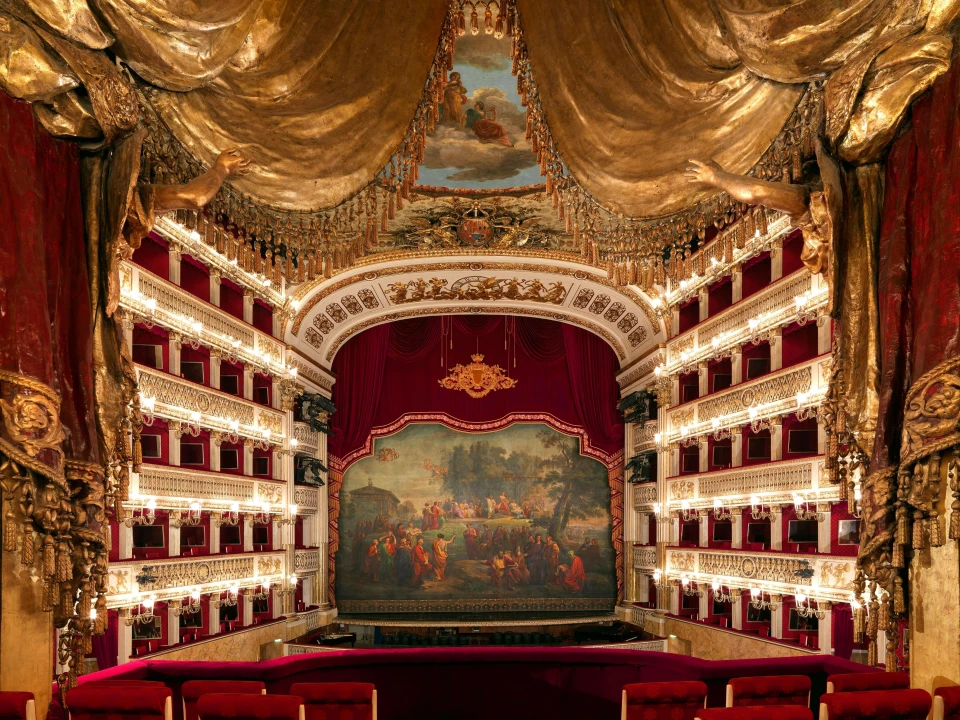
Today, entering the San Carlo remains a memorable experience. Its red velvet seating, gilded decorations, elegant balconies, monumental royal box, and richly decorated ceiling create an atmosphere that connects contemporary audiences with centuries of European cultural history.
Yet this is not simply a beautiful historic monument. The San Carlo remains an active artistic institution, presenting opera, ballet, and symphonic concerts while supporting performers, musicians, dancers, and specialized theatrical professionals.
Its orchestra, ballet company, artistic workshops, and educational activities demonstrate how a historic institution can remain relevant without abandoning its identity.
For Naples, the San Carlo represents much more than an architectural masterpiece. It is evidence of the city’s extraordinary contribution to the development of European music and of the cultural leadership that southern Italy exercised long before the emergence of the modern Italian state.
The most remarkable aspect of this world record is perhaps its continuity: generations of audiences have changed, kingdoms have disappeared, and musical styles have evolved, but the San Carlo remains a place where history is not simply remembered.
It is still performed.