

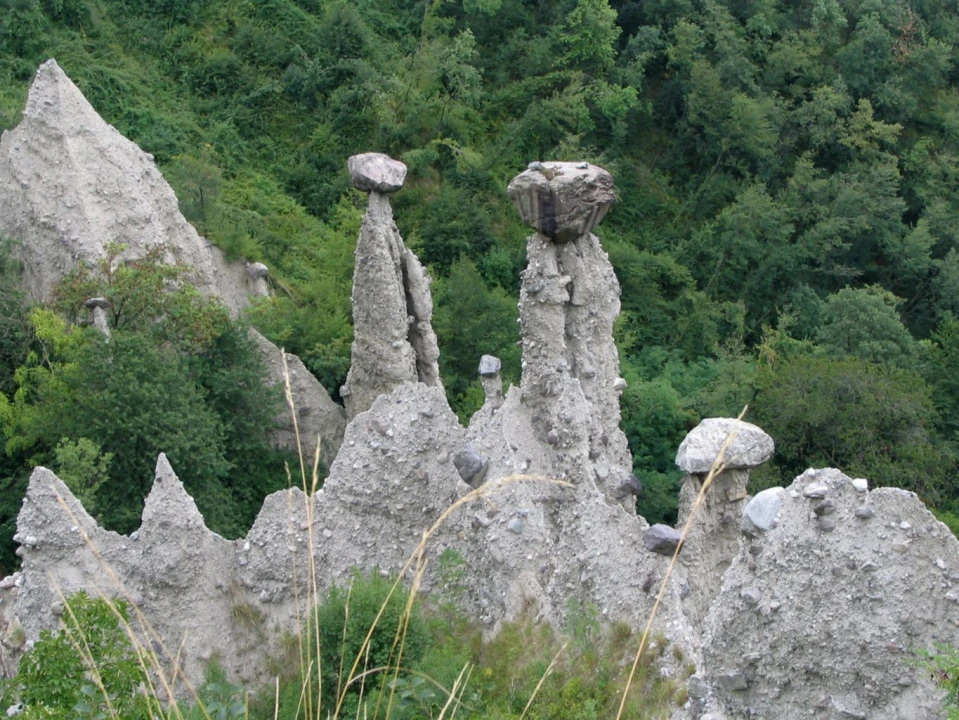

On the eastern shore of Lake Iseo, in Lombardy, lies one of Europe’s most unusual natural wonders – the so-called pyramids of Zone. At first glance they look like giant stone mushrooms, with enormous boulders balanced on top of tall clay spires. The sight inspires questions: who placed those rocks there, and how have they stayed put for so long? The answer isn’t giants or builders, but glaciers, erosion, and time.
The reserve covers about 21 hectares between 400 and 600 meters above sea level, in a small valley known as the Bagnadore. Around 150,000 years ago, during the Riss glaciation, this valley was filled by a branch of the massive Camuno glacier. As the ice advanced, it carved the landscape and deposited a chaotic mix of rocks, gravel, and sand. When the ice eventually retreated, it left behind a huge moraine – a pile of glacial debris that clogged the valley floor.
The raw material of the pyramids is mostly a reddish sandstone called Verrucano Lombardo, along with other rocks carried by the ice. Over millennia, rainwater and streams began eroding the moraine. The water cut deep channels, and wherever a large boulder happened to rest on top of a clay ridge, it acted like an umbrella. Protected from the rain, the column beneath the stone resisted erosion while the surrounding soil washed away. The result was a tall, narrow tower capped with a heavy block – a pyramid of earth and stone.
These formations are constantly changing. When a supporting column becomes too thin, the boulder eventually tumbles down, leaving the spire unprotected. Without its stone shield, the clay column quickly collapses. Elsewhere, new columns form under the protection of other rocks. It’s a slow but relentless cycle, creating a living landscape where destruction and creation happen side by side. Some of the towers reach nearly 100 feet in height, with bases more than 25 feet wide, their caps weighing many tons.
Colors add to the spectacle. The clay pillars appear in shades of gray and beige, the protective boulders often show violet or dark tones, and the surrounding forest offers a lush green frame. In autumn the foliage deepens to red and gold, making the pyramids look like monuments in a surreal park. Visitors often compare the scenery to a fantasy film set – a place where nature has done the work of a sculptor.
Walking through the reserve feels like stepping back in time. Each spire tells a story about glaciers that once dominated the valley, rivers that carved channels, and the delicate balance between stone and soil. The landscape is fragile – a single storm can reshape entire sections – but that fragility is part of its fascination. Over decades, scientists and hikers alike have witnessed new pyramids rising and old ones vanishing, proof that the Earth is never still.
Beyond their beauty, the pyramids also illustrate broader lessons about geology. The way water, gravity, and chemistry interact is visible here in real time. Rainwater, slightly acidic because of carbon dioxide in the atmosphere, slowly dissolves clay and carries it downhill. Streams cut miniature canyons, exposing layers of sediment. Even the protective effect of the boulders demonstrates a simple principle: shade and cover can make the difference between preservation and collapse.
For visitors, the reserve is accessible by trails that wind among the columns, sometimes close enough to touch their rough surfaces. Wooden platforms and paths allow safe exploration while protecting the terrain. Hikes here combine physical exercise with a sense of wonder – each turn in the trail reveals another tower, another improbable balance of mass and void. The silence of the valley, broken only by wind and birdsong, makes the experience even more striking.
The pyramids of Zone remind us how landscapes can be both fleeting and eternal. They exist because of events that began long before humans appeared in the region – yet they are also disappearing before our eyes, eroded by every rainfall. In this paradox lies their charm. They are monuments of chance, testaments to the patience of natural forces, and warnings about impermanence.
Standing before them, it’s easy to imagine myths about giants or ancient civilizations. But the truth is even more powerful: no human hand shaped these spires, only ice, water, and time. That knowledge doesn’t diminish the wonder – it deepens it. The pyramids of Zone show how nature itself can build structures as striking as anything in stone by architects, and they continue to evolve with every storm that sweeps across the valley.