

Spilimbergo, located in the province of Pordenone in the Friuli Venezia Giulia region, is renowned as the “City of Mosaics” due to its long-standing tradition in the art of mosaic making.
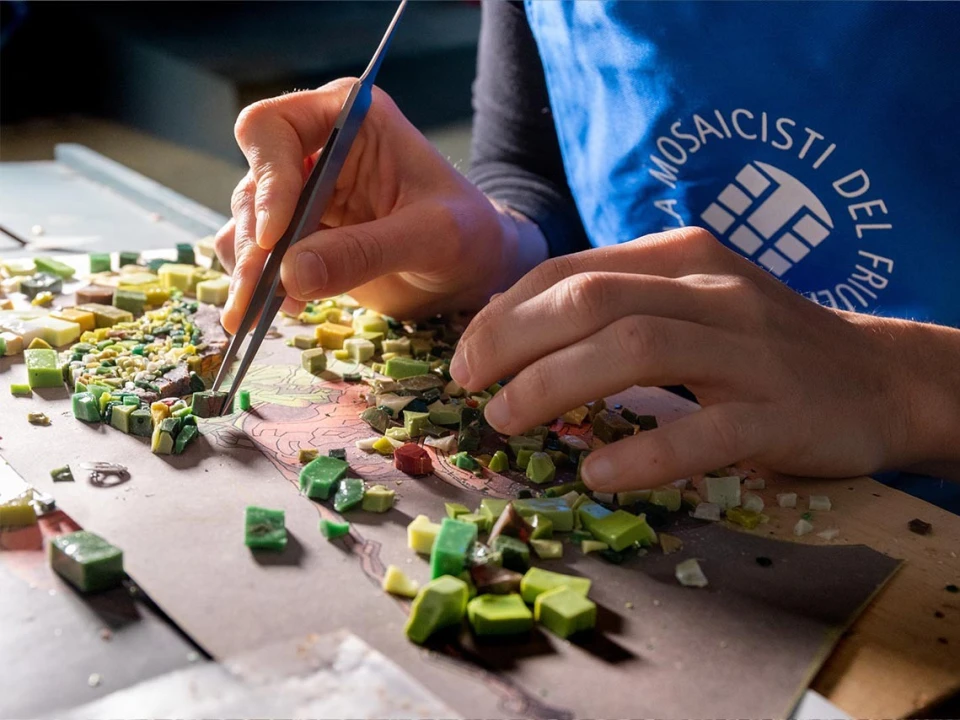
Mosaic is an ancient yet ever-evolving art form that enhances and personalizes the spaces around us with lasting colors, shapes, and materials. Starting with a sketch, photo, or image, the artist creates a color palette for the materials to be used in the mosaic - ranging from stones, marbles, enamels, and glass pastes to precious gold. The pieces are carefully cut, arranged, and glued together by the mosaicist, bringing the image to life one tile at a time.
The roots of modern Friulian mosaic-making can be traced back to the artistic renaissance of the 16th century. Spilimbergo’s proximity to Aquileia, an important center of ancient Roman civilization, and its position along the trade routes to Venice, a hub for Byzantine mosaic traditions, made it an ideal location for the craft. The surrounding area also offered an abundance of local stones from the Meduna, Cellina, Cosa, and Tagliamento rivers, providing free access to a wide variety of natural stone colors - ranging from aqua greens to soft pinks - that were integral to creating some of the finest Roman mosaics, such as those found in the National Archaeological Museum of Aquileia.
As the Venetian Republic gained control over the region, the art of mosaic-making spread, with skilled artisans from Friuli becoming renowned worldwide. One key figure in this development was Gian Domenico Facchina from Sequals (Pordenone), who revolutionized mosaic production by inventing the reverse mosaic technique. This method involved preassembling the tiles on paper and then gluing them to a flexible backing, making it possible to complete mosaics in the workshop rather than on-site, significantly reducing production costs.
In addition to this, the technique of Venetian terrazzo, also developed in Friuli, became famous for its beautiful and durable floors found in Venetian palaces and villas. Renowned architect Andrea Palladio praised the resilience and beauty of terrazzo, further cementing the region’s reputation for innovation in mosaic art.
By the late 19th and early 20th centuries, Friulian mosaicists began to spread across Europe and the Americas. Artists from Sequals and Spilimbergo started to look beyond local borders, dreaming of cities like Paris, Vienna, Prague, St. Petersburg, and Detroit as attainable destinations. This international expansion saw the next generation of Friulian mosaic artists establish themselves in various global capitals.
After World War I, with the region's mosaic tradition firmly established, there was a growing need to preserve and pass down the techniques and knowledge accumulated over centuries. In 1922, the Scuola Mosaicisti del Friuli was founded in Sequals to offer formal education in mosaic-making. Today, it is considered the world’s leading institution in the field. The school houses an impressive collection of over 800 works, making it a monumental artistic installation in itself. The school’s influence extends globally, with works created by its students and faculty appearing in locations such as the Library of Congress in Washington, D.C., and the subway stations at Ground Zero in New York City.
The school’s reputation soared in the mid-20th century, especially after being tasked with creating extensive mosaics for the Foro Mussolini in Rome - over 6,000 square meters of flooring and wall mosaics. This significant commission helped establish the school’s international fame. During the post-war period, as transportation was limited and recovery was slow, hundreds of young artists would travel to Spilimbergo on bicycles, eagerly arriving with hammers tucked behind their backs, ready to learn and work.
Through the decades, the school continued to thrive, maintaining its prestigious reputation with the help of skilled artisans, students, and active local workshops connected to the institution. The mosaics created in Spilimbergo can now be found in public and private buildings on all five continents, renowned for their vibrancy and fine craftsmanship.
The Scuola Mosaicisti del Friuli welcomes students from around the world, offering a three-year program that blends tradition with innovation. The curriculum covers a wide range of subjects, including mosaic techniques, terrazzo, drawing, color theory, applied geometry, computer science, and the history of mosaics, ensuring a comprehensive and versatile education. Students work with traditional materials such as marble, glass, and enamel but are also encouraged to experiment with modern materials and techniques.
Through its rich history, Spilimbergo has solidified its place as a global center for mosaic art, continuing to inspire and educate new generations of artists while preserving its time-honored traditions.