

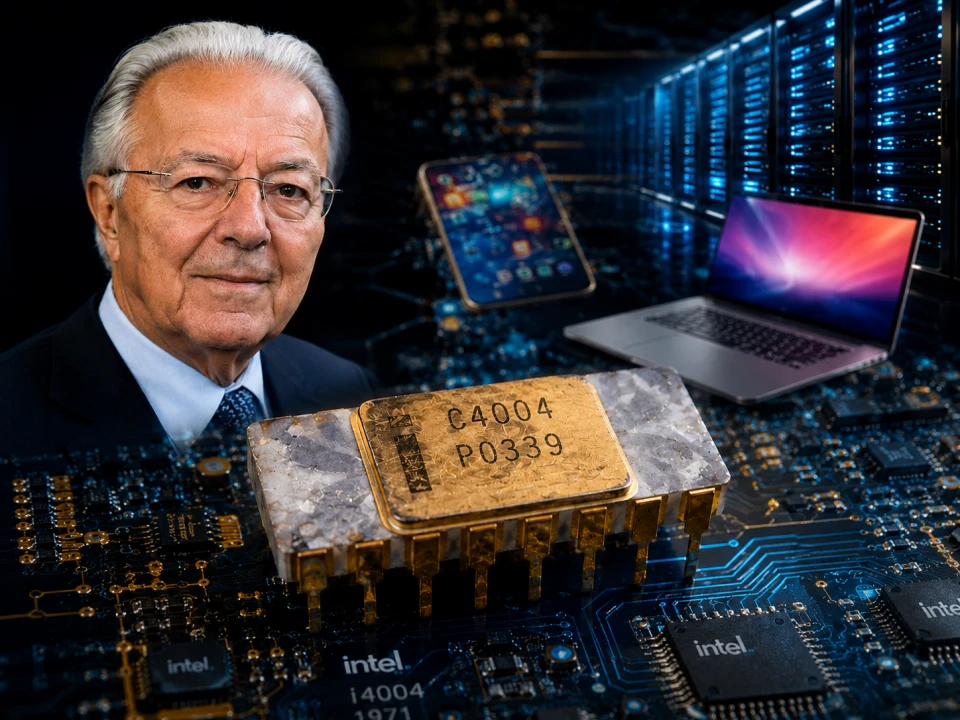

Every smartphone, laptop, tablet, and data center on Earth depends on a tiny piece of technology that transformed human history. Billions of people use it every day without giving it a second thought. Yet few know that one of the most important inventions of the digital age was created by an Italian engineer.
His name was Federico Faggin, and his invention was the world's first commercial microprocessor.
Born in Vicenza in 1941, Faggin grew up in postwar Italy at a time when electronics was still in its infancy. Fascinated by science and technology, he studied physics and engineering before beginning his career in Italy's growing electronics sector. His talent quickly became evident. While still in his twenties, he worked on advanced computer systems and semiconductor technologies, developing expertise that would eventually change the world.
In the late 1960s, Faggin moved to the United States, where the semiconductor industry was rapidly evolving. Silicon Valley was beginning to emerge as a center of innovation, and companies were searching for ways to make computers smaller, faster, and more affordable.
At the time, computers relied on multiple integrated circuits, each performing a specific task. Building a computer required numerous components, making systems expensive, complex, and difficult to miniaturize. Engineers dreamed of placing an entire central processing unit on a single chip, but nobody had successfully achieved it.
That challenge became the foundation of one of the most important patents in technological history.
Working at Intel, Federico Faggin led the development of the Intel 4004, introduced in 1971. It was the first commercially available microprocessor – a complete CPU integrated onto a single silicon chip.
The breakthrough was revolutionary.
For the first time, the computational power that previously required numerous electronic components could be concentrated into a device measuring only a few millimeters. The Intel 4004 contained approximately 2,300 transistors and could perform around 92,000 operations per second. By today's standards, that may seem modest, but at the time it represented a technological leap comparable to the transition from horse-drawn carriages to automobiles.
Faggin's contribution went far beyond the concept itself. He developed critical manufacturing techniques and design methods that made the microprocessor practical and commercially viable. His patented silicon gate technology dramatically improved the performance and reliability of integrated circuits and became the foundation for future generations of chips.
The impact was immediate and far-reaching.
Without the microprocessor, personal computers would likely have remained laboratory tools and corporate machines. The digital revolution that produced laptops, smartphones, gaming systems, GPS navigation, artificial intelligence, and cloud computing would have unfolded very differently.
Today, modern processors contain tens of billions of transistors, but they all trace their origins back to the same fundamental idea realized by Faggin and his team more than fifty years ago.
The invention also highlights a lesser-known aspect of Italian excellence. Italy is often associated with art, fashion, cuisine, and design, yet the country has also produced extraordinary inventors, engineers, and scientists whose innovations have shaped the modern world. From Marconi's radio to Fermi's nuclear research, Italian ingenuity has repeatedly crossed borders and transformed entire industries.
Faggin's story demonstrates how Italian creativity extends beyond traditional stereotypes. His achievement combined scientific knowledge, engineering precision, entrepreneurial vision, and the ability to solve complex problems through elegant solutions – qualities that have long characterized Italian innovation.
Over the decades, Federico Faggin has received numerous international honors recognizing his contribution to technology. Historians of computing place him among the pioneers of the digital age, alongside the figures who laid the foundations of modern electronics and information technology.
Yet his name remains far less familiar than the products his invention made possible.
Every email sent, every website visited, every online purchase completed, and every artificial intelligence system developed relies on descendants of the microprocessor he helped create. It is difficult to imagine a modern activity untouched by this technology.
Few patents can claim to have transformed everyday life on a global scale. The microprocessor is one of them.
And at the heart of that revolution stands an Italian inventor from Vicenza whose vision helped usher humanity into the digital era.