
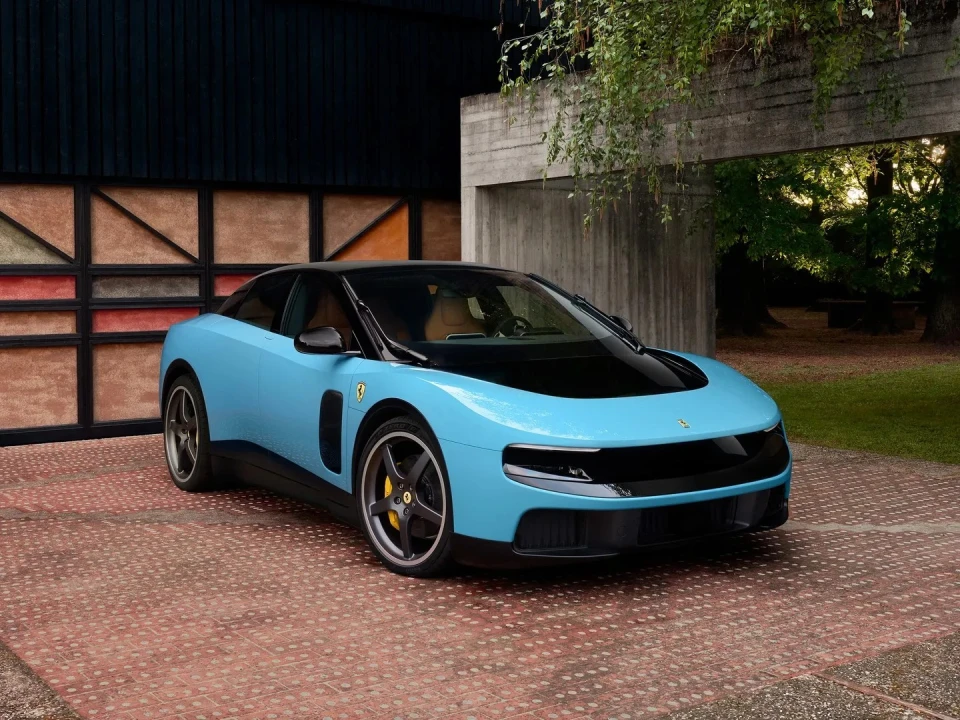

Ferrari recently unveiled the new Ferrari Luce, the Prancing Horse’s first fully electric model. At first glance, the car’s styling has raised considerable doubts, both among industry experts and the general public.
The Ferrari Luce indeed departs sharply from the traditional aesthetic standards of the Maranello marque, which have historically been defined by boldness and muscularity.
Nevertheless, the Ferrari Luce project is undoubtedly the result of a courageous vision, one that creates an unprecedented design bridge between Italy and the United States.
The car’s styling stems from the meeting of the Ferrari Design Studio, led by Flavio Manzoni, and the interdisciplinary approach of the American group LoveFrom.
LoveFrom is a creative company founded by Jony Ive and Marc Newson, two figures who have redefined the relationship between technology and luxury over the past thirty years.
The driving force behind LoveFrom, and unquestionably its most emblematic and representative figure, is the first of the two: Sir Jonathan Paul Ive.
Born in London in 1967, the designer became Steve Jobs’ creative partner at Apple in the early 1990s, the right-hand man who gave physical form to the dreams of the company’s founder.
It was Jony Ive who designed the products that entered legend, from the iPhone to the iPad, helping make Apple one of the most important and iconic technology companies in the world.
In other words, the British designer was the principal formal interpreter of the Apple revolution – from the colorful iMacs of the 1990s to the iPhone, passing through the iPod, iPad, and Apple Watch.
Not surprisingly, Steve Jobs regarded him as his creative alter ego, the man and technician capable of giving shape and substance to the insights of the Cupertino-based company.
By taking his work far beyond the dimension of form, Jony Ive succeeded in creating and innovating a chromatic language later adopted by virtually everyone else.
Initially, the designer emphasized color, freeing computers from their traditional gray appearance and making them seem more approachable and less alien in the public imagination.
He then moved decisively toward white, transforming them into elegant objects, almost pieces of furniture capable of enhancing the design of homes and offices.
More recently, he focused on a distinctive combination of glass and steel, which has since become a defining characteristic of contemporary technology.
Holder of more than 14,300 patents and the recipient of a knighthood conferred by Queen Elizabeth II in 2012, Jony Ive left Apple in 2019 to found LoveFrom, a collective bringing together creatives from every background: architects, sound designers, filmmakers, and human-machine interface specialists.
The result of the collaboration between Ferrari Design Studio and LoveFrom is a highly disruptive automobile that, at least in part, moves away from the sculptural aggressiveness traditionally associated with the Maranello brand.
The Ferrari Luce moves explicitly, one might even say deliberately, toward an aesthetic with a domestic undertone: clean lines, continuous surfaces, transparent materials, and the invisible integration of interfaces.
It seems undeniable that the project’s most influential cultural reference is Dieter Rams, the historic Braun designer and theorist of the “less but better” philosophy, who has long been a key inspiration for Jony Ive.
Every element of the Ferrari Luce appears designed to eliminate the superfluous without sacrificing the symbolic character of the object.
The interior, dominated by glass, steel, and haptic surfaces, immediately evokes the Apple design vocabulary: the central display becomes a continuous sheet of glass, while physical controls dissolve into tactile feedback and nearly imperceptible vibrations.
The British designer’s idea – one that Ferrari Design Studio has also embraced for years – is that digital technology should not replace the analog world but rather absorb and blend with it.
For Jony Ive, hardware must create a continuum with software, offering immediate ease of use through a dialogue between the digital and the analog.
In the Ferrari Luce, one example is the haptic feedback of the central screen, whose distinctive vibration allows users to perceive buttons that exist only virtually, while traditional gauges coexist with virtual overlays.
As stated in a note from the Maranello company: “The interpretation of the project by a designer external to the Ferrari Design Studio led by Flavio Manzoni made it possible to bring in a fresh perspective and encourage the cross-fertilization that allows new languages to emerge. LoveFrom was given the creative space necessary to help define the project’s design direction from the outset, translating a new interdisciplinary design language into an authentic Ferrari experience.”
These words reveal the full meaning, courage, and vision underlying the Ferrari Luce project, through which the Prancing Horse explicitly leaves its comfort zone and ventures into new territory, projecting itself toward the future.
It almost seems as if Benedetto Vigna and his team were inspired by a passage from Beyond the Hedge, a recent essay by Mauro Gallegati, which reads: “Let us not look backward: it is of little interest, if only because we have already been there.”
Only time will tell whether this fearless – perhaps in some respects even daring – gamble will prove to be an industrial success.
For now, we can only greet the initiative with warm sympathy and genuine admiration, as a boldly unconventional project.
At a time when cultural differences are deepening and the shores of the Atlantic seem to be drifting farther apart, the Ferrari Luce creates a genuine bridge of design between Italy and the United States.