

As the soccer world focuses its attention on the stadiums of the United States, Canada, and Mexico for the FIFA World Cup, a quiet industrial town just outside Milan celebrates its own continuous victory. The tournament represents the absolute pinnacle of athletic achievement, yet the ultimate symbol of that triumph is born far from the bright stadium lights.
It is crafted by hand in Paderno Dugnano, a small municipality in the Lombardy region of northern Italy. Here, the historic workshop GDE Bertoni transforms raw metal into soccer immortality, keeping a decades-old tradition of Italian artisanal excellence alive.
The story of the current trophy began in 1970 after Brazil won its third World Cup title, earning permanent possession of the original Jules Rimet Cup. FIFA needed a replacement and launched an international design competition, drawing 53 submissions from artists worldwide. The winning bid came from Silvio Gazzaniga, a Milanese sculptor who served as the artistic director for Bertoni.
Gazzaniga understood that a simple two-dimensional sketch could not fully capture the energy of his vision. To convince the FIFA committee in Zurich, he took a bold approach and created a three-dimensional plaster model instead. His hands-on technique allowed the judges to feel the physical weight and dynamic texture of the art, securing the historic commission for the Italian workshop.
Gazzaniga designed the trophy in 1971 to break away from the rigid, traditional cup shapes of the past. He wanted to capture the raw emotion, movement, and joy of victory. The final sculpture depicts two stylized athletes rising from a rough base, stretching upward in a moment of pure jubilation to support the entire world.
Standing 14.5 inches tall and weighing over 13 pounds, the solid 18-carat gold masterpiece features two rings of green malachite at the bottom. The green stone was chosen deliberately to mirror the vibrant color of a soccer pitch.
While FIFA keeps the gold original locked away in its Swiss museum, the artisans at GDE Bertoni return to work every four years to create an official replica for the winning nation.
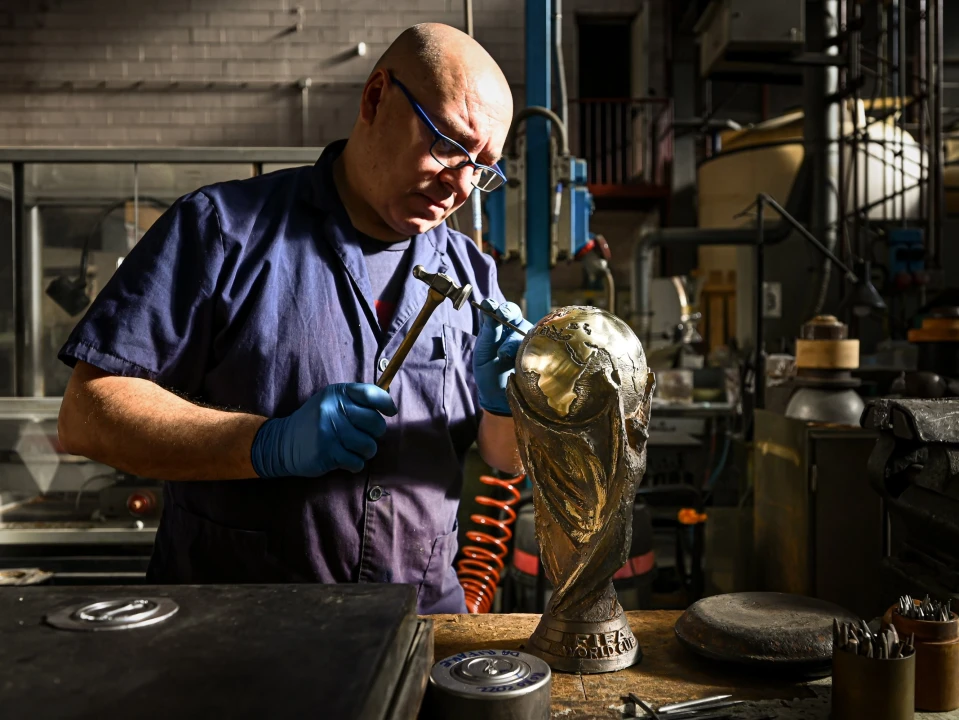
The manufacturing process relies on time-tested metalworking traditions passed down through generations. It begins in the foundry, where molten brass is poured into a specialized mold based on Gazzaniga’s original plaster model. Once the metal cools, master engravers use grinders and chisels to painstakingly carve out excess material, shaping the fine muscular details of the figures by hand.
After manual chiseling, the object undergoes intensive polishing to remove any imperfections. It then moves to a specialized bath for heavy gold plating, giving the replica its signature brilliant shine. Finally, the brass body is assembled with the green malachite base and protected with a clear lacquer coat. The workshop also receives the solid gold original before each tournament, gently cleaning and restoring it to ensure it looks flawless under the stadium lights.
The creative mastery of this Paderno Dugnano workshop extends far praise beyond the FIFA World Cup alone. Over the decades, GDE Bertoni has built a legendary reputation as the ultimate sculptor of global sports glory. The workshop produces almost all of European club soccer's most coveted prizes, including the iconic UEFA Champions League trophy. Known affectionately as Big Ears due to its oversized handles, this massive silver cup requires weeks of precise manual welding and alignment by Italian master craftsmen to ensure the metal handles curve perfectly.
The workshop also shapes the elegant UEFA Europa League trophy, which features a heavy octagonal silver cup supported by a hand-carved group of players fighting for a soccer ball. Other major continental prizes forged in this Lombardy facility include the UEFA Super Cup and the Africa Cup of Nations trophy. Beyond soccer tournaments, GDE Bertoni’s artistic legacy is deeply tied to the Olympic Games. The company burst onto the international stage by manufacturing the official medals for the 1960 Summer Olympics in Rome, followed by the 1980 Olympic medals for the Moscow Games.
The global spotlight shines directly on North America during this tournament, but the emotional heart of the victory remains deeply rooted in Italian craftsmanship. The artisans of Paderno Dugnano prove that true excellence is not just manufactured – it is sculpted, chiseled, and brought to life by human hands. When the winning captain lifts the golden globe into the air, they hold a piece of Lombardy’s rich artistic heritage.