

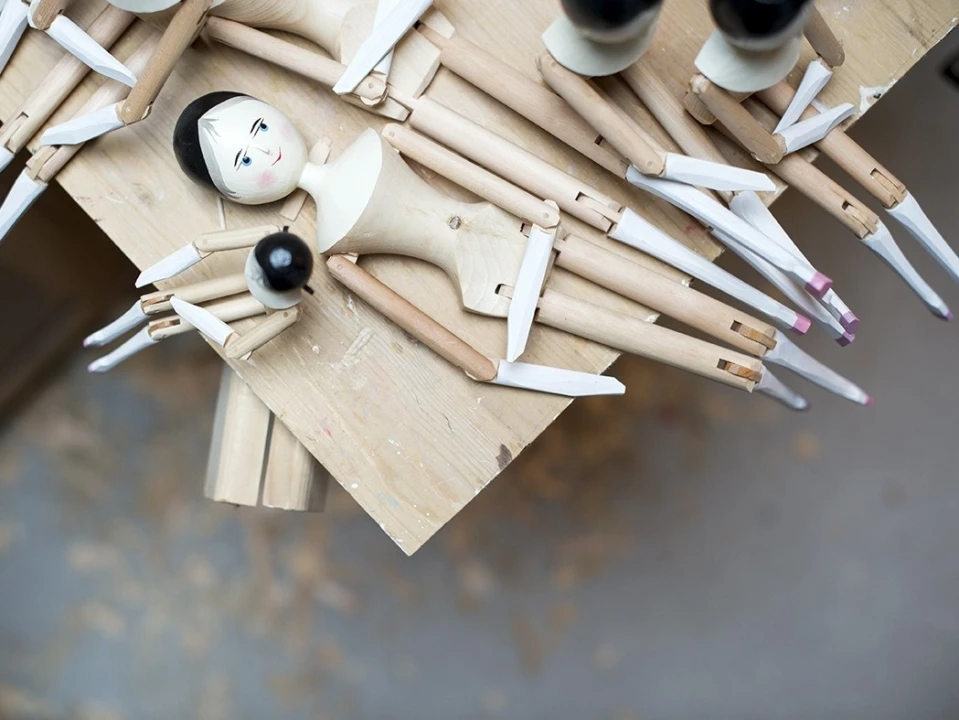

Tucked into the Dolomites of northern Italy, Val Gardena became internationally known not for paintings or textiles, but for wooden dolls. These simple yet expressive objects turned a remote Alpine valley into one of Europe’s most recognizable centers of toy making, long before mass production reshaped the global market.
The tradition emerged out of necessity. Until the 18th century, farming in Val Gardena was limited by altitude and climate. Snow often covered the ground for 5–6 months a year, leaving families with little agricultural work during winter. Wood, however, was abundant. Linden and Swiss pine were soft, lightweight, and easy to carve indoors. During long evenings, parents and children alike began shaping small figures, initially as toys for local use.
By the late 1600s, wooden dolls had become a recognizable product. These early figures were modest in size, typically 10–20 centimeters tall, with cylindrical bodies and limbs attached by wooden pegs. This jointed structure allowed movement and durability, making the dolls ideal for play rather than display. Faces were minimal but expressive, often painted with just a few strokes. Simplicity was not a limitation, but a strength.
During the 18th century, production expanded rapidly. As trade routes improved, Gardena carvers carried dolls on foot or by mule to regional markets. By around 1750, dozens of families were involved in doll making, and by the early 1800s the number had grown into the hundreds. Some estimates suggest that in peak decades of the 19th century, several hundred thousand wooden dolls were produced annually in the valley.
These dolls traveled far beyond the Alps. By the mid-1800s, they were exported throughout Europe and across the Atlantic. In the United States, they became widely known as peg wooden dolls and were sold as affordable toys for working- and middle-class families. Their low cost, durability, and handmade character gave them an edge over porcelain dolls, which were fragile and expensive.
The doll trade transformed the local economy. In some villages, more than 60–70% of households depended partially or entirely on wood carving. Work was highly organized. One family might rough-carve bodies, another specialize in heads, while women and children often handled painting and clothing. This division of labor allowed efficient production while preserving handcrafted quality.
Toward the end of the 19th century, competition increased. Industrial toys made of metal, rubber, and later plastic flooded the market. Wooden dolls from Val Gardena gradually lost their dominance as everyday toys. By the 1930s, large-scale doll production had declined sharply. Many workshops closed, and others shifted toward religious figures, decorative objects, or artistic sculpture.
Yet the tradition never disappeared. Today, wooden dolls remain a cultural symbol of the valley. In towns such as Ortisei, artisans continue to carve dolls inspired by historical models. Production numbers are far smaller, often limited to dozens or hundreds per year per workshop, but quality and detail have increased significantly. Modern dolls may include hand-sewn clothing, natural pigments, and certificates of origin.
Wooden dolls from Val Gardena are no longer simple toys. They are heritage objects, linking centuries of manual skill with contemporary appreciation for craftsmanship. What began as a winter necessity became a global product, and today survives as a refined expression of identity, memory, and enduring Alpine creativity.