

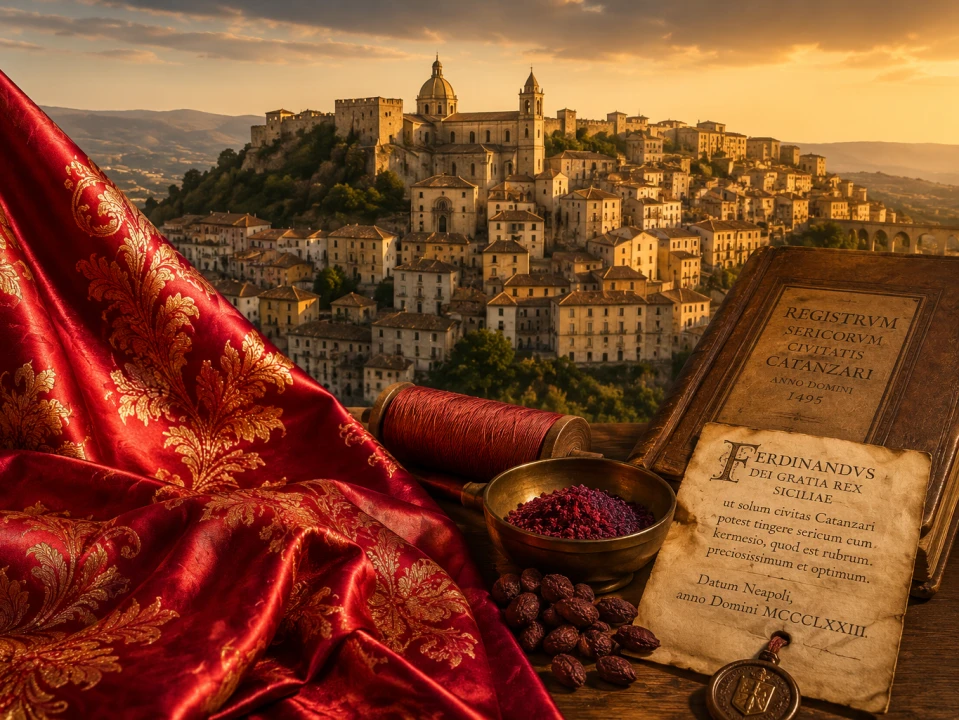

Today, Catanzaro is known as the capital of Calabria, a hilltop city overlooking the Ionian Sea in southern Italy. Few people realize, however, that five centuries ago this same city occupied a position of extraordinary importance in the European economy. During the late Middle Ages and the Renaissance, Catanzaro was one of the continent’s leading silk manufacturing centers, producing fabrics so prized that they reached royal courts from Italy to Northern Europe.
Its success was built on a combination of technical expertise, international trade connections, and a highly specialized workforce. At a time when luxury textiles were among the most valuable goods in Europe, Catanzaro’s silk industry became a source of wealth, prestige, and political influence.
One of the most remarkable episodes in the city’s history occurred in 1473, when King Ferdinand I of Naples granted Catanzaro an exclusive privilege linked to one of the most sought-after luxury products of the era: crimson-dyed silk. The color came from kermes, a tiny scale insect that produced a vivid red pigment considered among the most expensive dyes available before the arrival of cochineal from the Americas.
The royal decree effectively recognized Catanzaro’s mastery in producing and dyeing silk fabrics with this prestigious shade. Crimson garments were symbols of power, wealth, and status. Kings, princes, cardinals, and noble families across Europe paid enormous sums for textiles colored with these rare pigments.
The artisans of Catanzaro were far more than simple weavers. They combined the skills of chemists, engineers, merchants, and entrepreneurs. Their knowledge of spinning, weaving, dyeing, and finishing fabrics represented some of the most advanced manufacturing expertise of the period. The city developed a reputation for quality that extended far beyond the Kingdom of Naples.
Historical records indicate that Catanzaro became a major exporter of finished silk products. By the late 15th century, merchants were shipping large quantities of textiles to Florence, Milan, Venice, and the markets of Northern Europe. Documents from the Crown of Aragon record annual exports exceeding 1,500 bales of processed silk. Considering that each bale weighed dozens of pounds, the scale of production was extraordinary for a city of its size.
The economic impact was enormous. Silk generated employment, attracted investment, and financed urban development. Churches, noble residences, public buildings, and infrastructure benefited from the prosperity created by the textile trade. Long before the Industrial Revolution transformed northern Europe, Catanzaro had already established itself as a sophisticated manufacturing hub whose products circulated throughout international markets.
The city’s influence extended beyond economics. Catanzaro became a center for technological innovation in textile production. Historians credit local craftsmen with helping refine weaving techniques and machinery that later spread to other regions. The expertise developed in Calabria contributed to Italy’s broader reputation as a leader in luxury textile production.
At its peak, Catanzaro stood alongside some of the most important commercial cities in the Mediterranean. Its workshops supplied fabrics that symbolized prestige and authority. Wearing crimson silk produced in Catanzaro was not simply a fashion statement – it was a visible display of status.
Yet prosperity did not last forever. Between the 16th and 17th centuries, changing trade routes, political instability, foreign competition, and shifting economic conditions gradually weakened the city’s dominance. New global markets emerged, monopolies disappeared, and the center of textile production slowly moved elsewhere. Over time, much of Catanzaro’s once-thriving silk industry faded.
Today, only fragments of this remarkable story remain visible. The city’s historic center, churches, palaces, and archival records preserve traces of an era when Catanzaro helped define luxury fashion across Europe. Yet outside specialized historical circles, its role is largely forgotten.
That makes Catanzaro one of Italy’s most fascinating hidden stories. Long before Milan became a global fashion capital, this Calabrian city had already built an international reputation based on craftsmanship, innovation, and the production of one of the world’s most coveted luxury goods.
For centuries, the crimson silks of Catanzaro clothed Europe’s elite. The city may no longer dominate the textile trade, but its legacy remains a powerful reminder that some of Italy’s greatest economic achievements were born far from the country’s modern industrial centers.