

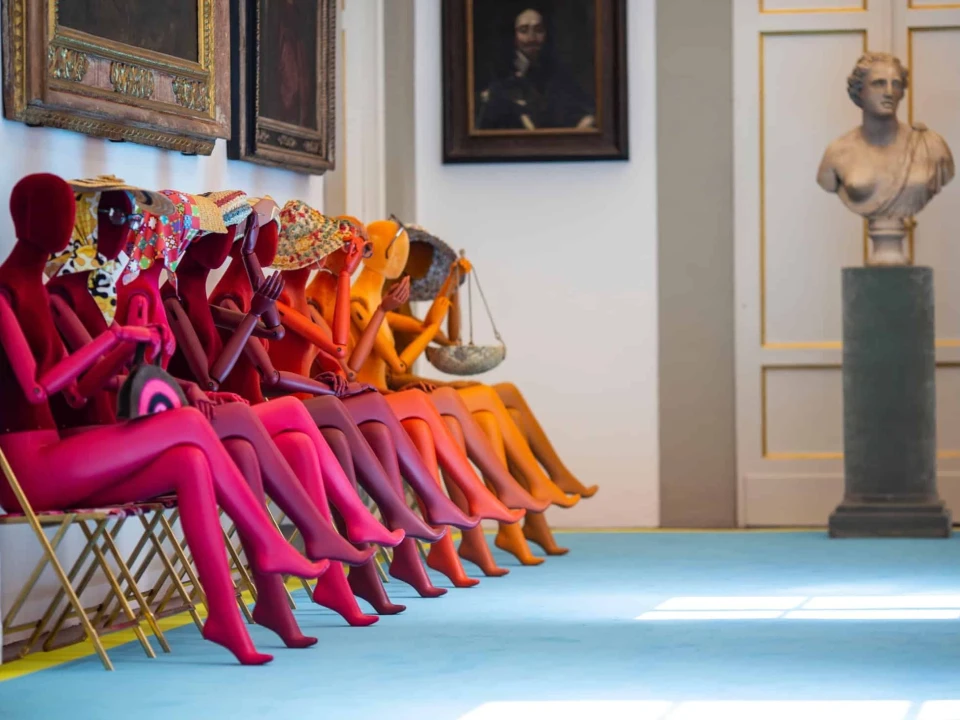

Design is a rapidly expanding phenomenon, steadily broadening its scope and exerting an increasingly pervasive influence across all areas of business. This trend is clearly reflected in the story of a somewhat hidden excellence of Italian design – a company that, within its sector, represents a true gem of Made in Italy on the global stage: Bonaveri.
The company was founded in Renazzo di Cento in Emilia Romagna by Romano Bonaveri in 1953, during the extraordinary period of growth in Italy known as the Economic Boom, and today it is a global leader in mannequin production. The business grew out of its founder’s artisanal experience: in the postwar years, he masterfully shaped paper to create allegorical figures for the floats of the famous Carnival of Cento.
Now led by his sons Andrea and Guido Bonaveri, the Ferrara-based company is unquestionably a benchmark in its field, combining craftsmanship, design, industrial processes, and technology in the creation of its mannequins.
The company has recently strengthened its international leadership through the acquisition of another historic brand in the sector: Rootstein, a London-based firm founded in the late 1950s, specializing in mannequins modeled after famous models and personalities.
Bonaveri’s reputation is now universally recognized: leading fashion houses and major costume museums – including Fondazione Valentino, Les Arts Décoratifs in Paris, and the Metropolitan Museum of Art in New York, to name just a few – choose its mannequins not only as display tools but, above all, as vehicles of their visual identity.
Andrea Bonaveri summarizes more than seventy years of history as follows: “Bonaveri was born from our father Romano’s intuition. In the postwar period, he created allegorical figures for Carnival floats; from that experience came his vocation for shaping bodies and bringing to life forms that tell stories. The first mannequins were entirely handmade in papier-mâché and plaster, with an almost sculptural approach. Over the years, we have evolved this artisanal heritage, officially founding the company in 1953 and integrating it with advanced technologies, new materials, and aesthetic research. Today Bonaveri produces around 15,000 mannequins per year and is recognized as an international benchmark, with a strong presence in major global markets. We have several lines, each expressing a different aesthetic language. Our mannequins are chosen by major international brands because they combine design, sustainability, innovation, and a quality that remains authentically artisanal.”
Over time, the company has undergone significant growth, marked by courage and foresight, always focusing on mannequins – a product that may seem simple but actually embodies remarkable complexity.
Bonaveri’s production is organized into four main lines, each further reinterpreted in details and poses to cover all product categories: Classic, Schläppi, Sartorial, and B by Bonaveri.
Across every aspect of the company’s activity – from the stylized lines of Schläppi to the tailored silhouettes of Bonaveri Sartorial, from the more glamorous figures of B by Bonaveri to the hyper-realistic forms of Adel Rootstein – digital innovation, including 3D scanning and computerized volume studies, coexists with the craftsmanship of sculptors skilled in shaping clay, plaster, resin, marble, bronze, and wood.
In recent years, the company has paid increasing attention to the principles of sustainability and the demands of corporate social responsibility. Since 2012, Bonaveri has been developing alternative materials, bio-resins, and low-impact coatings. The BNatural project, in particular, replaces fiberglass with plant fibers and bio-based resins, while renewable energy and redesigned packaging help reduce consumption and emissions.
In 2025, the project “BNatural – Sustainable Mannequins for Ethical Fashion” was awarded the prestigious Responsible Innovators Prize 2025 by the Emilia-Romagna Region.
In line with the expanding trajectory mentioned at the outset, the company is now bringing its heritage, expertise, and know-how into the field of furniture design with the launch of Bonaveri Decor, presented in Milan in October 2025.
The collection, titled “The 10 Collection,” is conceived as the imagined exhibition of a collector “who, over the course of a lifetime, has gathered precious objects filled with emotion, memories, and personal history” (from the company’s website).
The project brings together ten sculptural elements and ten architectural pedestals, transforming materials and anatomical forms into a new domestic landscape. It draws inspiration from the atelier’s 75-year history, translating it into unexpected and contemporary forms.
Among the standout pieces is “The Red Hand,” a modern reinterpretation in lacquered bio-resin of the historic Schläppi hand from 1968, painted in Bonaveri Red – the historic color of Ferrara, the family’s hometown.
Also striking is “La Baronessa,” which pays tribute to Constantin Brâncuși’s Sleeping Muse, combining Portoro marble and polished brass.
The 1967 Loisir mannequin, originally conceived as a monumental work, is reimagined on a smaller scale as a totemic, primitive, and enigmatic object carved in Rosso Verona marble.
The collection also explicitly pays homage to British artist Barbara Hepworth, particularly inspired by her 1949 blue marble work The Cosdon Head.
Bonaveri’s remarkable journey can truly be seen as a modern manifesto of the potential of design – a multifaceted tool capable of creating virtuous and surprising connections between creativity and sustainability, business and art.