

For thousands of years, an extraordinary collection of stone warriors lay buried beneath the agricultural fields of western Sardinia. Their existence remained unknown until 1974, when ordinary farming activities near Cabras brought fragments of ancient sculptures to the surface. What initially appeared to be an unusual archaeological discovery gradually revealed one of the most remarkable mysteries of the ancient Mediterranean: the Giants of Mont’e Prama.
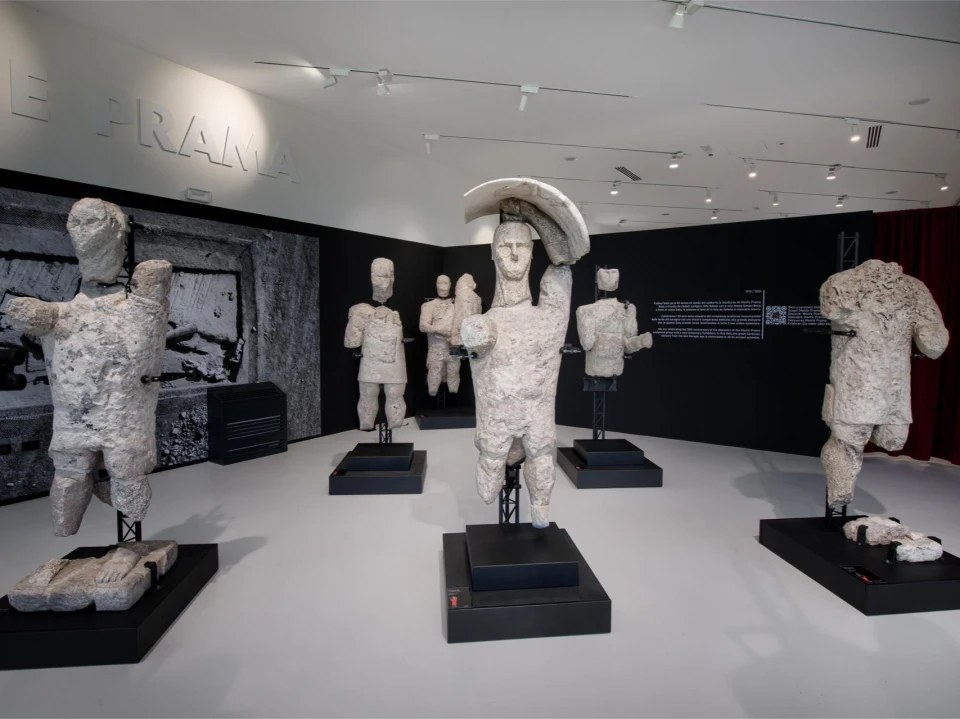
These monumental sculptures, created by the Nuragic civilization, have transformed our understanding of prehistoric Sardinia. Standing as tall as approximately 2 meters, or 6.6 feet, the statues depict warriors, archers, and figures traditionally identified as boxers. Their imposing proportions, distinctive geometric features, and enigmatic expressions make them unlike almost anything else produced in the Mediterranean during the same period.
The discovery took place on the Sinis Peninsula, a beautiful coastal area characterized by lagoons, agricultural landscapes, and beaches of white quartz sand. On March 28, 1974, farmer Sisinnio Poddi encountered fragments of sculpted limestone while plowing a field. Archaeological investigations followed, eventually revealing thousands of fragments, ancient tombs, and evidence of an elaborate monumental complex.
The sculptures are generally associated with the early Iron Age, particularly the ninth and eighth centuries BC, although aspects of their chronology remain debated. They belong to the extraordinary cultural world of Nuragic Sardinia, famous for its thousands of stone towers, known as nuraghes, constructed across the island during the Bronze Age.
What makes Mont’e Prama especially fascinating is that the statues challenge the traditional image of Nuragic civilization as a society represented mainly by defensive towers, bronze figurines, and village settlements. These enormous stone figures reveal a community capable of producing sophisticated monumental sculpture on an impressive scale.
The statues are divided into several categories. The so-called boxers carry distinctive protective shields above their heads and wear armed gloves or other protective equipment. The archers hold bows and display carefully modeled military accessories, while the warriors carry round shields and weapons.
Their faces are particularly striking. Large circular eyes, pronounced eyebrows, and geometric facial structures give them an almost futuristic appearance. Despite being created nearly 3,000 years ago, their stylized features sometimes appear surprisingly modern.
Archaeologists also discovered stone models of nuraghes, confirming the symbolic importance of these towers to the communities responsible for the sculptures.
The relationship between the statues and the nearby necropolis remains one of the site's central mysteries. Were the giants representations of heroic ancestors? Did they celebrate military achievements or important members of society? Were they guardians of a sacred area, or expressions of collective identity during a period of political transformation?
Different interpretations have been proposed, but no single explanation has been conclusively established. The sculptures were found broken into thousands of fragments, raising additional questions about when and why they were destroyed.
Their restoration has been an extraordinary undertaking. Specialists have spent years identifying, cleaning, and assembling the fragments, reconstructing dozens of monumental figures and revealing details that had remained hidden for centuries.
The archaeological importance of Mont’e Prama extends well beyond Sardinia. The sculptures are among the earliest examples of monumental stone statuary in the western Mediterranean, demonstrating that the island participated in complex cultural developments long before Roman domination.
Their rediscovery has also generated renewed interest in Sardinia's ancient history, encouraging further archaeological research and creating new opportunities for cultural tourism.
Since April 2026, the complete Mont’e Prama statuary complex has been displayed at the Giovanni Marongiu Civic Museum in Cabras, bringing these remarkable works together in the territory where they were discovered.
Perhaps the most fascinating aspect of the Giants of Mont’e Prama is that they continue to raise questions. Almost half a century after their discovery, researchers are still investigating the civilization that created them, the meaning of their unusual appearance, and the circumstances surrounding their destruction.
Their story reminds us that Italy's archaeological heritage still contains extraordinary surprises. Sometimes, a discovery capable of changing our understanding of ancient history begins not with an elaborate expedition, but with a farmer working an ordinary field.