

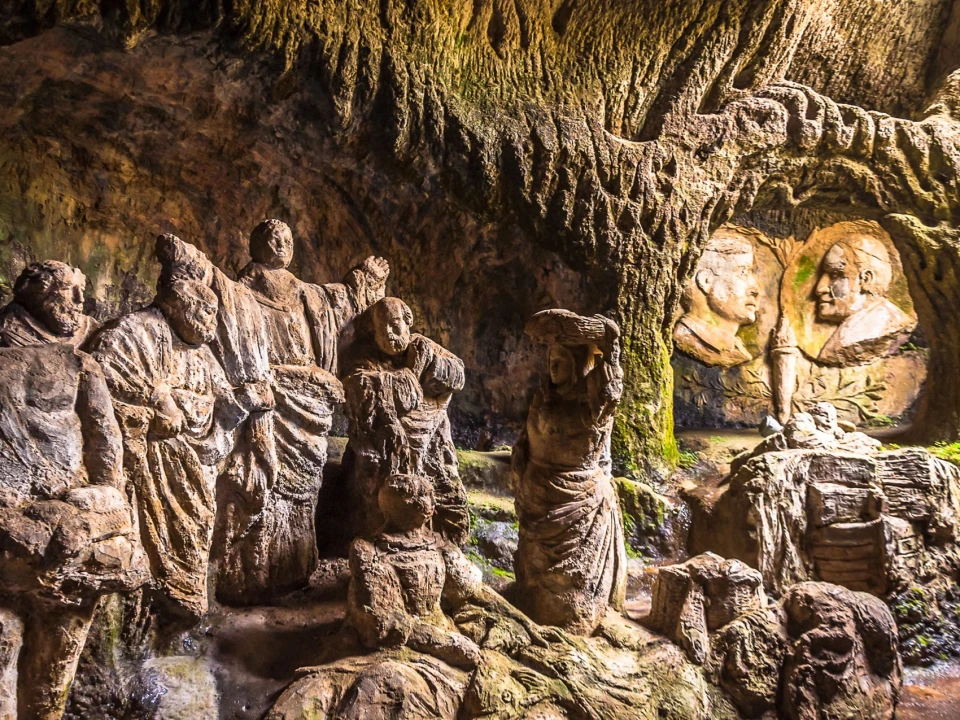

Carved directly into a cliff overlooking the Tyrrhenian Sea, the Chiesetta di Piedigrotta is one of the most unusual religious sites in southern Italy. Located about 1 kilometer north of Pizzo, Calabria, this small sanctuary appears to emerge naturally from the coastal rock, blending faith, folk art, and landscape into a single, powerful experience. More than a traditional church, it is a space shaped by devotion, patience, and human hands over centuries.
The origins of the church are rooted in legend and survival. In the late 17th century, a ship sailing near the Calabrian coast was caught in a violent storm. According to local tradition, the crew prayed to an image of the Madonna kept on board, promising to build a place of worship if they survived. The vessel was destroyed against the rocks, but all sailors reached shore alive. Along with them came the sacred image and a bronze ship’s bell dated 1632. In gratitude, the survivors carved a small cave into the soft tuff stone and placed the image inside, marking the birth of Piedigrotta.
For nearly 200 years, the site remained a modest grotto chapel, used mainly by fishermen and local residents. Its transformation into the space seen today began at the end of the 19th century. A local craftsman, Angelo Barone, undertook the ambitious task of expanding the cave and decorating it entirely by hand. Using simple tools, he carved altars, columns, and figures directly from the rock, gradually turning the hollow cliff into a sculpted interior. After his death in 1915, his son Alfonso continued the work, adding further statues and architectural details.
Today, the interior contains dozens of carved figures. Saints, angels, biblical scenes, and decorative elements emerge from walls, pillars, and ceilings, all sculpted from the same stone. Some statues stand nearly 2 meters tall, while others appear in bas-relief, integrated seamlessly into the surrounding rock. Natural light enters through the main opening and small side apertures, illuminating the carvings and changing their appearance throughout the day.
The setting plays a central role in the experience. The church opens directly onto a small beach, where waves gently reach the base of the cliff. The constant sound of the sea, combined with the cool air inside the cave, creates a quiet, contemplative atmosphere unlike that of any conventional church. Visitors descend a short staircase from the coastal road, passing abruptly from open sunlight into a stone-carved sanctuary shaped by faith and labor.
Despite its intimate size, Piedigrotta remains an active place of worship. Religious services are still held on special occasions, particularly in early July, when the Madonna is honored with celebrations that include a procession by sea. During this event, boats accompany the sacred image along the coast, linking the church’s maritime origins to contemporary devotion.
Beyond religion, the site has become an important cultural landmark in Calabria. It attracts thousands of visitors each year, drawn by its mix of legend, art, and natural beauty. Neither purely architectural nor purely sculptural, the Chiesetta di Piedigrotta stands as a rare example of how belief, environment, and craftsmanship can converge. What began as a simple act of gratitude evolved into a living monument, carved slowly from stone and memory, facing the sea that gave it life.