

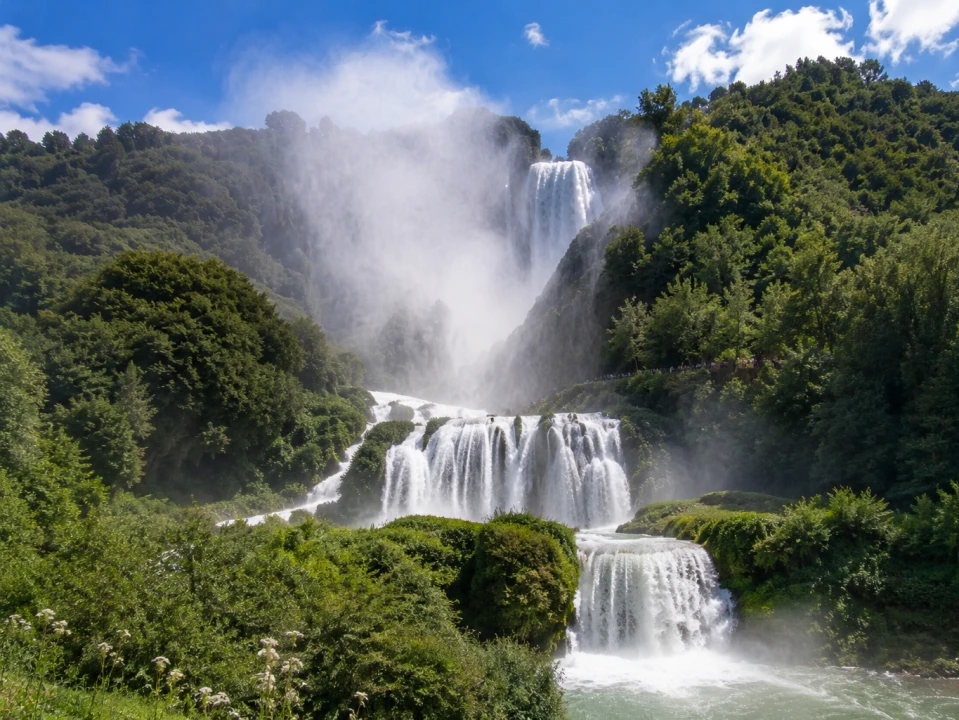

Visitors arriving at the Marmore Falls are often struck by the same thought: nature can be astonishing. Water plunges dramatically over three levels, creating a spectacular cascade nearly 540 feet high, making it one of the tallest waterfalls in Europe. Surrounded by lush vegetation and the rolling landscapes of Umbria, the scene appears completely natural.
Yet one of the most fascinating facts about the Marmore Falls is that they are not a natural waterfall at all.
What millions of visitors admire today is actually one of the oldest hydraulic engineering projects in the world, conceived and built by the ancient Romans more than 2,200 years ago. The falls stand as a remarkable testament to Roman ingenuity and remain one of Umbria's greatest historical and technological treasures.
The story begins in 271 B.C., when the Roman consul Manius Curius Dentatus faced a serious environmental problem. The Velino River flowed into a vast marshy area near present-day Rieti, creating stagnant waters that caused flooding and unhealthy living conditions. The Romans decided to solve the problem through engineering.
Rather than attempting to drain the wetlands gradually, they devised a bold solution. Workers excavated a canal that redirected the waters of the Velino River toward the edge of a limestone cliff overlooking the Nera Valley. Once the water reached the precipice, it plunged into the valley below, creating an artificial waterfall unlike anything seen before.
The result was the Cascata delle Marmore.
Its name derives from the marble-like deposits of calcium carbonate that formed over centuries on the surrounding rocks. The brilliant white appearance of these formations inspired the term "Marmore," which means "marble-like" in Italian.
The project demonstrated the extraordinary capabilities of Roman engineering. The civilization that built aqueducts, roads, bridges, and harbors throughout the Mediterranean was equally capable of reshaping entire landscapes. The Marmore Falls became one of the earliest examples of large-scale environmental engineering, proving that the Romans could control water on a monumental scale.
Of course, managing such a massive hydraulic system was not always easy. Over the centuries, sediment accumulation and changing water flows created new challenges. During the Middle Ages and the Renaissance, various popes, architects, and engineers worked to improve the system and reduce flooding in nearby areas. Among those involved were some of Italy's greatest minds, including Antonio da Sangallo the Younger and other prominent engineers of the period.
The waterfall that visitors see today is therefore the result of more than two millennia of continuous maintenance, innovation, and adaptation.
What makes the Marmore Falls particularly special is the way human ingenuity and natural beauty have become inseparable. Although created by people, the waterfall has blended perfectly into the Umbrian landscape. Dense forests, scenic trails, and rich biodiversity now surround the cascade, making it difficult to imagine that it originated as a Roman public works project.
Today, the falls are located near Terni, in southern Umbria, a region often described as Italy's green heart. While neighboring Tuscany attracts much of the international spotlight, Umbria preserves some of the country's most authentic landscapes and lesser-known historical treasures. The Marmore Falls perfectly embody this identity. They are spectacular, historic, and uniquely Italian, yet still capable of surprising visitors who expect only natural wonders.
The site attracts hundreds of thousands of visitors each year. Many come for the panoramic viewpoints and hiking trails, while others enjoy rafting, kayaking, and outdoor activities in the Nera River Park. Yet beyond the adventure and scenery lies a deeper story – one that connects modern travelers to the achievements of ancient Rome.
The Marmore Falls remind us that innovation is not a modern invention. More than 22 centuries ago, Roman engineers transformed a problematic marsh into a functioning hydraulic system that continues to operate today. Few engineering works anywhere in the world can claim such longevity.
In an age fascinated by technology and infrastructure, the Cascata delle Marmore offers a powerful lesson from the past. What appears to be one of Europe's most beautiful natural waterfalls is actually one of humanity's oldest surviving engineering masterpieces.
It is a symbol of Umbria's rich heritage, a monument to Roman genius, and a reminder that sometimes the most extraordinary landscapes are not created by nature alone.