

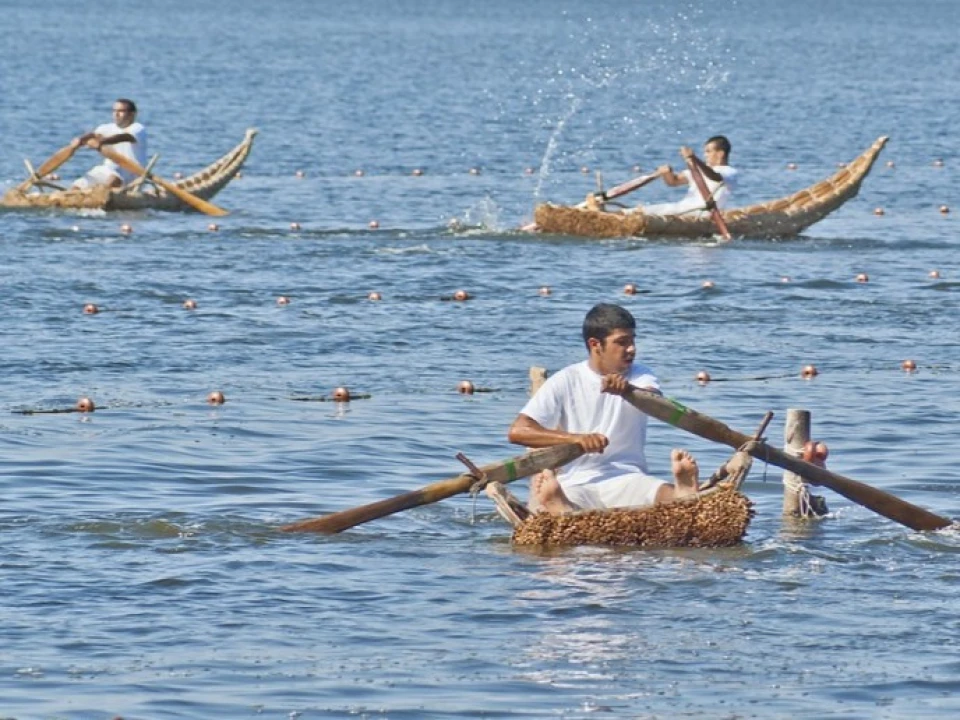

“Is Fassonis”, A unique blend of nature, heritage, and craftsmanship comes to life each year in the small town of Santa Giusta, in the province of Oristano, Sardinia. Here, a remarkable water spectacle highlights one of the oldest boating traditions known to humankind. These vessels, entirely handmade from natural materials, are tightly bound together using age-old techniques passed down through generations.
The process begins with weaving reeds harvested from the lagoon, shaping them into what is considered one of the earliest forms of watercraft. Mastering not only their construction but also their navigation is an art. Fishermen stand upright on these narrow boats, balancing carefully while propelling themselves forward with a long pole made of reeds. The hull, composed of dried marsh grass, glides just above the water’s surface. While the image may seem almost poetic, for the local fishermen these boats, known as Is fassonis, are part of everyday life. They represent both survival and identity, a living tradition renewed daily through skill and dedication.
Originating in the nearby communities of Cabras and Santa Giusta, these boats are regarded as unique worldwide, despite their striking resemblance to South American vessels like the caballito de totora from Huanchaco and the reed boats of Lake Titicaca in Puno. Santa Giusta has maintained a cultural partnership with these South American towns for more than 10 years. Evidence of the boats’ ancient roots can be found in a depiction inside the hypogeum of San Salvatore di Sinis, dating back to the 4th century AD. Some researchers suggest a Phoenician origin due to similarities with papyrus boats, while others trace them even further back to the Nuragic era, over 3,000 years ago.
Since 1978, Santa Giusta has celebrated this heritage every August with the Regata de Is fassonis, a popular event held along the lagoon’s shores. The race combines cultural significance with competitive spirit, showcasing the balance and strength of the participants. The boats typically measure about 350 cm in length and 95 cm in width, dimensions that have remained largely unchanged over centuries. Historically used by Nuragic, Phoenician, and Roman populations, they were essential tools for fishing and transportation in shallow waters.
Construction relies on bundles of fenu, a local aquatic plant now protected by regional environmental regulations. The reeds are tied together with natural fiber ropes, forming a sharply pointed bow and a flat stern, ideal for navigating waters with minimal depth. Their design is both simple and highly functional, reflecting centuries of adaptation to the lagoon environment.
The regatta takes place in the Pauli Maiori lagoon and attracts visitors of all ages – families, tourists, and locals alike. Spectators gather along the banks to enjoy the cool breeze and the captivating race, which begins at sunset on the first Sunday of August. Standing upright, competitors push against the lagoon floor with a long pole known as a cantoi, racing across the water in a test of speed and balance.
The event also offers a chance to experience local cuisine, including freshly grilled fish and the renowned Vernaccia wine from Oristano. Thanks to the dedicated efforts of local associations, including the Pro Loco, municipal authorities, and a small number of skilled artisans, the knowledge of building Is fassonis continues to be passed on to younger generations. This ensures that a tradition spanning thousands of years will endure, preserving a distinctive piece of Sardinia’s cultural identity for the future.