

Italian rap is becoming more local precisely as its production becomes more global. Across Italy, artists are placing Neapolitan, Genoese, Sardinian, Roman, and other regional voices over trap hi-hats, drill patterns, deep sub-bass, and polished electronic arrangements. The result is not folklore added to modern music. The language itself becomes part of the sound design.
Every regional language carries its own percussion. Standard Italian favors open vowels, clearly articulated syllables, and words that often end in vowels. That natural musicality works beautifully in pop, but rap demands compression, collision, and surprise. Dialect can offer sharper consonants, shortened endings, swallowed vowels, doubled sounds, and accents that fall in unexpected places. A final syllable can disappear before the snare. A hard consonant can land like a drum hit. A stretched vowel can float across Auto-Tune like a synthesizer.
This is why listeners can feel a verse before fully understanding it. Flow communicates geography through texture. American audiences already know the principle: Atlanta trap, New York drill, Southern drawl, and West Coast phrasing do not merely deliver lyrics. They shape rhythm, attitude, and identity. Italy’s regional languages perform a similar function, but within short distances.
Naples is the powerful example. Neapolitan can sound clipped and fluid, intimate and confrontational, sometimes within the same bar. Its apostrophes and elisions create pockets where producers can place kicks, pauses, and ad-libs. Its vowels remain singable, helping rappers move from aggressive verses into melodic hooks without changing linguistic register.
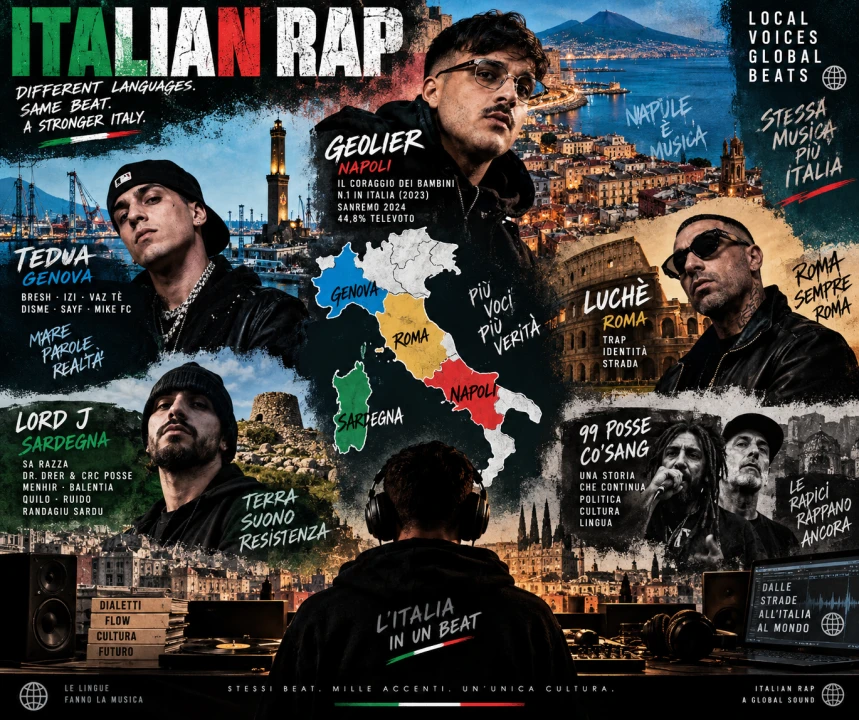
Geolier turned that sound into national pop. His 2023 release Il coraggio dei bambini finished number one on Italy’s annual album chart and earned multiple platinum certifications. At Sanremo in 2024, I p’ me, tu p’ te finished second, while Geolier received 44.8% of the broad televote during the final phase. The figures matter because they show that audiences did not require dialect to be translated or softened.
His technique builds on a longer Neapolitan continuum. 99 Posse brought dialect into politically charged rap and electronic music. Co’Sang developed darker, tightly interlocked street flows. Clementino emphasized speed, breath control, and freestyle energy. Luchè refined a colder trap vocabulary, while Liberato placed Neapolitan melody inside atmospheric electronics. Different productions reveal different properties of the same language.
Genoa produces another sound. The city’s leading urban artists, including Tedua, Bresh, Izi, Vaz Tè, Disme, and Sayf, rap in Italian, yet their delivery carries Ligurian cadence, local slang, and maritime imagery. The flow often feels leaner and more restrained than Naples’ dramatic musicality. Mike fC goes further, using Genoese directly and demonstrating how its compact words and unusual consonant clusters can cut cleanly through a beat.
Sardinian rap has a heavier, earthier phonetic character. Strong consonants and compact vowels give verses physical weight, while repeated sounds create insistent internal rhymes. Sa Razza, active since 1991, helped establish this approach. Dr. Drer & CRC Posse, Menhir, Balentia, Quilo, Ruido, Randagiu Sardu, and Lord J connect island languages with boom bap, reggae, trap, and traditional instruments. Lord J’s Su Sennori is performed entirely in Sardinian.
This musical revival arrives while everyday dialect use is declining. In 2024, only 9.6% of Italians spoke predominantly or exclusively in dialect at home, down from 32% in 1988. Urban music reverses that retreat inside the recording studio. It samples endangered sounds, amplifies them, and sends them through headphones nationwide.
For Italian Americans, these records offer a new way to hear Italy. The country is not one voice laid over imported beats, but a collection of rhythmic systems. Dialect supplies more than local color – it changes where the rhyme lands, how the bass breathes, and how identity sounds.