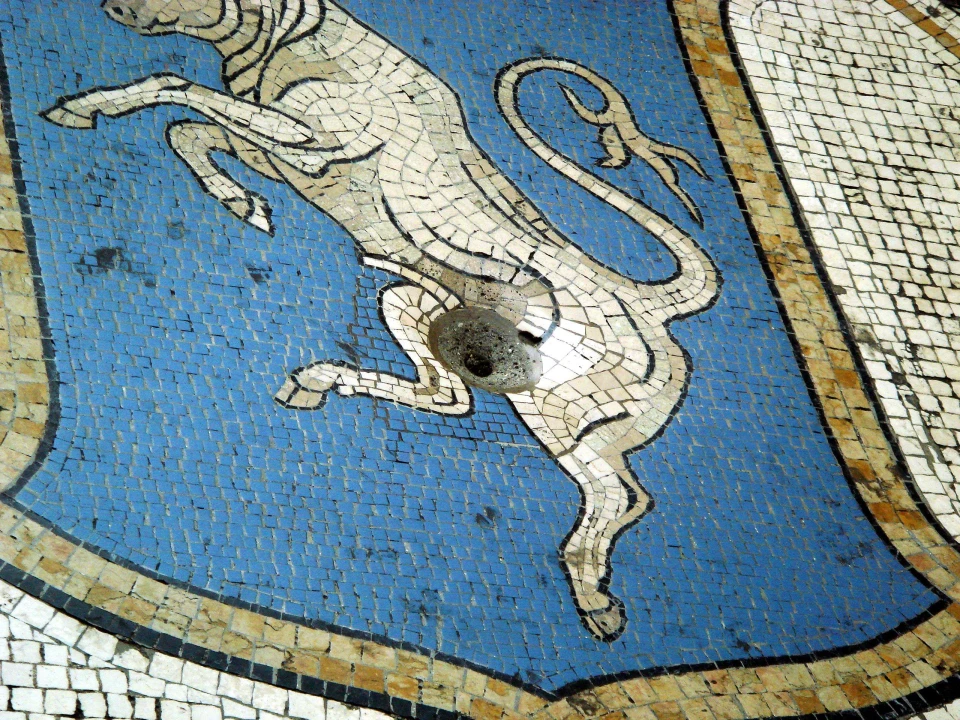

Folk beliefs usually leave their mark on our memories. In Milan, one has managed to wear a hole in the floor.
It happens beneath the glass dome of the Galleria Vittorio Emanuele II, where a mosaic depicting the coat of arms of Turin features a bull that has grown accustomed to some rather undignified treatment: visitors plant their right heel on its private parts and spin around three times. In return, tradition promises good luck and, according to one of the most popular versions, a return trip to Milan.
The obvious question would be: Does it work?
The more interesting one is: Why do we keep doing it?
Superstitions have a remarkable talent for outliving the explanations that gave rise to them. They may begin with fear, a precaution, a game, or simply the desire to make the things we cannot control feel a little less unpredictable. Eventually, the explanation fades, but the ritual survives. Good luck is uncertain. Three spins, on the other hand, are a perfectly clear set of instructions.
It is the same mechanism that allows certain family sayings to travel from one generation to the next. They do not always come with supporting evidence. They survive because someone we trust passes them along. And as traditions travel, they can change along the way.
A 1993 report in l'Unità already described tourists gathering around the bull, with short lines forming on especially busy days. It even noted an amusing reversal: Milanese residents had begun imitating a ritual made popular by visitors.
It is a miniature laboratory of cultural transmission. Someone inherits a ritual, someone else discovers it, takes a picture, tells the story, and sends it back into circulation. Before long, remembering exactly where it all started becomes almost beside the point.
And that is precisely why we should be wary of stories that sound a little too perfect.
One frequently repeated explanation claims that the ritual began as a playful Milanese jab at rival Turin or the House of Savoy. It is plausible, and the bull really does represent Turin on its coat of arms. But the available historical evidence is not enough to establish that version as the definitive origin of the tradition.
In other words, repeat an explanation of a superstition often enough, and it may become a superstition about the superstition itself.
Then comes the part that requires no faith whatsoever.
In May 2026, the City of Milan restored the mosaic once again. Countless spinning heels had worn down the tiles, creating what city officials described as a "small crater." The restoration required removing damaged material to a depth of at least 2.5 centimeters, or nearly an inch. The previous restoration specifically addressing this problem had taken place in 2017.
The superstition thus pulls off a neat logical trick: it promises an invisible result while producing one that can be measured with remarkable precision.
But the absence of evidence that three spins can change your luck does not mean the ritual is meaningless.
A tradition can represent memory, belonging, playfulness, or nostalgia. It can be something you do because someone before you did it, or simply because, for three seconds, it is fun to imagine that fate might actually take directions.
That is exactly what critical thinking helps us do: distinguish what a tradition means from what it claims to accomplish.
So the bull can keep bringing good luck to anyone willing to give it the benefit of the doubt.
Whether the luck is real remains to be seen. The wear and tear, however, has already come with a very real price tag.
Aspetta 2 ore (Credenze popolari smontate con logica, scienza e satira), by Frederik Quarta, explores more than 200 popular beliefs, misconceptions, and superstitions from everyday Italian culture, putting them to the test through logic, science, cultural observation, and satire. Published by Viastante Edizioni in 2026.