
In the mountains of northern Piedmont, above the small town of Varallo in Valsesia, one of the most extraordinary artistic achievements of the Italian Renaissance brings painting, sculpture, architecture, and storytelling together. The Sacro Monte di Varallo is a place where art does not simply represent a story – it invites visitors to enter it. Much of this remarkable experience is the work of Gaudenzio Ferrari, one of the most original artists of 16th-century Italy.
Born around 1475 in Valduggia, near Varallo, Ferrari developed an artistic language that combined the emotional intensity of Lombard painting with the innovations of the High Renaissance. Although less internationally celebrated than Leonardo da Vinci, Michelangelo, or Raphael, he demonstrated an exceptional ability to integrate different artistic techniques into a single, compelling visual experience.
The Sacro Monte was founded in 1486 by the Franciscan friar Bernardino Caimi, who had spent time in Jerusalem and wanted to recreate the sacred places of the Holy Land for pilgrims unable to undertake the difficult journey. His vision gradually developed into a monumental religious complex overlooking the Sesia Valley.
Today, the sanctuary includes 45 chapels and a basilica, with hundreds of life-size sculptures and thousands of painted figures. In 2003, it became part of the UNESCO World Heritage listing of the nine Sacred Mountains of Piedmont and Lombardy.
Ferrari played a decisive role in transforming this devotional project into an artistic masterpiece. Working at Varallo during the early decades of the 1500s, he developed a revolutionary relationship between painting and sculpture. His figures appear to step out of the walls, while painted landscapes and crowds extend the physical space around the sculptures.
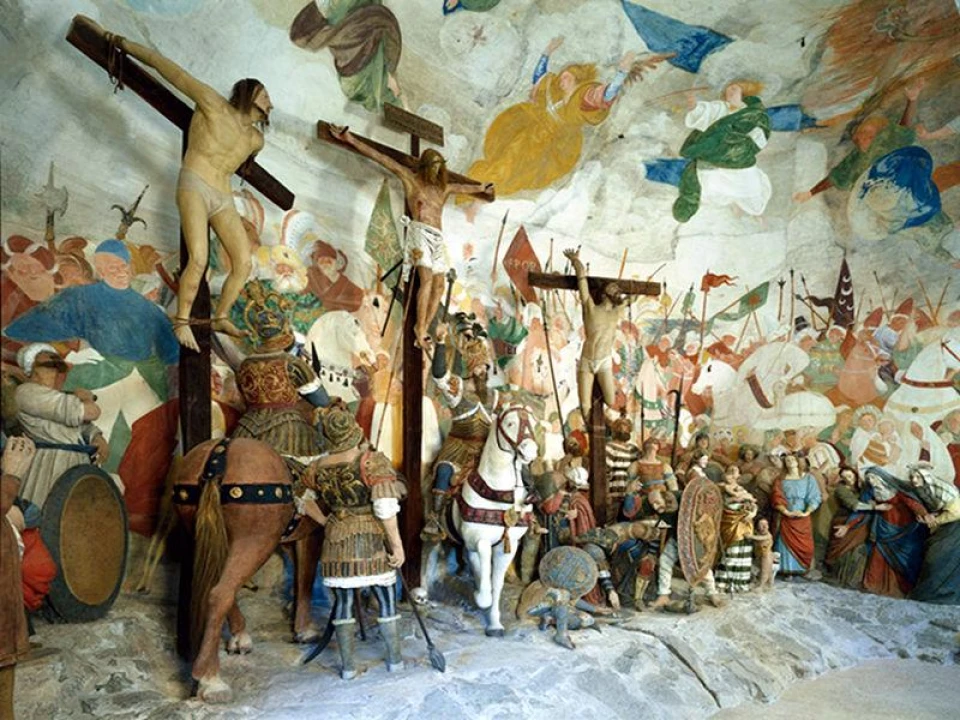
The most impressive example is Chapel 38, dedicated to the Crucifixion. Created and transformed during the 1520s, the chapel presents an astonishingly crowded scene of grief, fear, curiosity, and compassion. Its 87 polychrome terracotta statues, together with wooden figures and surrounding frescoes, transform a biblical episode into a dramatic encounter. Roman soldiers, mourners, horsemen, and ordinary people occupy the same space, with their expressions conveying individual reactions to the unfolding tragedy.
Ferrari did not treat the sculpted figures and frescoes as separate works. Painted spectators continue the crowd beyond the statues, while carefully coordinated proportions blur the boundary between actual and imagined space. The result feels surprisingly modern – an immersive environment created centuries before the invention of cinema.
The artistic achievement lies equally in the details. Gestures, clothing, faces, and postures make each character recognizable, drawing on the world Ferrari knew rather than relying exclusively on idealized Renaissance beauty. His work gave religious storytelling an immediacy accessible to visitors regardless of their education or familiarity with art.
Unlike a conventional fresco, which directs attention to a single painted surface, this kind of art asks viewers to discover the story from several angles. The chapels are arranged along paths and small squares, giving the entire hill the rhythm of a pilgrimage. A visitor moves from one episode to the next, encountering the narrative as a sequence of places rather than isolated images. For 16th-century pilgrims, many of whom would never see Jerusalem, the experience offered an extraordinary way to imagine distant sacred events in familiar human terms.
The hill itself becomes a stage for the entire story.
Ferrari's approach profoundly influenced the artists who completed other chapels over the following centuries. At Varallo, his legacy is not confined to a painting hanging on a museum wall. It surrounds visitors as they move through an extraordinary landscape of architecture and art, where the Renaissance remains vivid, physical, and deeply human.