

Along the southeastern coast of Sicily, between Noto and Pachino, lies one of the Mediterranean's most remarkable protected landscapes. The Vendicari Nature Reserve is a fascinating combination of wetlands, sandy beaches, coastal dunes, rocky shores, and Mediterranean vegetation. Here, the natural environment has preserved an extraordinary richness of habitats, creating an important refuge for wildlife and a destination for visitors interested in discovering a different side of Sicily.
Established in 1984 by the Sicilian Region and effectively protected from 1989, the reserve extends across approximately 1,500 hectares, or 3,700 acres, along a coastal stretch of about 8 kilometers.
Its importance derives primarily from the coexistence of several ecosystems within a relatively limited area.
The wetlands, locally known as pantani, are among the reserve's most distinctive features. These shallow coastal basins collect rainwater and are influenced by seasonal changes, evaporation, and their proximity to the sea.
During different periods of the year, their water levels and salinity vary considerably, creating environmental conditions suitable for numerous species of birds.
Vendicari occupies a strategic position along Mediterranean migration routes connecting Europe and Africa. Thousands of birds use the reserve as a resting and feeding area during their seasonal journeys.
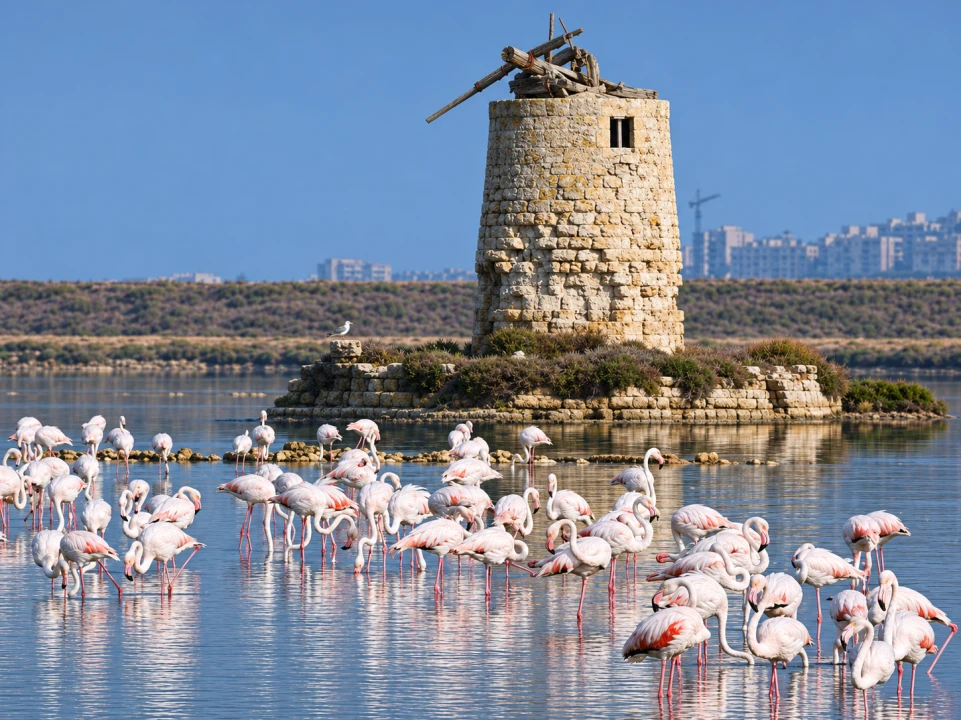
Greater flamingos are among its most recognizable visitors. Their elegant silhouettes and pink plumage create spectacular scenes against the shallow waters, particularly when large groups gather during migration.
Herons, egrets, black-winged stilts, avocets, and various species of ducks can also be observed, depending on the season.
The reserve is especially important because these birds depend on healthy wetland habitats during demanding migrations that may cover thousands of miles.
Beyond the wetlands, Vendicari offers a remarkable diversity of coastal landscapes.
The beach of Calamosche is particularly famous for its sheltered bay, framed by rocky headlands and Mediterranean vegetation. Its relatively protected waters and natural setting have made it one of the best-known beaches in southeastern Sicily.
Other stretches of coastline, including Marianelli and San Lorenzo, offer different combinations of sand, dunes, and coastal habitats.
The dunes themselves are environmentally significant. They provide specialized habitats for plants adapted to salty winds, shifting sand, and intense summer heat.
Mediterranean scrub vegetation, including lentisk, juniper, and other drought-resistant species, helps stabilize the coastal environment and supports insects, reptiles, and small mammals.
Vendicari also offers an interesting example of the relationship between nature and human history.
Near the coast stands the remains of an ancient tuna-processing complex, known as the tonnara, which recalls the importance of fishing in the local economy. The structure, whose surviving buildings date mainly from later phases of its history, is one of the reserve's most recognizable landmarks.
Nearby, the Torre Sveva, a historic coastal tower, illustrates the defensive role played by this stretch of shoreline during earlier centuries.
These architectural remains create a fascinating contrast with the surrounding natural environment, demonstrating how coastal communities adapted to the opportunities and challenges presented by the Mediterranean.
Today, the reserve is managed with the objective of protecting biodiversity while allowing carefully regulated public access.
Marked trails lead visitors through different habitats, while observation points provide opportunities for birdwatching and nature photography.
Seasonal restrictions and conservation measures help protect particularly sensitive areas, especially during nesting periods.
Vendicari's ecological importance also extends beyond its boundaries. The reserve forms part of a wider network of Mediterranean coastal habitats whose preservation is essential for migratory birds and other species.
Climate change, coastal development, and increasing pressure on water resources make the protection of these environments particularly important.
Vendicari demonstrates that Sicily's natural heritage is far more diverse than its famous mountains, volcanoes, and beaches might suggest.
Its wetlands, dunes, and coastal ecosystems reveal a quieter landscape where ecological processes unfold according to seasonal rhythms.
For visitors, the greatest attraction may be the opportunity to experience a Mediterranean coastline where nature remains the protagonist. The sight of flamingos crossing the sky above ancient fishing buildings captures the extraordinary character of a place where biodiversity, history, and landscape coexist.