

Cork isn’t just a material in Sardinia – it’s a living craft shaped by forests, families, and slow, careful work. On the island’s northeastern shoulder, especially in Gallura, cork oak groves spread across granite hills where sea winds toughen the bark and give it character. Here, artisans have learned to read a tree the way a shepherd reads the weather, balancing respect for nature with the practical know-how to turn bark into beautiful, durable objects.
Everything starts in the forest. Cork oaks grow for decades before they’re ready for the first harvest – a careful stripping that happens in summer when sap rises and the bark releases more easily. Skilled cutters mark panels with a precise axe, lift them away in broad sheets, and leave the living layer intact so the tree can regenerate. Each tree rests for about nine years before the next harvest. That cycle – patient, predictable, sustainable – underpins the entire Sardinian cork economy. The result is a raw material that’s light, elastic, water-resistant, and uniquely warm to the touch.
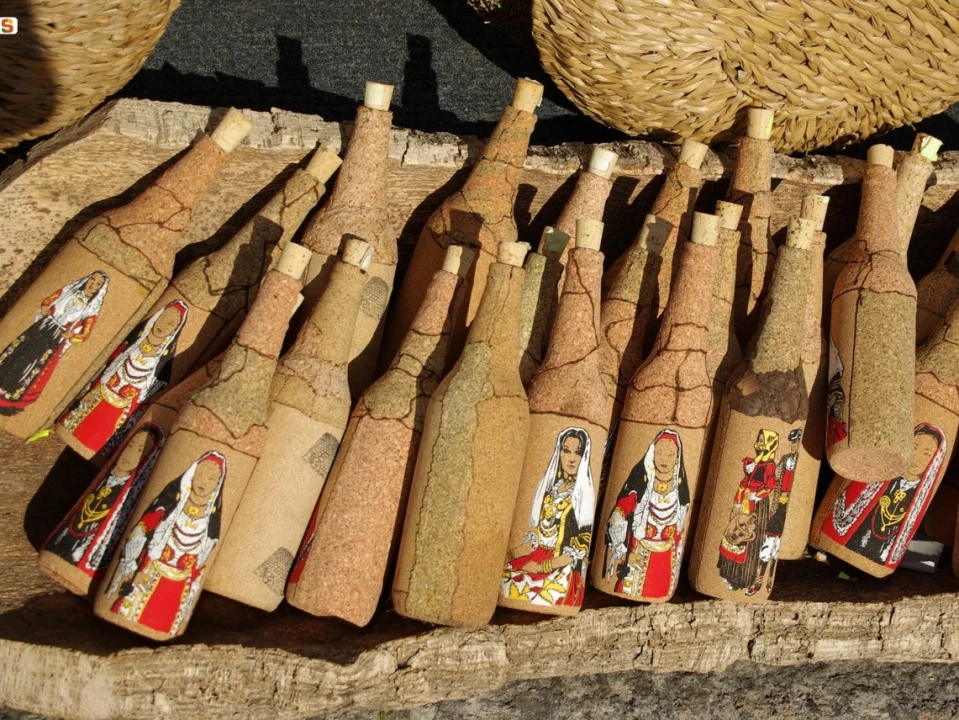
The journey from bark to object is a sequence of traditional steps. Fresh cork seasons in the open air, then gets boiled to sanitize, soften, and stabilize the sheets. The boards rest again – moisture needs to equalize – before they’re flattened and sorted by density and quality. For generations, stoppers were the flagship product, graded by hand and eye, destined for wine bottles across Europe. But Sardinia’s cork craft has long reached far beyond stoppers. Artisans slice, laminate, and shape cork into trays, boxes, wall panels, and furniture components. They turn it on the lathe for bowls and candlesticks, carve it for nativity scenes, and combine it with leather, linen, or wood for fashion accessories. Architects and designers prize cork for acoustic panels and thermal insulation – a natural solution that’s breathable, hypoallergenic, and pleasantly tactile.
Aesthetics matter. Sardinian makers often leave traces of the bark’s original texture as a design statement – a rugged surface paired with clean lines – while others sand and burnish to a silky matte. Natural pigments and wax finishes keep the palette earthy and understated. The island’s visual language shows up everywhere – spiral motifs inspired by Nuragic stones, wave patterns echoing the coast, stylized leaves drawn from the maquis. Nothing feels mass-produced; each piece carries the slight variations that come from handwork and small-batch processes.
The social fabric around cork is just as important. Family workshops anchor many towns, passing techniques from parent to child. Local schools and training centers teach harvesting safety, tool handling, and product design – a practical blend that keeps the craft relevant. Cooperative networks help small shops share machinery, pool orders, and access export markets. Seasonal rhythms steer the year – harvest crews in summer, finishing and fabrication through fall and winter – while fairs and village festivals showcase new designs and celebrate old skills.
Sustainability isn’t a buzzword here – it’s built into the ecosystem. Cork oaks protect soil from erosion, shelter biodiversity, and capture carbon. Properly managed groves resist drought better than many monocultures, and periodic harvesting actually stimulates the tree’s regenerative bark growth. Waste is minimal – offcuts become granulate for flooring, insulation, yoga blocks, and even technical components for footwear and sports gear. In a world of synthetics, Sardinian cork offers a fully recyclable, long-lasting alternative that ages with grace.
Tourism adds another dimension. Visitors can tour groves, watch stripping demonstrations, and step inside workshops where the air smells faintly sweet and woody. Boutiques in coastal towns sell refined pieces – coasters and jewelry for carry-home gifts, sculptural lamps and wall art for design lovers. Many travelers don’t just buy a product – they meet the maker, hear the backstory, and take home something that connects them to a landscape and its people.
The craft faces challenges. Climate change brings heat waves, pests, and more frequent fires – all threats to cork oak health. Rural depopulation makes it harder to recruit young harvesters for a physically demanding job that requires precision and patience. And in the beverage world, synthetic and screw-cap closures compete on price and logistics. Sardinian producers are responding with better forest stewardship, selective breeding of resilient oaks, and certifications that verify traceability and responsible management. In the workshop, innovation means CNC-assisted cutting paired with hand finishing, new composites that blend cork with natural fibers, and collaborations with contemporary designers who push form while honoring the material’s limits.
What keeps the tradition resilient is its adaptability. The same qualities that made cork essential in the age of sail – buoyancy, resistance to salt and rot – now suit it to modern needs like sound control, energy efficiency, and wellness-driven interiors. Artisans lean into that flexibility, crafting products that are light yet strong, minimalist yet warm, sustainable yet stylish. Whether it’s a flawlessly turned bowl, a grid of wall tiles that soften a room, or a bottle stopper that seals a celebration, Sardinian cork carries the island’s identity – rugged, resourceful, and quietly refined.
In short, cork craftsmanship in Sardinia is more than a set of techniques – it’s a culture rooted in long cycles and skilled hands, in forests that breathe with the seasons, and in objects that marry utility with beauty. As the market changes and the climate tests the land, this tradition endures by doing what it has always done best – working with nature, not against it, and letting the material lead the way.