

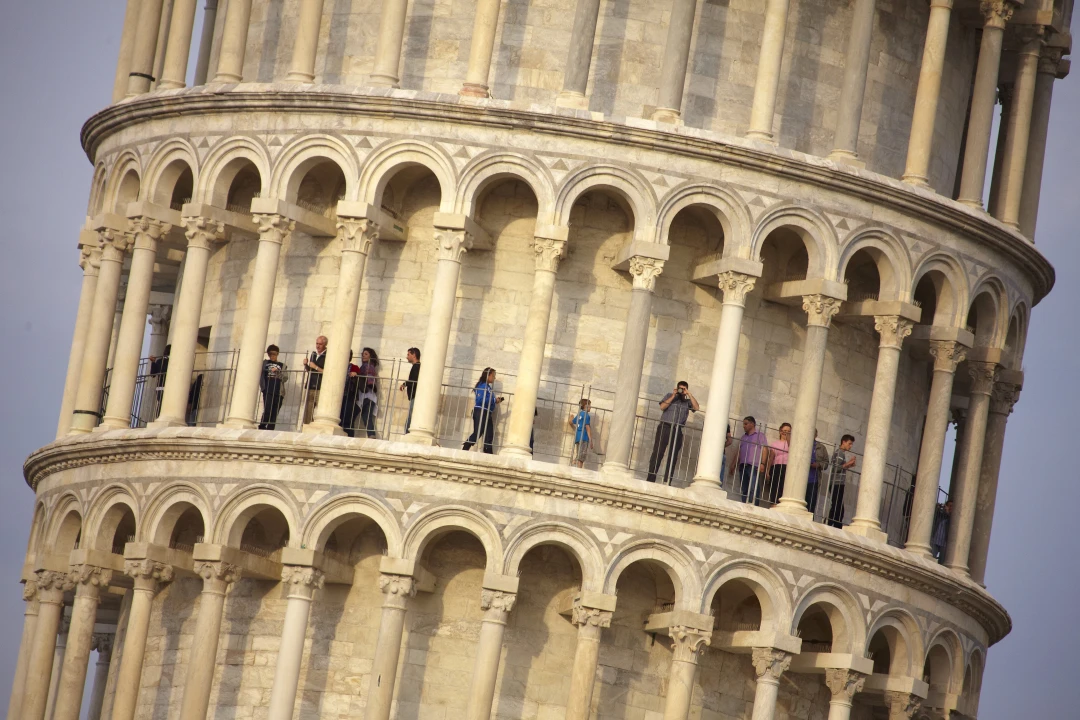

In August 1173, under the Tuscan sun in the Piazza dei Miracoli, master builder Bonanno Pisano began what was meant to be the most magnificent bell tower of the Cathedral of Santa Maria Assunta. Pisa, then a powerful maritime republic, wanted a monument that would display its glory to the world. But beneath the surface, the soil held a hidden flaw – layers of sand and clay so soft they could barely support the weight of marble.
By 1178, when the third level was finished, the tower began its slow lean toward the south. Workers were stunned, unsure whether to continue or tear it down. Soon after, wars with Florence and Genoa forced construction to stop. The half-built tower stood silent for nearly a century – and that unexpected pause would prove its salvation. During those long decades, the unstable ground settled and the structure found a fragile balance that kept it standing.
When work resumed, new architects tried to correct the tilt with clever adjustments. Giovanni di Simone and later Tommaso Pisano designed the upper floors with one side slightly taller than the other, creating a gentle opposite curve – the subtle “banana” shape that remains visible today to anyone who looks closely. Slowly, level after level, the tower rose again.
At last, around 1350 – or perhaps a bit later, in 1372 – the belfry was completed. The tower reached nearly 57 meters in height, crowned by seven bells, each corresponding to a note on the musical scale. From the first ring, the Leaning Tower became more than a bell tower – it became a marvel of survival and imperfection.
What began as a construction error has since turned into one of the most recognized symbols in the world. Tourists line up every day, posing with outstretched hands as if to hold it up, unaware that its tilt was never planned. For centuries, architects and engineers have fought to preserve it, adjusting its angle and strengthening its base. Once leaning at more than five degrees, it now rests safely at about four – enough to keep its charm, but no longer in danger.
The Leaning Tower of Pisa is a masterpiece born from misfortune. It reminds us that beauty can emerge from mistakes, and that what once seemed a failure can become a triumph of creativity and persistence. The wars that interrupted its construction, the flaws in its soil, and the ingenuity of its builders all combined to give it the shape that defines it today.
Eight centuries later, the tower still tilts gracefully against the sky – proof that sometimes history’s most lasting wonders begin when everything goes wrong.