
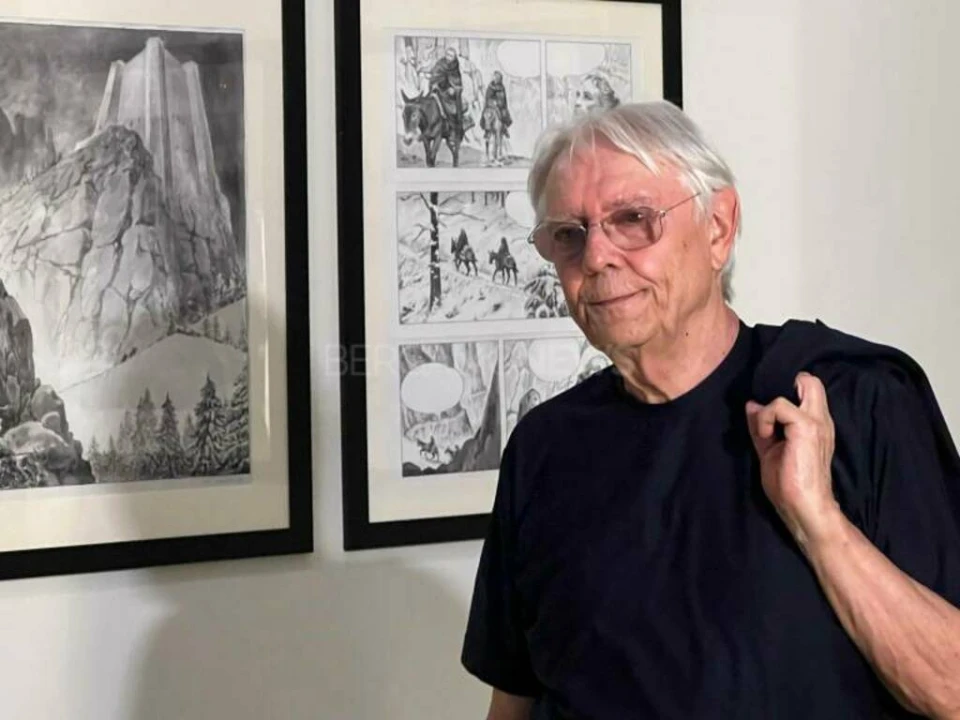

Comics are art too, and Italy has produced some of the finest. One of the most charismatic, provocative, and successful among them turns 80 this month.
Reaching 80 is an extraordinary moment for any artist - but for Milo Manara it marks a celebration of creativity that has stretched across half a century. Known around the world for his mastery of erotic illustration, Manara has transformed sensuality into a refined language of storytelling, blending beauty, irony, and fantasy into images that continue to fascinate and provoke.
Born in Luson, Trentino Alto Adige, in 1945, Manara grew up in a country still healing from war. His early passion for drawing and narrative soon evolved into a career that would take him far beyond the borders of his homeland. By the late 1970s his name was already associated with a unique style - flowing lines, luminous faces, and female figures that embodied both mystery and independence.
Manara’s visual universe is unmistakable - elegant, detailed, playful, and often daring. While erotic art had long existed, he pushed it into new territory, avoiding vulgarity in favor of suggestion, humor, and dreamlike scenarios. For him, eroticism was not only about desire but about freedom - an exploration of the human imagination without censorship.
Over the years, his talent attracted collaborations with some of the greatest creative minds of his time. Federico Fellini sought his hand for visual projects, Hugo Pratt shared narrative experiments, and other partnerships stretched into cinema, literature, and music. Whether illustrating a classic tale, designing a poster, or creating a new comic, Manara brought his instantly recognizable style - sensual yet intelligent, provocative yet sophisticated.
Yet his fame has also brought criticism. Manara’s focus on the female form - often nude, often idealized - has fueled debate about the line between art and objectification. Some critics accuse him of perpetuating stereotypes, presenting women as fantasies crafted through a male gaze. His defenders argue the opposite - that his heroines, though erotic, carry a sense of power, autonomy, and playfulness that transcends cliché. The tension between admiration and critique has followed him for decades, making his art not only visually striking but culturally contested.
One famous controversy erupted when he created variant covers for American comic books, including depictions of well-known female superheroes in highly sensual poses. The images sparked heated arguments - some praised his audacity and style, while others condemned the work as outdated or inappropriate. For Manara, these debates underscored the cultural divide between seeing eroticism as art and treating it as scandal.
Despite polemics, his place in visual culture is undeniable. His women remain iconic - embodiments of seduction mixed with irony, figures who move through surreal landscapes that blur the borders between reality and fantasy. Whether one views them as liberating or problematic, they have ensured that Manara’s work continues to inspire conversation, not just admiration.
At 80, exhibitions and tributes honor both his achievements and his complexity. They reveal an artist who has never shied away from risk - who has chosen to keep creating regardless of shifting tastes or criticism. His art is still alive, vibrant, and unafraid to stir debate.
The legacy of Milo Manara rests not only in the elegance of his line but in the way his drawings compel viewers to question - about beauty, desire, freedom, and representation. Few artists sustain such relevance across decades. He has managed it by remaining true to himself - daring, inventive, and unwilling to separate art from controversy.
Today, as he continues to draw, Manara proves that creativity knows no expiration date. His work remains seductive and divisive - a reminder that great art often lives precisely where fascination and discomfort meet.