

Most museums ask visitors to slow down, lower their voices, and cross a threshold. Cosenza’s Museo all’Aperto Bilotti, known as the MAB, does the opposite. It places modern and contemporary sculpture directly in the flow of Corso Mazzini, the city’s pedestrian main street, where shoppers, students, families, and café-goers encounter art without buying a ticket or stepping through a door.
The MAB turns the ordinary act of walking into an exercise in looking. A bronze horse and dragon can appear between storefronts. A faceless couple can stop a passerby in a busy square. A green marble wolf can hold its ground amid pavement, benches, and the moving life of the city. The museum is not a decorative afterthought to the street. The street is the gallery.
The project grew from works donated to Cosenza by the local-born patrons Carlo and Enzo Bilotti, following the pedestrianization of Corso Mazzini in 2002. Its most interesting quality is not simply the caliber of its names. Salvador Dalí, Giorgio de Chirico, Mimmo Rotella, Giacomo Manzù, Pietro Consagra, and Emilio Greco all appear in this urban constellation. Its real achievement is changing the relationship between sculpture and everyday life.
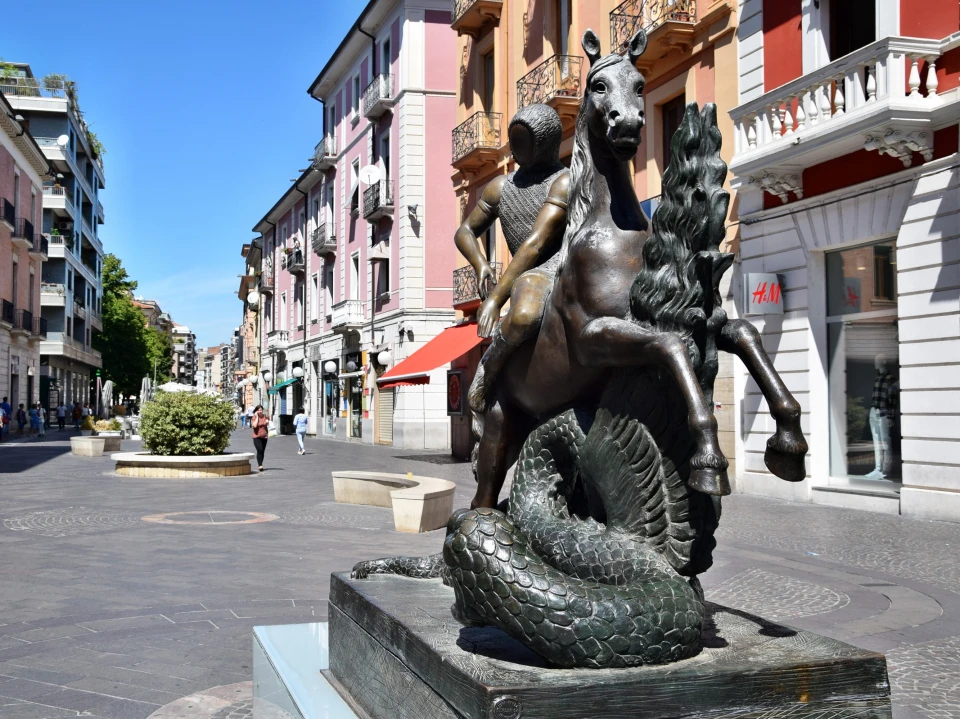
Dalí’s San Giorgio e il Drago is among the route’s most theatrical encounters. The bronze sculpture, dated 1977–1984, represents the legendary saint on horseback confronting the dragon. It brings fantasy and motion into a commercial street, yet its setting prevents it from becoming a remote monument. Instead, Dalí’s myth lives beside daily errands, conversations, and window displays. The piece is an example of how public placement can make a familiar subject feel newly unstable.
Giorgio de Chirico’s Ettore e Andromaca, installed near Piazza Kennedy, offers a quieter kind of drama. The 2005 bronze stands 230 centimeters high and shows the Trojan hero and his wife in an embrace. De Chirico’s figures are stylized and faceless, which removes them from a single historical moment. They feel less like illustrated characters than architectural presences – tall, enclosed, intimate, and oddly still. On a street built for circulation, the sculpture creates a pause. It makes the viewer notice the emotional weight of bodies that cannot quite touch in a conventional way.
Mimmo Rotella’s Lupo della Sila gives the museum its most direct Calabrian note. Rotella is best known internationally for his torn-poster décollages, a medium based on urban visual noise, layers, rupture, and surprise. Here, however, his 2005 wolf is carved in green marble from a wooden prototype. Its material matters: marble slows the eye down, while its animal form gives the route a local pulse. The work does not illustrate Calabria. It distills an image associated with the region into a sharp, sculptural sign.
That shift between international art and local space is the MAB’s central idea. The museum does not require Cosenza to imitate a capital city with a sealed white-cube institution. It lets global artists share the visual rhythms of a Calabrian avenue. Consagra’s abstract forms, Manzù’s human figures, and Sosno’s interventions expand the conversation beyond recognizable subjects. Their presence invites repeat viewing, because a sculpture seen in morning light can read differently in rain, during a market, or on an evening walk.
For Italian Art, the MAB is compelling because it makes access part of the artwork’s meaning. These sculptures are not protected from the city; they are exposed to it. They become landmarks, meeting points, and occasional surprises. Cosenza’s lesson is simple but radical: art does not become less serious when it leaves the museum building. Sometimes it becomes more alive.