

In the foothills of Monte Grappa, in the Veneto region of northeastern Italy, the small town of Possagno preserves the extraordinary legacy of one of the greatest sculptors in European history. Antonio Canova, born here on November 1, 1757, transformed marble into an artistic language of grace, beauty, and emotion. His works became symbols of Neoclassicism, admired by popes, emperors, aristocrats, and collectors across Europe. Yet despite his international success, Canova never forgot the village where his remarkable journey began.
His artistic education started within his own family. His grandfather, Pasino Canova, was a skilled stonecutter who introduced him to the tools and techniques of sculpture. After losing his father at an early age, Antonio grew up under his grandfather's guidance. His talent soon attracted the attention of the Venetian nobleman Giovanni Falier, who supported his training. At just 11 years old, Canova entered the workshop of Giuseppe Bernardi, known as Torretti, before continuing his education in Venice.
The young sculptor initially worked within the artistic traditions of eighteenth-century Venice, producing works such as Orpheus and Eurydice and Daedalus and Icarus. His move to Rome in 1779 marked a decisive turning point. Surrounded by ancient sculptures and inspired by classical ideals, Canova developed an unmistakable style characterized by harmonious proportions, controlled movement, and an extraordinary ability to suggest life beneath the surface of stone.
His masterpieces include Psyche Revived by Cupid's Kiss, The Three Graces, Pauline Bonaparte as Venus Victrix, and Theseus and the Minotaur. Each demonstrates his mastery of human anatomy and his ability to communicate emotions through apparently motionless figures. Unlike sculptors who emphasized theatrical gestures, Canova often captured the quiet instant before or after an important action, allowing viewers to imagine the movement themselves.
One of the secrets of his artistic process was his extensive use of preparatory models. Before creating a finished marble sculpture, Canova developed drawings, clay sketches, and plaster models. These allowed him to refine proportions, experiment with compositions, and guide the translation of his ideas into marble.
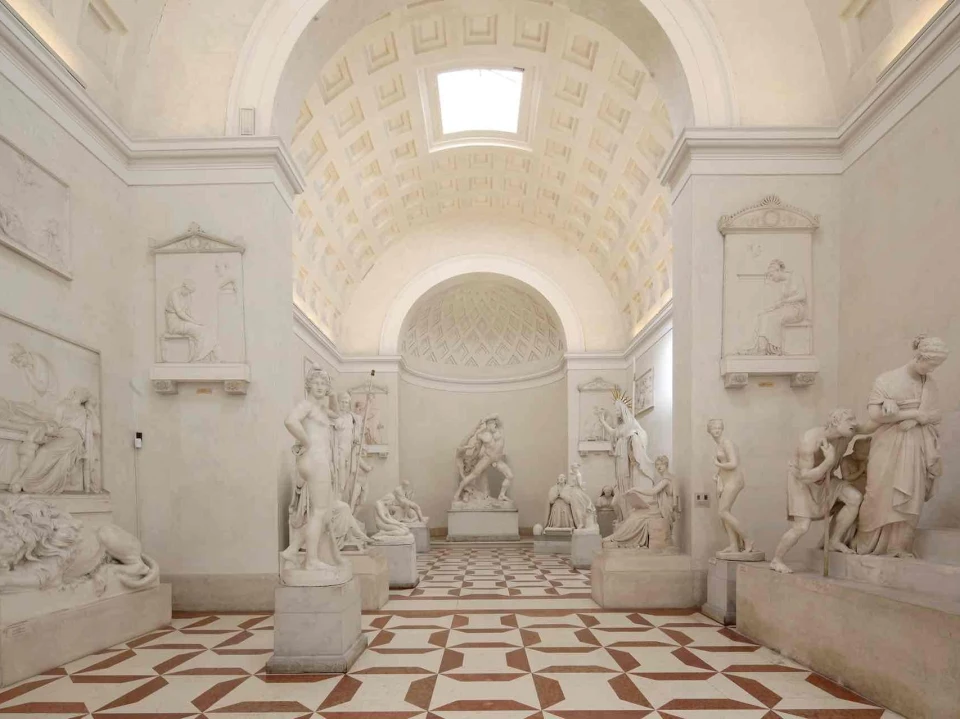
Today, the Museo Gypsotheca Antonio Canova preserves this essential dimension of his creativity. The museum includes his birthplace and a remarkable collection of plaster models, offering visitors the opportunity to understand how some of the world's most celebrated sculptures were conceived.
The original Gypsotheca was constructed between 1831 and 1836 to accommodate the plaster works transferred from Canova's Roman studio by his half-brother, Giovanni Battista Sartori. More than a century later, the celebrated architect Carlo Scarpa designed an extension, inaugurated in 1957. Scarpa's architectural intervention created a sophisticated dialogue between natural light, modern design, and Canova's classical forms.
Possagno also preserves another extraordinary expression of the sculptor's attachment to his birthplace: the Tempio Canoviano. Canova financed the construction of this monumental church, whose architecture combines references to the Greek Parthenon and the Roman Pantheon. Work began in 1819, but the artist died in Venice on October 13, 1822, before its completion. The building eventually became his final resting place.
The relationship between Canova and Possagno is particularly meaningful because it connects international artistic achievement with local identity. The same young boy who learned to shape stone in a provincial workshop became one of the most influential artists of his generation, yet he invested part of his success in the cultural and spiritual life of his community.
Today, visitors to Possagno encounter much more than a museum dedicated to a famous sculptor. They discover the origins of an artistic vision that crossed borders, influenced generations, and continues to demonstrate how Italian creativity can transform a simple material into something timeless.