
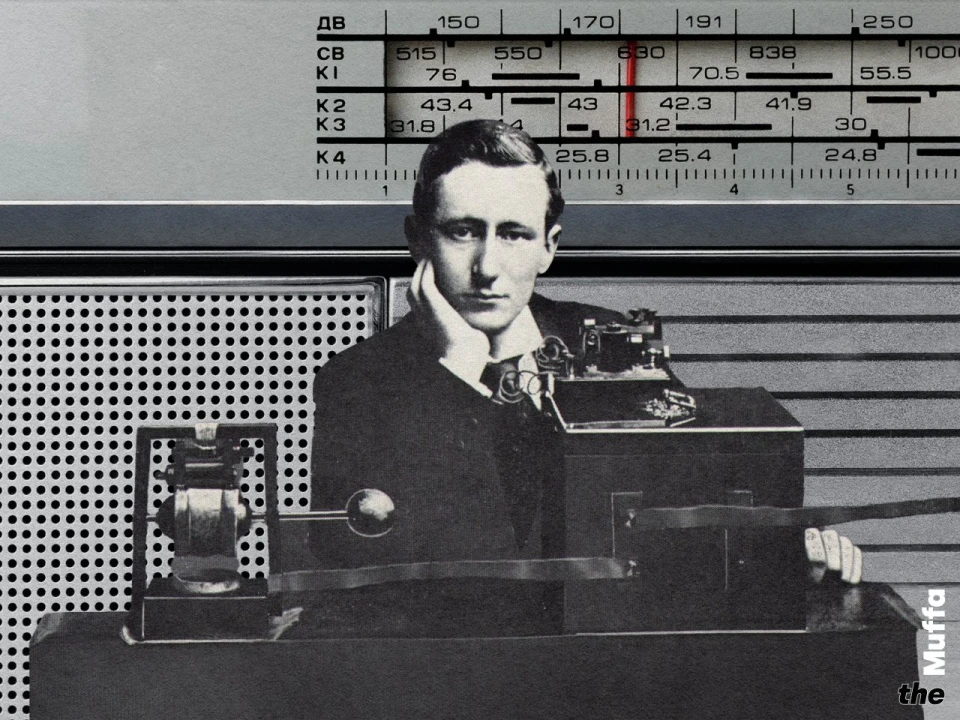
Today, February 13 is celebrated as World Radio Day, a day designated by UNESCO to highlight the enduring power of radio as an informational, cultural, and educational medium. The history of radio is closely tied to the name of Guglielmo Marconi, the Italian inventor who transformed scientific theory into a revolutionary communication system.
Born in Bologna in 1874, Marconi grew up fascinated by electricity and physics. Inspired by earlier studies on electromagnetic waves, he began conducting experiments in the mid-1890s on his family’s property. In 1895, he successfully transmitted wireless signals over a distance of about one mile, proving that communication without wires was possible. That breakthrough marked the practical birth of radio.
In 1897, Marconi patented his wireless telegraph system and founded a company to develop and commercialize the technology. Early radio was not used for music or entertainment, but for Morse code transmissions between ships and coastal stations. Its importance quickly became clear, especially for maritime safety. In 1901, Marconi achieved a historic milestone by transmitting a wireless signal across the Atlantic Ocean, from England to Newfoundland – a feat many scientists had considered impossible. His work earned him the Nobel Prize in Physics in 1909, shared with Karl Ferdinand Braun. Marconi became a global symbol of Italian innovation and scientific excellence.
While other researchers contributed to the scientific foundations of wireless communication, Marconi’s genius lay in turning experimental discoveries into practical systems. His inventions laid the groundwork for the development of modern broadcasting. By the early 20th century, radio technology was evolving beyond telegraphy into voice transmission, opening the door to mass communication.
In Italy, regular radio broadcasting began in 1924 with the creation of Unione Radiofonica Italiana. This organization later evolved into EIAR and eventually into RAI, the national public broadcaster. During the 1920s and 1930s, radio became a powerful medium for news, music, and cultural programming. It played a central role in shaping public opinion and connecting citizens across the country, especially in rural areas where newspapers were less accessible.
After World War II, radio continued to expand, adapting to changing political and social realities. The arrival of television in the 1950s reduced radio’s dominance, but it did not eliminate its importance. Instead, radio reinvented itself through music programming, talk shows, and local stations. Today, more than 120 years after Marconi’s first experiments, radio remains one of the most accessible and resilient forms of media. Digital broadcasting, podcasts, and online streaming have expanded its reach, but its core mission – informing, educating, and connecting people – remains unchanged.