
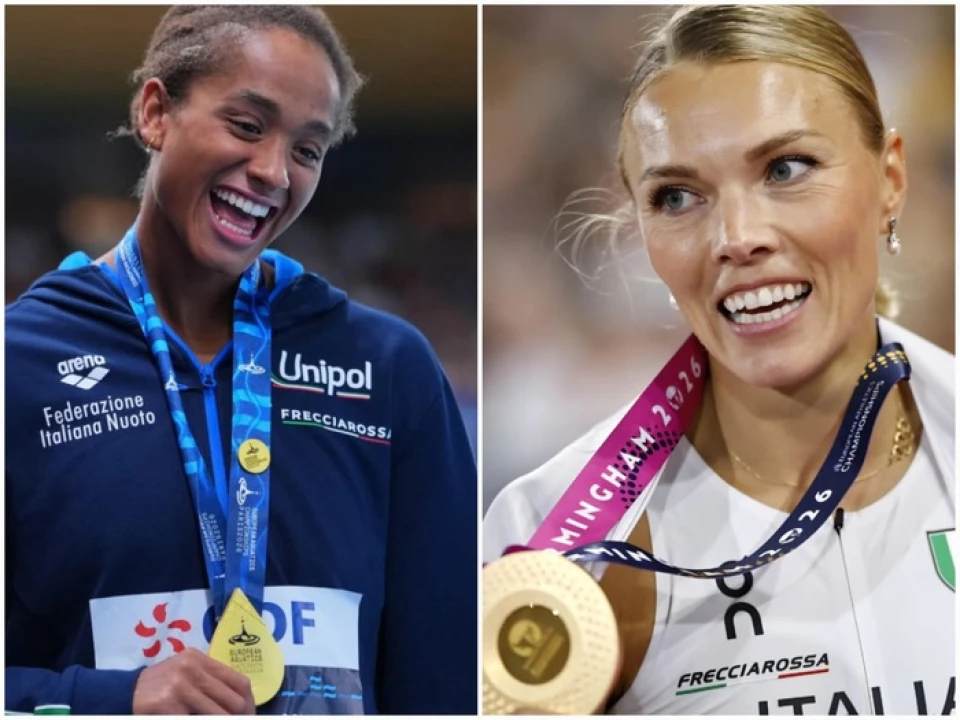
On one extraordinary August night, 2 Italian women with family stories extending far beyond the country’s borders gave Italy reasons to celebrate – and perhaps something deeper to think about.
Sara Curtis and Dariya Derkach became European champions in 2 different cities and 2 different sports. Their victories were athletic achievements of the highest level, but they also offered a powerful portrait of an Italy whose identity can be inherited, embraced and enriched through different paths.
In Paris, 19-year-old Curtis won the European title in the 50-meter backstroke in 26.56 seconds, breaking the world record she had already lowered to 26.63 in the semifinals. The previous global mark, 26.86, belonged to Australia’s Kaylee McKeown.
Born in Savigliano, Piedmont, in 2006, Curtis is the daughter of an Italian father, Vincenzo, and a Nigerian mother, Helen. Her story is entirely Italian while also reflecting a country increasingly connected to the wider world. Now studying and training at the University of Virginia, she has combined the Italian swimming tradition with an American collegiate experience. Her Paris triumph came after she had already earned bronze in the 100-meter freestyle and silver in the 4x100 freestyle relay.
Hundreds of miles away in Birmingham, 33-year-old Dariya Derkach completed a very different journey. Born in Vinnytsia, Ukraine, in 1993, she moved with her family to Pagani, near Salerno, in 2002, when she was 9. She grew up athletically in Italy, collected 18 national youth titles in 6 years and received Italian citizenship in 2013. A month later, she finally made her senior debut wearing the Italian jersey.
After 3 Olympic appearances, an eighth-place finish at Paris 2024, European indoor silver in 2023 and a career complicated by 3 operations on her left Achilles tendon in 2025, Derkach finally reached the top of the European podium in the triple jump. At 33, she produced the finest competition of her career and became European champion.
Curtis and Derkach represent 2 ways of being wonderfully Italian. One was born in Piedmont to a Nigerian mother and Italian father. The other was born in Ukraine, arrived in Campania as a child and chose Italy as the country in which to grow, live, compete and build her identity.
Their stories suggest a broader lesson. Italy loses nothing by welcoming people who belong to it through ancestry, blood, culture, upbringing or conscious choice. It gains talent, affection, international connections and millions of potential ambassadors for the country.
That should also encourage renewed reflection on the citizenship-by-descent reform approved in 2025, which significantly restricted recognition for many descendants of Italians born abroad. Protecting citizenship from purely opportunistic claims is legitimate. But making Italian identity excessively narrow risks weakening one of Italy’s greatest global assets – the enormous human community that feels Italian beyond the peninsula.
Curtis and Derkach wore the same colors and heard the same anthem. Their roads to the podium were different. Their Italy was the same.