
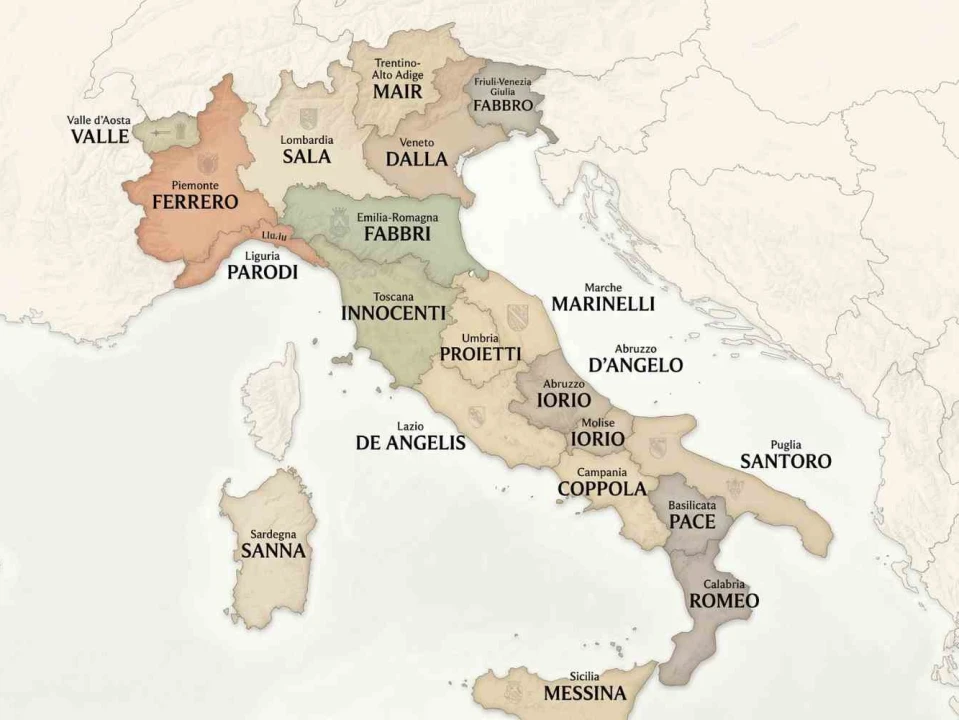
Italy’s most common surnames tell the story of migration, regional identity and centuries of local traditions. While names like Rossi, Russo and Ferrari are widespread across the country, every Italian region still preserves surnames that reflect its own history, dialects and social roots.
In Abruzzo, the most common surnames include D’Angelo, Di Marco, Mancini and Di Pietro. Basilicata is dominated by Grieco, Pace, Colangelo and Telesca, while Calabria features Romeo, Russo, Greco, Perri and Ferraro. In Campania, Esposito remains the best-known surname, followed by Russo, Romano, Coppola and De Rosa. Esposito historically referred to abandoned children left in religious institutions, similar to the surname Proietti in Rome.
In Emilia Romagna, Ferrari and Rossi lead the rankings alongside Fabbri, Montanari and Barbieri. Many of these names are connected to medieval professions, especially blacksmiths and craftsmen. Friuli Venezia Giulia has a different linguistic tradition, with surnames such as Furlan, Visintin, Trevisan, Fabris, Mauro and Fabbro reflecting Venetian and Slavic influences.
Lazio is strongly associated with Rossi, Mancini, Proietti, De Angelis and De Santis. In Liguria, Parodi stands out alongside Ferrari, Pastorino and Bruzzone. Lombardy is dominated by Colombo, Ferrari, Rossi, Bianchi and Cattaneo, while Marche features Rossi, Mancini, Marinelli, Vitali and Ricci. In Molise, Mancini, Testa, Lombardi and Ricci are especially common.
Piemonte is known for Ferrero, Gallo, Bruno and Rosso. In Puglia, Greco, Russo, Rizzo, Santoro and Lorusso are widespread. Sardinia has one of the most distinctive surname traditions in Italy, with Sanna, Piras, Pinna, Melis and Serra appearing frequently across the island. Sicily is dominated by Russo, Messina, Lombardo, Caruso and Marino, while Tuscany is strongly associated with Rossi, Innocenti, Bianchi, Gori and Ricci. Veneto also has a recognizable identity through surnames such as Trevisan, Carraro, Pavan, Boscolo and Vianello.
Across Italy, surnames often originated from professions, physical characteristics, places of origin or religious traditions. Names such as Ferrari and Fabbri come from blacksmiths, Rossi and Russo refer to red hair or complexion, while Romano and Colombo point to geographic or symbolic origins.