

At the southeastern edge of Italy, Salento stretches between two seas, the Adriatic to the east and the Ionian to the west. It is the final portion of Puglia, the heel of the Italian boot, but geography alone does not fully explain it. Salento has developed such a distinctive combination of landscape, language, history, architecture, music and traditions that its name carries an identity of its own.
The Salentine peninsula covers about 5,800 square kilometers, including the entire province of Lecce and parts of the provinces of Brindisi and Taranto. Its northern limits are less obvious than its maritime borders, traditionally associated with the Soglia Messapica. From there, the land gradually narrows toward Santa Maria di Leuca, while two very different coastlines accompany it southward.
The Adriatic side is often rocky and dramatic, with cliffs, caves and coves around places such as Otranto, Castro and Santa Cesarea Terme. The Ionian side includes long stretches of sand and extraordinarily clear water around Gallipoli, Porto Cesareo and farther north. Between them lies an overwhelmingly Mediterranean countryside of limestone, dry-stone walls, vineyards, masserie and fields shaped by generations of agricultural life.
Salento's individuality has very ancient roots. Before the Roman conquest, much of the area was inhabited by the Messapi, and archaeological traces of prehistoric and ancient civilizations remain scattered across the peninsula. Greeks, Romans, Byzantines, Normans, Angevins, Aragonese and Spaniards subsequently contributed layers to its history. For centuries, the area formed the heart of Terra d'Otranto, a historical province that included Lecce, Taranto, Brindisi and Gallipoli.
Greek influence remains particularly fascinating. In the Grecìa Salentina, south of Lecce, communities have preserved Griko, a language of Greek origin whose survival reflects Salento's centuries-old relationship with the eastern Mediterranean. Salentino itself is not simply a variation of standard Italian. Its dialects belong to Italy's extreme southern linguistic group and distinguish the area from much of northern and central Puglia.
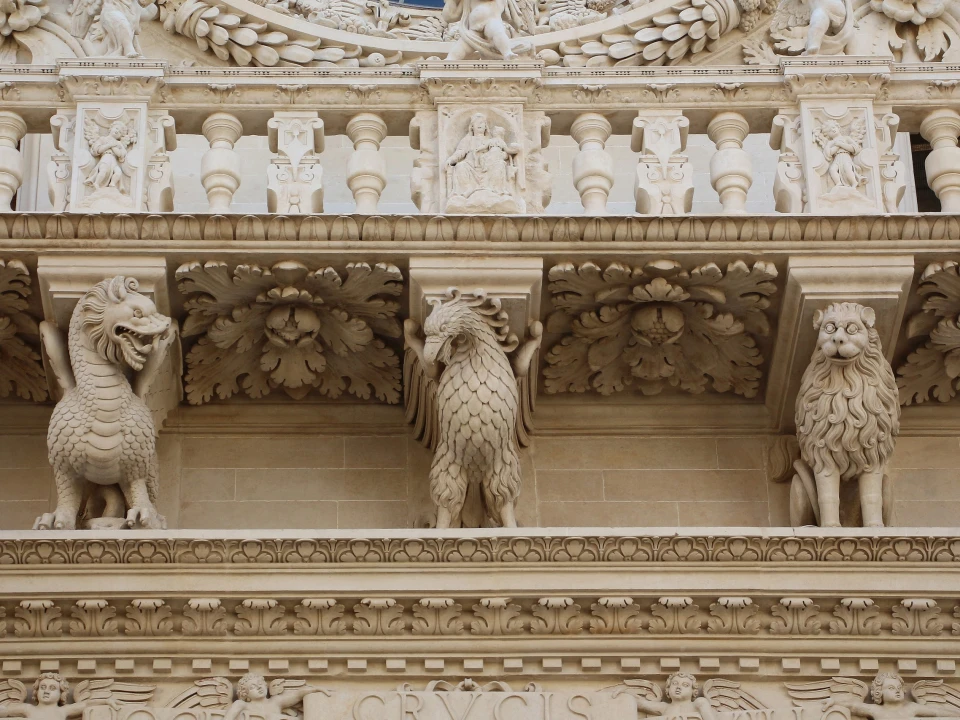
Lecce provides the territory with its great urban expression. The city's famous Baroque architecture developed through the extraordinary possibilities offered by pietra leccese, the soft local limestone that craftsmen transformed into elaborate façades, balconies, columns, flowers, animals and religious figures. The Basilica of Santa Croce is perhaps its most spectacular expression.
Yet Salento is equally defined by smaller places: Otranto and its cathedral, Gallipoli facing the Ionian Sea, the whitewashed streets of Specchia, the fortified architecture of Acaya, the villages of Grecìa Salentina and Santa Maria di Leuca at the peninsula's southern extremity. Menhirs, dolmens, underground olive presses, coastal watchtowers, pajare and dry-stone walls create another architectural language, one belonging to the countryside.
Music provides one of Salento's strongest cultural signatures. Pizzica, traditionally connected with the much more complex phenomenon of tarantism, has evolved into a symbol of Salentine identity. Tambourines, dancing and traditional songs have moved from villages and family celebrations to major cultural events, most famously the Notte della Taranta in Melpignano.
Food tells the same story of a civilization deeply connected to agriculture. Friselle, puccia, pittule, ciceri e tria, rustico leccese and pasticciotto are among its most recognizable specialties. Olive oil, wheat, legumes, vegetables and wines made from grapes including Negroamaro and Primitivo reflect a cuisine historically based on simple ingredients transformed through ingenuity.
Religious celebrations remain central to community life. Patron saints are honored with processions, marching bands and extraordinary luminarie – elaborate structures illuminated by thousands of lights that turn streets and squares into temporary architecture. Customs can change noticeably from one town to another, even across very short distances.
This strong local dimension may be Salento's most remarkable characteristic. Its people are Puglian, but being Salentino carries another geographical and emotional meaning. Two seas, a distinctive dialect, Greek linguistic heritage, ancient peoples, Baroque stone, rural architecture, music, food and deeply rooted celebrations have produced something unmistakable: a Mediterranean land whose identity has been shaped over centuries and remains immediately recognizable today.