

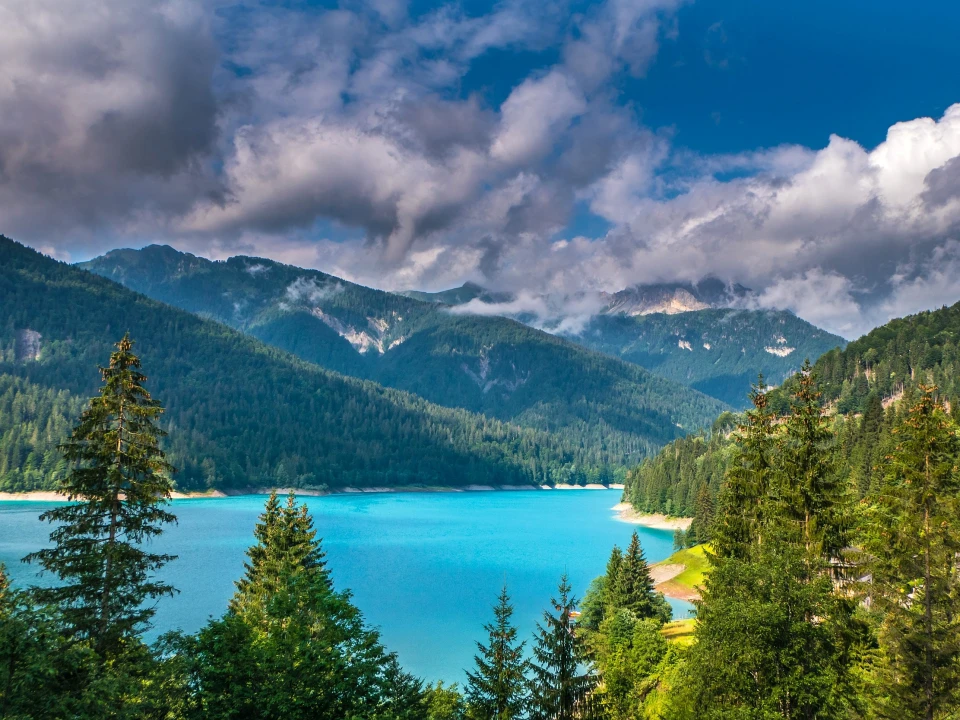

Carnia is a mountainous area in the northern part of Friuli Venezia Giulia, close to the Austrian border and framed by the Carnic Alps. Covering about 1,300 square kilometers, it includes 28 municipalities and is home to roughly 40,000 residents. The territory is defined by steep peaks, narrow valleys, dense forests, alpine meadows, and small villages shaped by centuries of adaptation to a demanding environment. Elevations range from valley floors below 400 meters to mountain summits rising above 2,700 meters, creating sharp contrasts in climate and landscape within short distances.
Human settlement in Carnia dates back thousands of years. The area takes its name from the Carni, a Celtic people who settled here before Roman expansion into northern Italy. Later, Roman control brought roads, trade routes, and early urban centers that linked the Alps with the plains to the south. During the Middle Ages, Carnia passed through multiple political phases, influenced by Lombard, Frankish, and later Venetian rule. Despite these changes, its remote geography allowed many customs, dialects, and social structures to survive with limited outside influence.
The natural structure of Carnia is shaped by a system of valleys carved by tributaries of the Tagliamento River. Among the most important are the Degano, Bût, Lumiei, and Tagliamento valleys. These corridors have historically served as both barriers and passageways, connecting alpine communities while also isolating them during harsh winters. Forests cover a large share of the territory and include fir, beech, spruce, and larch. The region hosts more than 2,000 plant species and a wide range of wildlife, making it one of the most biodiverse mountain areas in northeastern Italy.
Tolmezzo functions as the main economic and administrative center of Carnia. Located at a strategic crossroads between valleys, it has long played a key role in trade, craftsmanship, and services. Smaller villages are scattered throughout the mountains, often built on terraces or sunny slopes to maximize exposure and protection. Places such as Sauris, Sutrio, Arta Terme, and Raveo preserve strong local identities, each with distinctive architecture, dialect features, and traditions linked to farming, forestry, and seasonal migration.
Life in Carnia has always been closely tied to self-sufficiency. Agriculture developed around hardy crops, dairy farming, and livestock grazing on high pastures during summer months. Food traditions reflect this environment, combining simple ingredients with careful preparation. Dishes such as stuffed pasta with sweet and savory fillings, smoked meats, mountain cheeses, and rye-based breads tell the story of a cuisine shaped by climate, altitude, and limited resources. These foods remain central to local celebrations and family life.
The landscape also offers significant opportunities for outdoor activities. In warmer months, hundreds of kilometers of trails connect villages, forests, and mountain huts, attracting hikers and cyclists. Lakes such as Cavazzo, one of the largest natural lakes in Friuli, and reservoirs like Verzegnis add visual variety and recreational options. In winter, snow transforms the region into a destination for skiing, snowshoeing, and alpine sports, particularly around Mount Zoncolan, known for its steep gradients and long descents.
Modern history has left deep marks on Carnia. During the First World War, the region lay near the front lines, and traces of military roads and fortifications remain visible. In 1976, a powerful earthquake struck Friuli, causing widespread damage across Carnia and accelerating depopulation trends already underway. Reconstruction efforts focused on preserving village layouts and cultural heritage while improving safety standards.
Today, Carnia faces challenges common to many mountain regions, including aging populations and limited economic diversification. At the same time, there is growing interest in sustainable tourism, local products, and cultural preservation. Its appeal lies in authenticity rather than scale, offering visitors a landscape where nature, history, and daily life remain deeply interconnected.