
Every spring, a corner of Lombardy appears to dissolve into the sky. Fields become shallow mirrors, clouds float beneath rows of poplars, and the silhouettes of old farmhouses seem to rise from the water. This is Lomellina, a largely overlooked territory in the western part of Pavia province, where the landscape is not simply scenery. It is the result of centuries of human ingenuity.
Bounded by the Sesia, Ticino, and Po rivers, Lomellina covers approximately 1,240 square kilometers and includes 57 municipalities. Unlike the mountainous Lombardy of postcards, it is almost entirely flat. Its defining feature is a vast network of rice paddies, crossed by canals, embankments, and country roads. Local tourism sources describe around 60,000 hectares of rice fields, making water the central element of the region's identity.
Yet this seemingly natural landscape was carefully constructed. Generations of farmers, monks, and landowners drained marshes, leveled ground, and organized irrigation systems. Rice cultivation expanded during the Renaissance, when the Sforza rulers encouraged agricultural development. The great cascine, traditional farm complexes with enclosed courtyards, became centers of work and rural life. For much of the 20th century, this economy also depended on the mondine, women who worked long hours weeding and transplanting rice by hand. Their songs became part of northern Italy's collective memory and inspired literature and cinema, including the 1949 film Bitter Rice. Mechanization transformed their work, but the stories remain deeply rooted in local identity.
Lomellina changes color with the seasons. In April and May, flooded fields create an extraordinary checkerboard of reflections. By summer, young rice plants turn the plain bright green. Around harvest time, in September and early October, the countryside takes on golden tones. The rhythm of agriculture is visible everywhere, offering a different experience on every visit.
Water also supports wildlife. Herons, egrets, and other waterbirds frequent the paddies and protected nesting areas known as garzaie. Near Sartirana, an old bend of the Sesia forms a wetland rich in birdlife. Along the Ticino, woodlands and river habitats provide another perspective on this intensely cultivated territory.
The region's other defining feature is its remarkable concentration of castles. Sometimes called the "Little Loire" of Lombardy, Lomellina is dotted with medieval fortresses and noble residences. Sartirana's imposing castle, surrounded by a moat, dates to the 14th century. Scaldasole preserves one of the area's most impressive fortified complexes, while smaller villages reveal brick towers, ancient walls, and quiet squares.
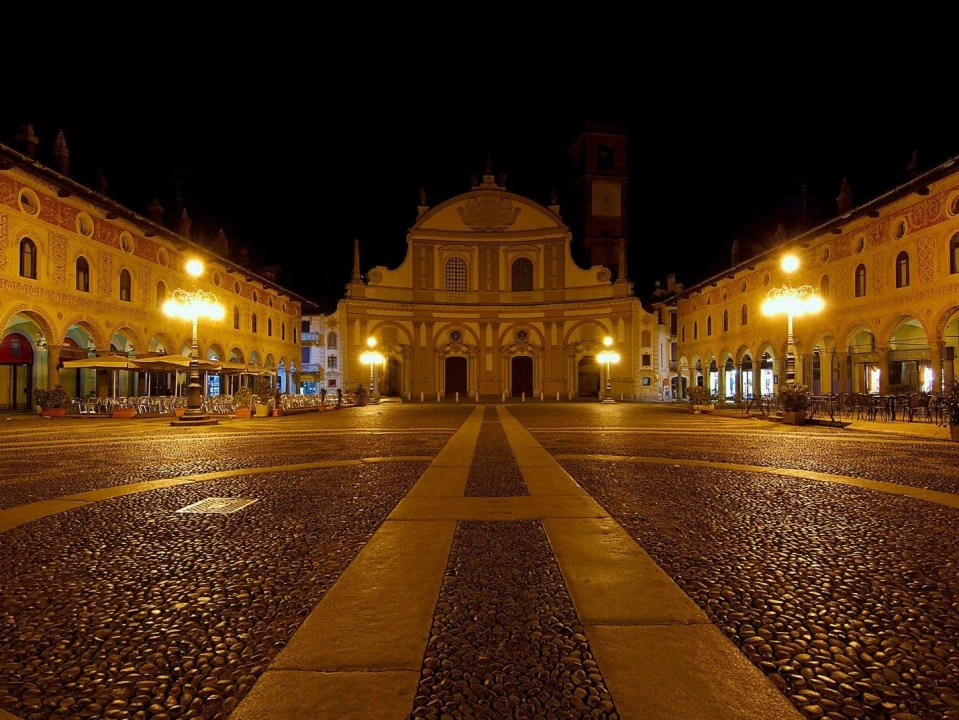
Vigevano offers a particularly magnificent introduction. Its Renaissance Piazza Ducale, associated with the court of Ludovico Sforza, is among Italy's most elegant urban spaces. Nearby, the vast Sforza Castle recalls the power of the Duchy of Milan. A short drive away, Lomello preserves the Basilica of Santa Maria Maggiore and the early Christian Baptistery of San Giovanni ad Fontes, whose origins reach back to the fifth to seventh centuries.
There is also a more intimate history. Sections of the Via Francigena, the ancient pilgrimage route toward Rome, cross the plain. In Breme, the Abbey of San Pietro recalls the role of Benedictine communities in shaping the countryside. In Mortara, centuries of local food traditions survive in goose salami, while Breme is celebrated for its sweet red onion. Rice, naturally, appears in countless versions of risotto.
For travelers accustomed to Italy's famous lakes, mountains, and art cities, Lomellina offers something less theatrical but equally distinctive: a living landscape where agriculture, architecture, and nature remain inseparable. The pleasure is in taking an unhurried road, stopping in a village, watching a heron lift off from a flooded field, and discovering how much history can hide in an apparently endless plain.