

Surrounded by the imposing mountains of central Italy, Valle Peligna is one of Abruzzo's most fascinating historical and geographical landscapes. Located in the province of L'Aquila, this broad valley combines medieval towns, ancient archaeological sites, religious monuments, agricultural traditions, and spectacular mountain scenery. At its center stands Sulmona, a city whose history and cultural identity have shaped the surrounding territory for more than two millennia.
Valle Peligna lies between the mountainous environments of the Maiella massif and the ranges connected with the central Apennines. Its landscape is characterized by a relatively open basin surrounded by dramatic peaks, creating an extraordinary contrast between cultivated fields, historic settlements, and rugged mountain slopes.
The valley takes its name from the ancient Paeligni, an Italic people who inhabited this part of central Italy before Roman domination. Their territory became increasingly integrated into the Roman world, leaving important traces of settlements, roads, and cultural exchanges.
Sulmona, known to the Romans as Sulmo, is particularly famous as the birthplace of the poet Ovid, born in 43 BC. One of the greatest literary figures of ancient Rome, Ovid remains an essential part of the city's identity.
His memory is celebrated in the historic center, where a statue dedicated to the poet stands in Piazza XX Settembre.
Sulmona's architectural heritage offers an impressive journey through different historical periods. Medieval churches, Renaissance palaces, and elegant public spaces reflect centuries of economic and cultural development.
One of the city's most recognizable landmarks is the monumental medieval aqueduct, constructed in the thirteenth century. Its series of stone arches crosses Piazza Garibaldi, creating one of the most distinctive urban scenes in Abruzzo.
The square also hosts the traditional Giostra Cavalleresca, a historical equestrian competition revived in modern times, celebrating Sulmona's medieval heritage.
Another important cultural tradition is the production of confetti, the colorful sugar-coated almonds that have made Sulmona internationally famous. Local confectionery craftsmanship dates back centuries, and the town remains strongly associated with these decorative sweets, often arranged into elaborate floral compositions.
Beyond Sulmona, Valle Peligna contains numerous villages that preserve distinctive architectural and cultural identities.
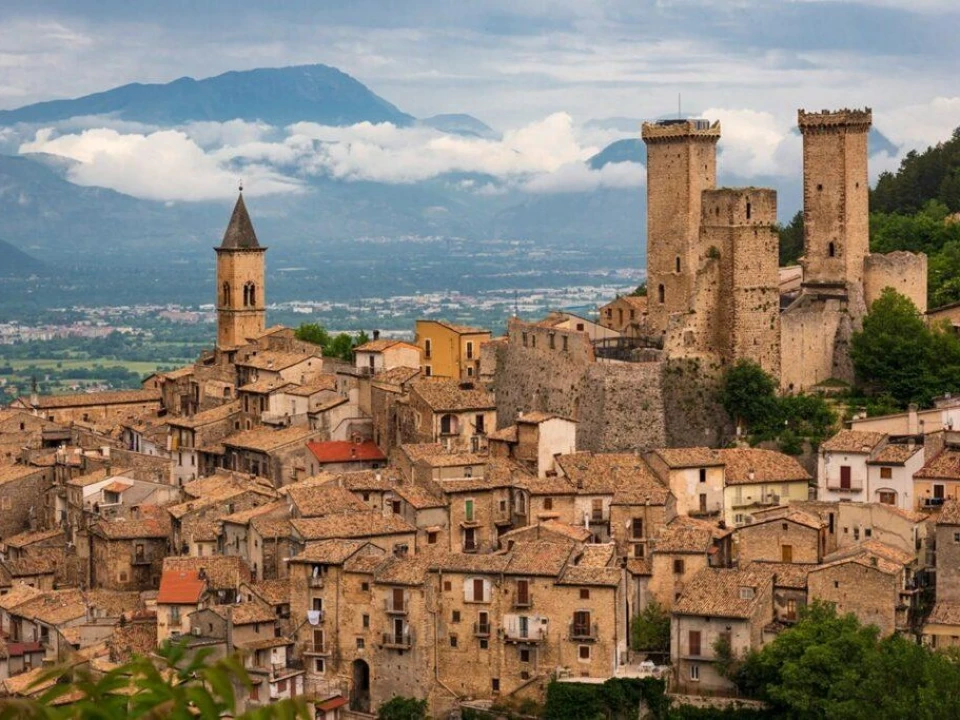
Pacentro, situated on the slopes of the Maiella, is particularly admired for its medieval appearance, narrow streets, stone buildings, and the towers of the Caldora Castle. Its historic center is recognized among Italy's most beautiful villages.
Nearby, Corfinio occupies a place of exceptional importance in Italian history.
During the Social War against Rome, beginning in 91 BC, the Italic allies established a political center at Corfinium, renaming it Italia. Coins issued by the rebels carried the name Italia, providing one of the earliest documented uses of the name in a political context.
This extraordinary episode gives the territory a special connection with the historical development of Italian identity.
Religious heritage is another defining characteristic of the valley.
Near Sulmona stands the Abbey of Santo Spirito al Morrone, an imposing monastic complex associated with Pietro da Morrone, the hermit who became Pope Celestine V in 1294.
The nearby Hermitage of Sant'Onofrio al Morrone, built into the mountainside, preserves the memory of his spiritual life and offers remarkable views across the valley.
Nature is equally important to Valle Peligna's identity.
The surrounding mountains provide access to protected landscapes, hiking trails, forests, and high-altitude environments. The Maiella National Park, established in 1991, protects an exceptional variety of ecosystems and wildlife, including the Apennine wolf, Marsican brown bear, and Apennine chamois.
The valley also serves as a gateway to mountain destinations such as Campo di Giove, where traditional villages and outdoor activities attract visitors throughout the year.
Agriculture continues to shape the local landscape. Olive groves, vineyards, orchards, and cultivated fields contribute to a regional food culture based on seasonal ingredients and longstanding rural traditions.
The territory's geographical position has historically connected mountain communities with commercial routes crossing central Italy, encouraging the exchange of products, ideas, and customs.
Today, Valle Peligna offers visitors an opportunity to discover an Abruzzo that combines celebrated historical landmarks with quieter, less familiar destinations.
Its greatest appeal lies in the extraordinary concentration of experiences within a relatively compact territory. Ancient history, medieval architecture, mountain wilderness, and living traditions coexist naturally.
From the Roman legacy of Ovid to the political history of Corfinio, from Sulmona's monumental aqueduct to the peaceful hermitages of the Maiella, Valle Peligna tells a story that reaches far beyond its geographical boundaries.
It is a landscape where the history of Italy can be explored through its towns, mountains, monuments, and people – an authentic expression of the cultural richness of inland Abruzzo.