

There is a small village perched in the mountains of Trentino called Palù di Giovo, where the roads climb steeply toward the sky and the wind carries the scent of snow even in summer. That is where it all began.
That is where a boy with powerful legs and a heart as hard as rock began training by riding downhill in the morning, knowing that when he returned, tired and exhausted, the climb back home would be waiting for him. That boy was Francesco Moser, who celebrates his 75th birthday on June 19.
For those who grew up in Italy during the 1970s and 1980s, the name Moser is more than a name. It is an emotion. It is the radio playing in the kitchen, the newspaper spread across the table, a father rising from his chair.
For those who lived those years far away, in America, in New York, Chicago, San Francisco, and the Little Italies where the aroma of Sunday gravy mixed with homesickness, the name Moser was an invisible thread leading back home. A victory by Francesco was a victory for Italians everywhere, because cyclists around the world envied Italy for having him.
Francesco Moser was born into a large and humble family: twelve siblings, fields to cultivate, vineyards to tend. His father, Ignazio, was a farmer with a passion for bicycles, and three of his sons – Enzo, Aldo, and Diego – became professional cyclists before Francesco. Although older than they were, he was different and showed little interest in cycling as a boy.
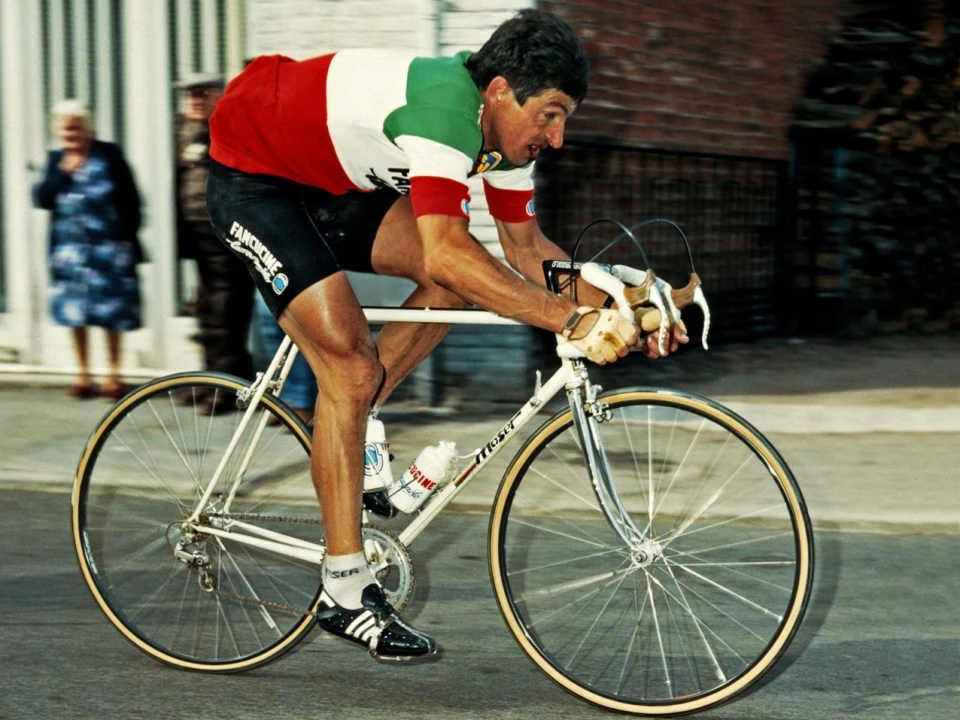
Then, at eighteen, almost by chance, he began riding seriously and immediately started winning amateur races. He turned professional at twenty-two in 1973, and the following year earned important victories at the Giro del Piemonte, Giro dell’Emilia, and Paris–Tours. In 1975, he captured his first Giro di Lombardia, and the cycling world began to take notice. Journalists gave him a nickname that would stay with him forever: “The Sheriff,” because he could command the peloton like few others, with natural authority and without ever raising his voice.
The year 1977 marked his breakthrough. In San Cristóbal, Venezuela, Moser became Road World Champion, defeating Germany’s Dietrich Thurau in a sprint finish. Italy celebrated wildly. Wearing the rainbow jersey, Moser returned to racing as if nothing extraordinary had happened, the way only the greatest champions can.
Then came Paris–Roubaix, the race known as “The Hell of the North” – 250 kilometers through northern France, mud, rain, and above all the brutal cobblestones that break bicycles and men alike. It is the cruelest race in cycling, and Moser won it three consecutive times, from 1978 through 1980. No rider has matched that achievement since. Three times he arrived alone at the Roubaix velodrome, his face covered in mud and his eyes shining. Three times he proved that the man from the mountains of Trentino could conquer the stone roads of Northern Europe.
His rivalry with fellow Italian champion Giuseppe Saronni became legendary during those years, as epic as the rivalry between Coppi and Bartali a generation earlier. They were different in every way, yet united by a destiny of competition, resentment, and mutual respect.
But the moment that made Francesco Moser immortal came on January 19, 1984. Mexico City, more than 7,000 feet above sea level, a velodrome, and a bicycle that looked as though it had come from the future: an aerodynamic frame, disc wheels, every detail engineered like a work of mechanical art. Moser was thirty-two years old. Skeptics said he was too old and that Eddy Merckx’s Hour Record – 49.431 kilometers ridden in sixty minutes – was untouchable. Few Italian journalists even traveled to Mexico City to witness the attempt.
Moser pressed on. On January 19, he covered 50.808 kilometers. He became the first man in history to ride more than fifty kilometers in one hour. Four days later, he improved the mark again to 51.151 kilometers. Merckx’s record, which had stood for twelve years, was gone.
Italy cried tears of joy. In the homes of Italian immigrants across America, bottles were uncorked in celebration. Because it was more than a sporting victory. It was proof that a boy raised in a mountain village, with twelve siblings and hands roughened by farm work, could challenge the limits of human possibility and win.
That same year, Moser also won Milan–San Remo and the Giro d’Italia. It was an unforgettable season, a masterpiece.
Moser retired in 1988 at the age of thirty-seven with 273 professional victories – more than any other Italian cyclist and the third-highest total in history behind only Eddy Merckx and Rik Van Looy. Yet he never truly stopped. He returned to the land of his childhood and, together with his brother Diego, cultivated vineyards in the Cembra Valley, producing wines that bear the family name and are now among Italy’s most respected. He made wine, built bicycles, and mentored young champions with the wisdom gained over a lifetime.
The call of cycling, however, remained irresistible. In 1994, at forty-two years old, he returned to Mexico City to attempt the Hour Record once again. He did not succeed, but he achieved the second-best performance ever recorded at the time.
Moser is a son of postwar Italy – a country poor in resources but rich in heart, an Italy that never gives up, that keeps pedaling uphill even when exhausted, that always looks ahead.
Happy Birthday, Sheriff. Seventy-five years carried the way a true champion carries himself – with grace, strength, and dignity.