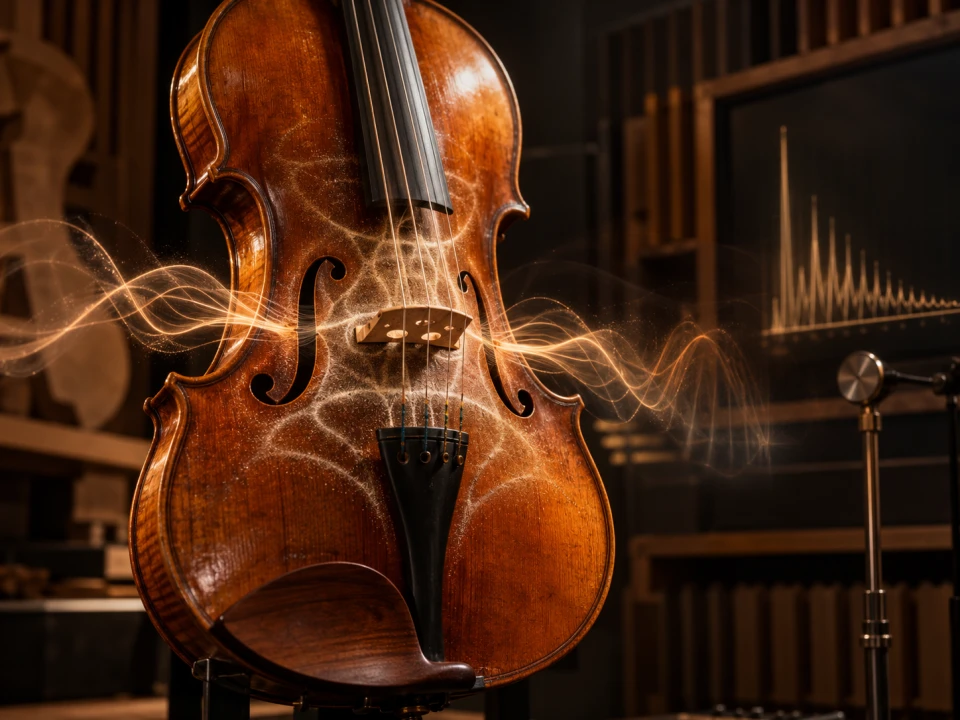

A violin can sound astonishingly like a human voice. It can whisper, cry, rise into a brilliant high note, or turn a single sustained tone into something almost spoken. In Cremona, the Italian city synonymous with Antonio Stradivari and Giuseppe Guarneri del Gesù, that expressive power begins long before a bow touches the strings. It begins with a tree.
The bow sets the strings in motion, but the wooden body gives those vibrations their character. Without that resonating shell, even beautiful playing would sound thin.
For the violin’s top plate, makers traditionally choose resonant spruce, prized for being light yet stiff enough to transmit vibrations efficiently. Maple, often used for the back, ribs, and neck, contributes strength and a different pattern of vibrations. The wood must be carefully selected and seasoned. Its grain, density, and elasticity matter, but no two pieces behave identically. A master violin maker, or liutaio, must listen to the material as carefully as a musician listens to a note.
The next secret is geometry. The curved top and back are carved to precise, varying thicknesses. A small wooden post, fitted between the plates beneath the treble side of the bridge, transfers vibrations and influences the instrument’s response. Inside, a bass bar reinforces the top while helping distribute vibration. The bridge itself is more than a support for strings: it channels their motion into the resonating body.
Even the two elegant f-shaped openings are acoustic machinery. Research at the Massachusetts Institute of Technology found that their elongated shape helps violins radiate sound efficiently, especially at lower resonances. Across generations of Cremonese makers, relatively small changes in design helped produce an instrument capable of filling a concert hall without electricity.
Then comes the most famous mystery: varnish. The glowing amber finish on a Stradivari has inspired stories about lost formulas and miraculous ingredients. But science has not established a single secret coating responsible for the legendary sound. Varnish protects the wood and can affect its vibration; treating it as the one explanation overlooks the interaction of wood, shape, construction, and the player.
Why, then, does a great violin seem to sing? When a string vibrates, it generates a fundamental pitch and many higher frequencies, called harmonics. The instrument’s body amplifies some frequencies more than others, creating a distinctive tone color. Researchers studying historical Italian violins have identified resonances resembling the formants of human singing – the frequency patterns that help us recognize vowels. A violin does not reproduce a human throat, but it can evoke one with extraordinary conviction.
Cremona’s achievement is therefore not a frozen recipe. UNESCO recognized its traditional violin craftsmanship as intangible cultural heritage in 2012, honoring an art transmitted through teaching, apprenticeship, and repeated experimentation. Today, makers still adjust arches, tap plates, and compare responses, combining inherited experience with acoustic measurement.
Perhaps the perfect violin sound is not a fixed frequency or a miraculous varnish. It is the moment when physics becomes expression – when carefully shaped wood gives a musician another voice.