
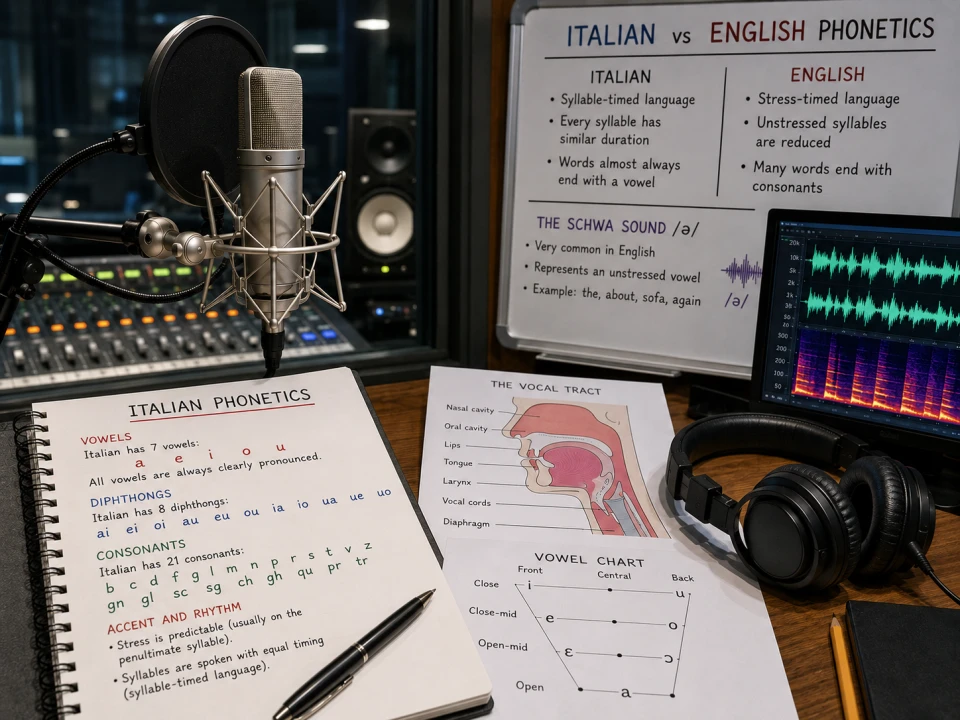

If cinema is the art of moving images, dubbing is the science that allows those images to speak a different language without losing their soul. In our Italian Sounds column, exploring dubbing means understanding a fundamental acoustic challenge: the radical contrast between the "syllable-timed" nature of Italian and the "stress-timed" nature of American English. It is a phonetic chasm that Italian professionals bridge every single day, turning a structural disparity of sounds into pure cinematic harmony.
English is a language governed by the rhythm of stresses. In an American sentence, the time between two stressed syllables is almost always constant, regardless of how many unstressed syllables fall in between; the latter are literally crushed or shortened - a phenomenon most evident in the neutral schwa sound. Italian, by contrast, is a syllable-timed language: every single syllable has a similar duration and requires a clear, round, and well-defined space of vocal emission. When a Hollywood actor delivers a fast-paced action line, their phonemes cluster into dense, lightning-fast bursts. Translating for the microphone means streamlining the Italian verbal structure - stripping away superfluous adverbs or redundant pronouns - to avoid a frantic, unnatural "machine-gun effect" in the headphones.
Another great, invisible obstacle is managing the ends of words. English is packed with words that end in sharp, hard consonants - stop consonants like T, D, K, and G - which abruptly cut off the airflow and leave the actor’s mouth in a semi-open or clenched position. Italian words, almost 100% of the time, end in a vowel. This structural characteristic requires the dialogue writer to invent clever, seamless solutions where the final Italian vowel dampens almost instantly, or blends fluidly into the next word. This technical craftsmanship prevents the audience from perceiving a distracting mismatch between the open sound they hear and the closed lips they see on screen.
Within this phonetic labyrinth, the dubbing director acts as a true symphony conductor. Success is measured not just by the dramatic acting performance, but by the frequency spectrum. Italian voice actors historically possess warm, deep voices rich in harmonics - a heritage of the nation's operatic and theatrical traditions. To ensure this acoustic "Italianness" doesn't distort the gritty, intimate, and often whispered realism of modern American cinema, studios rely on close-mic techniques. Voice actors perform just inches away from the microphone membrane, capturing the tongue clicks, tiny sighs, and micro-pauses that bridge the phonetic distance between Rome and Los Angeles.
The ultimate result is an extraordinary paradox. Through the scientific study of phonetics and the natural elasticity of the language, the Italian school succeeds in making Hollywood sound entirely native. It isn't just translation; it is the comprehensive reinvention of a global sonic code.