
Close your eyes during a trallalero performance, and the first surprise is how much seems to be happening. A high voice floats above the melody. Deeper voices gather underneath. Somewhere between them, a rhythmic sound suggests a guitar, although nobody is holding one. Everything comes from human voices, combining in one of Liguria’s most distinctive musical traditions.
Rooted in Genoa and its surrounding territory, trallalero turns group singing into an intricate exchange of contrasting sounds. Its identity depends on the relationship between individual singers, each contributing something different. The pleasure lies in hearing those differences work together: bright and dark, sustained and rhythmic, lyrical and almost instrumental.
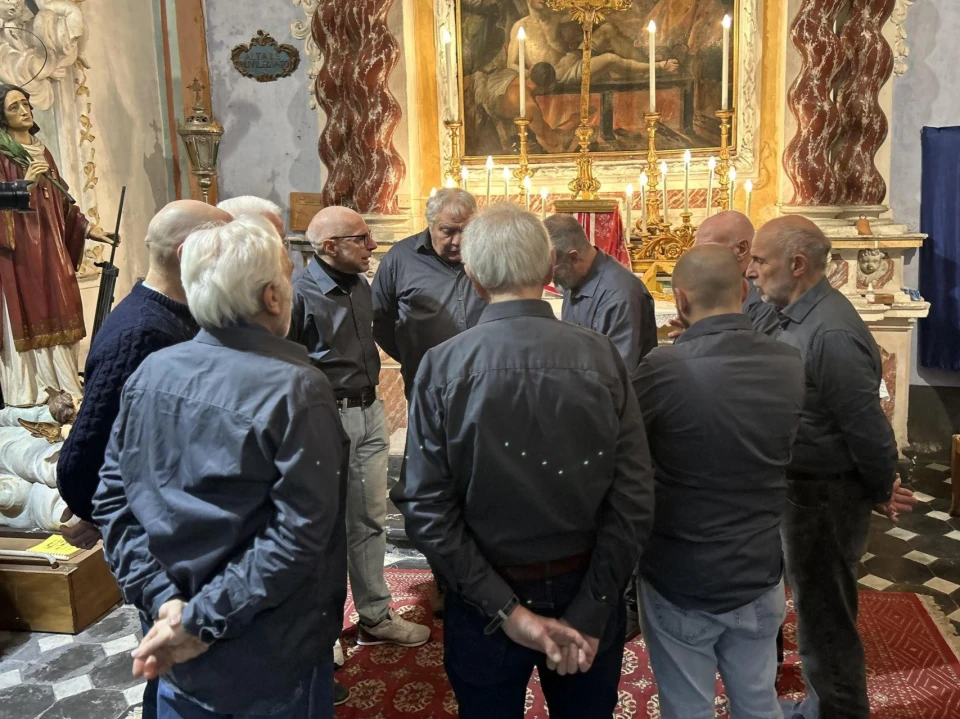
The singers organize themselves into “squadre,” or teams. The term captures both their cooperation and the neighborhood pride that historically helped sustain them. Written and oral documentation reaches back to the middle of the 19th century, although the tradition may be older. Its precise origins remain debated, making any single story about its birth difficult to establish.
What is clear is its connection with Genoa’s social life. Taverns, neighborhood meeting places, and informal gatherings provided settings where singers could listen, learn, and measure themselves against others. Organized competitions strengthened the identity of individual teams. Musical distinction brought recognition within the community, giving performers a reason to cultivate both technical skill and a recognizable collective character.
The traditional structure contains five vocal roles: tenor, contralto or falsetto, baritone, vocal guitar, and basses. These are five functions, rather than five performers. Four soloists work above a group of bass singers, whose combined sound supplies the foundation. The ensemble becomes an exercise in balance, requiring individual confidence alongside constant attention to everyone else.
The vocal guitar, called “chitàra” in Genoese, is especially striking. A baritone voice creates an instrumental effect within the texture, contributing rhythmic movement and a distinctive color. For a first encounter with trallalero, following this part offers an immediate entry point. Listen beneath the more obviously melodic voices, and the arrangement reveals another layer of activity.
Then turn toward the highest part. Traditionally sung in falsetto, it introduces a contrasting register above the lower voices. Its presence helps explain why a small group can produce such a varied sound. The effect comes from differences in timbre as much as differences in pitch: each role brings its own character to the shared musical space.
Words matter, but they sometimes give way to syllables chosen for their sound. Traditional pieces move from short texts into passages built on expressions such as “tra-la-le-ro,” which give the genre its name. Without a story demanding attention, listeners can concentrate on rhythm, melodic movement, and the interplay of voices. The sound itself becomes the main event.
Trallalero has also absorbed material from beyond its traditional repertoire. Teams adapted opera, operetta, popular songs, and compositions in both Italian and Genoese. This openness allowed familiar melodies to acquire a different identity through performance. The defining quality remained the way the singers shaped the music together.
In 1954, American folklorist Alan Lomax recorded Genoese singers at the Ritrovo dei Facchini and Bar Tugni. Those recordings, later presented in The Trallaleri of Genoa, offer an international audience a direct encounter with this remarkable vocal world.
For anyone exploring Italian sounds, trallalero rewards repeated listening. Follow one voice, then another; notice how the same passage changes when your attention shifts. What initially sounds like a single chorus gradually opens into individual contributions. Genoa’s musical ingenuity lives in that exchange, where a group of singers creates its own accompaniment, its own momentum, and its own unmistakable sense of place, carried entirely by the expressive possibilities of the human voice.