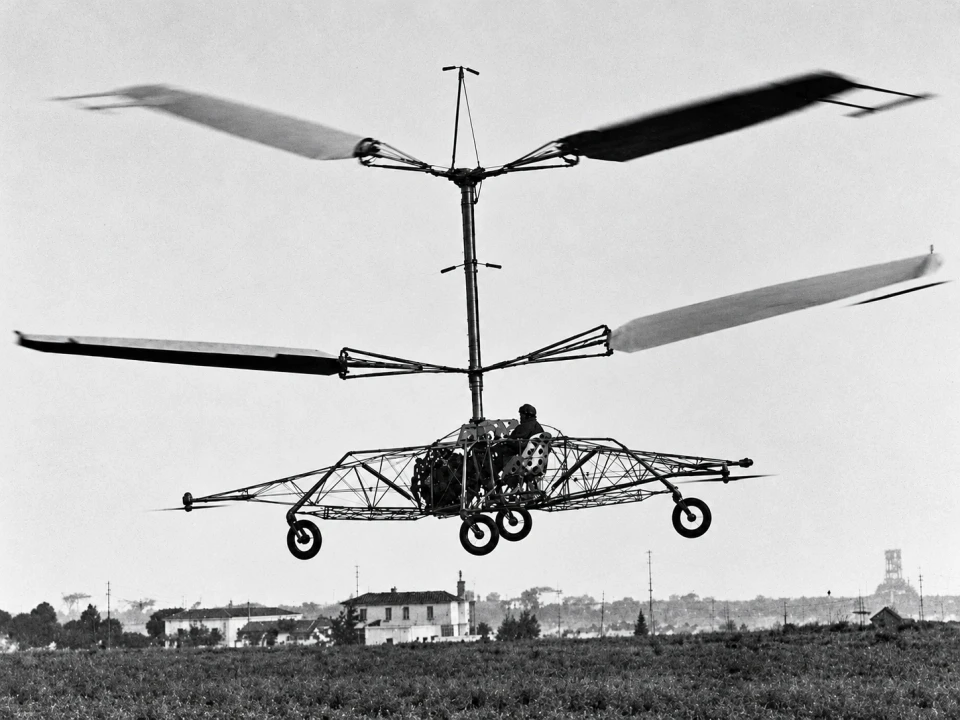

Before helicopters became indispensable to emergency medicine, military operations, transportation, and rescue missions, they represented one of aviation’s greatest engineering challenges. How could a machine rise vertically, remain suspended in the air, and move safely in any direction? Among the pioneers who helped answer that question was Corradino D’Ascanio, a brilliant Italian engineer born in Popoli, Abruzzo, on February 1, 1891.
D’Ascanio grew up fascinated by flight. In 1906, when he was only 15, he reportedly built an experimental glider using simple materials, including bedsheets. The Wright brothers had made their historic powered flight just three years earlier, and aviation was still an emerging frontier. For the young inventor, however, flying was already a lifelong obsession.
After studying mechanical engineering, D’Ascanio pursued opportunities in aeronautics. Between 1918 and 1919, he also spent time in the United States, where he worked on aircraft projects and explored the possibilities of a rapidly developing industry. His American experience was relatively brief, but it reflected an ambition that extended well beyond Italy.
Back in his homeland, D’Ascanio concentrated on a particularly difficult problem: vertical flight. Conventional airplanes needed forward motion to generate lift. A helicopter, by contrast, had to achieve lift and stability while hovering, requiring extraordinarily sophisticated mechanical solutions.
Working with Baron Pietro Trojani, D’Ascanio developed several experimental aircraft. His most significant achievement was the D’AT3, a helicopter prototype equipped with two coaxial, counter-rotating rotors. This configuration helped counteract the torque produced by the spinning blades, while innovative control mechanisms improved the pilot’s ability to manage the aircraft.
The decisive breakthrough came in October 1930 at Rome’s Ciampino Airport.
Between October 8 and 13, test pilot Marinello Nelli established three internationally recognized helicopter records aboard the D’AT3. The machine remained airborne for 8 minutes and 45 seconds, covered a straight-line distance of 1,078 meters – approximately 3,537 feet – and reached an altitude of 18 meters, or about 59 feet.
These figures may appear modest compared with modern helicopters, but in 1930 they represented an extraordinary achievement. D’Ascanio had demonstrated that a helicopter could accomplish controlled, sustained flight rather than merely make brief experimental hops.
He was not the first person to investigate rotary-wing flight, and several international pioneers contributed to helicopter development. Nevertheless, his engineering solutions and record-breaking prototype earned him an important place in the history of modern aviation.
Unfortunately, technological success did not immediately translate into commercial production. The Italian aviation authorities eventually withdrew financial support, preventing the D’AT3 from evolving into a mass-produced aircraft. D’Ascanio’s ambition to revolutionize flying remained only partially fulfilled.
Yet his engineering career took another remarkable turn.
In 1932, he began collaborating with Piaggio, then an important aircraft manufacturer. After World War II, Enrico Piaggio asked him to design an affordable vehicle suitable for a country struggling to rebuild its economy.
The result was the Vespa, introduced in 1946. D’Ascanio applied principles from aeronautical engineering to create a scooter that was comfortable, practical, mechanically accessible, and easy to ride. Its cantilevered wheel mounting reflected solutions familiar from aircraft landing gear.
The inventor who had helped helicopters rise into the sky had also transformed mobility on the ground.
Today, D’Ascanio’s legacy belongs both to the history of aviation and to the extraordinary tradition of Italian industrial design. His story also reminds us that technological revolutions do not always begin in famous laboratories or major industrial capitals. Sometimes they begin with a curious teenager in a small Abruzzo town, looking upward and imagining that human beings could fly differently.