
Sicily is internationally celebrated for its archaeological heritage, extraordinary landscapes, and centuries of cultural exchange. Yet on the eastern side of the island, in the shadow of Mount Etna, another distinctive Italian achievement has taken shape: one of Europe's most important centers for microelectronics and semiconductor technology.
Known as Etna Valley, the industrial and technological ecosystem surrounding Catania demonstrates how scientific expertise, manufacturing investment, and cooperation between universities and businesses can transform a regional economy.
Its development also challenges a familiar stereotype about southern Italy, showing that the Mezzogiorno can play a significant role in some of the world's most advanced industrial sectors.
The origins of Etna Valley date primarily to the second half of the 20th century, when electronics manufacturing began establishing a presence in the Catania area. A decisive contribution came from the operations that eventually became part of STMicroelectronics, the multinational semiconductor company created in 1987 through the merger of Italy's SGS Microelettronica and France's Thomson Semiconducteurs.
STMicroelectronics developed Catania into a major center for semiconductor research, development, and manufacturing, attracting engineers, technicians, suppliers, and specialized service companies.
Over time, the concentration of technological activities encouraged the emergence of a broader industrial district, with connections to telecommunications, information technology, electronics, and advanced materials.
The term Etna Valley, inspired by California's Silicon Valley, reflects this ambition to establish an internationally competitive technology ecosystem in Sicily.
Semiconductors are essential components of modern life. They control electrical signals in devices ranging from smartphones and computers to automobiles, medical equipment, industrial machinery, and renewable energy systems.
Their strategic importance has increased dramatically as governments and manufacturers seek to strengthen technological independence and make global supply chains more resilient.
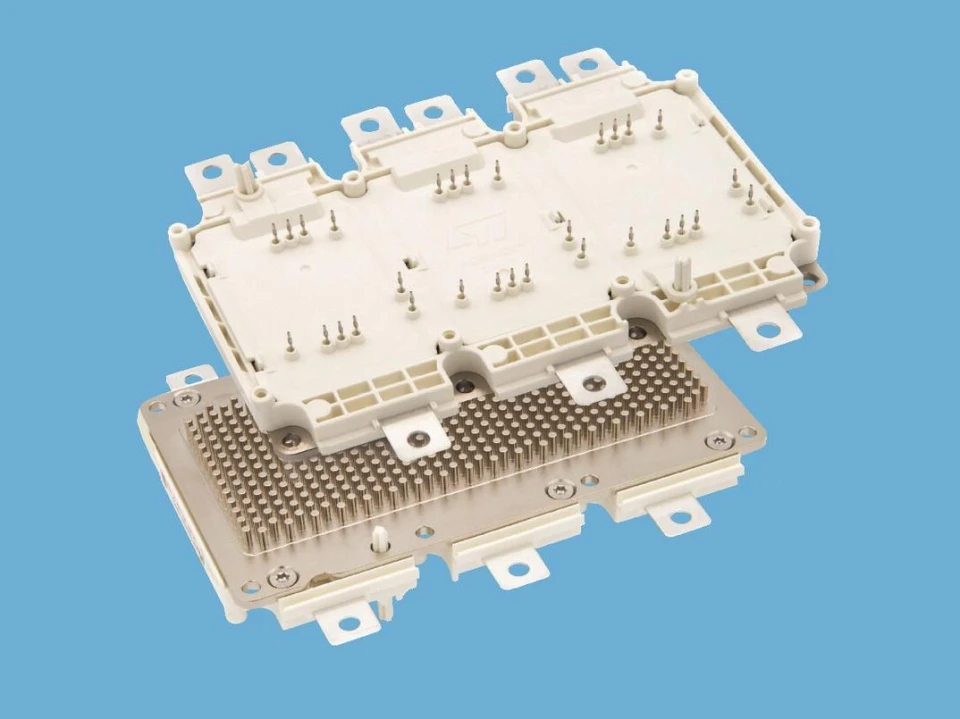
One of Catania's particular strengths is the development of silicon carbide technology.
Silicon carbide, commonly abbreviated as SiC, is a semiconductor material with properties that make it especially valuable for power electronics. Compared with conventional silicon in suitable applications, it can support higher operating voltages, greater thermal performance, and improved energy efficiency.
These characteristics are particularly important for electric vehicles, charging infrastructure, industrial power systems, and renewable energy installations.
STMicroelectronics has made Catania a central location in its silicon carbide strategy. In 2024, the company announced plans for a new integrated silicon carbide manufacturing facility in the city, representing an investment of approximately €5 billion, including public support provided within the European regulatory framework.
The project is designed to develop an integrated production ecosystem covering different stages of silicon carbide manufacturing, from substrate development to semiconductor devices.
Its significance extends beyond the investment itself. Semiconductor manufacturing requires highly specialized infrastructure, substantial research capabilities, and a skilled workforce.
A major production facility can therefore generate opportunities for suppliers, universities, research laboratories, engineering companies, and technical training institutions.
The University of Catania plays an important role in this ecosystem, providing education and research in engineering, physics, materials science, and related disciplines.
Collaboration between academic institutions and industrial companies helps prepare the professionals required by an increasingly sophisticated technological sector.
Other companies and research organizations contribute to the area's broader electronics and digital economy, reinforcing connections between manufacturing, software development, automation, and innovation.
The district also illustrates an important characteristic of Italian industrial development. While many internationally recognized Italian industries are organized around traditional manufacturing specializations, Etna Valley represents a technologically intensive model in which scientific knowledge and industrial production are closely integrated.
Its success depends not only on individual companies but also on the relationships connecting businesses, researchers, educational institutions, and public authorities.
Challenges remain. Semiconductor manufacturing is capital-intensive, global competition is strong, and technological development requires continuous investment. Energy costs, infrastructure, and the availability of qualified professionals also influence the district's long-term competitiveness.
Nevertheless, Etna Valley has established Catania as an important participant in Europe's semiconductor landscape.
For Italy, this achievement carries a broader economic and cultural meaning. It demonstrates that the country's industrial identity extends far beyond the traditional excellence of fashion, food, furniture, and automotive design.
Italian expertise also contributes to the invisible technologies that make contemporary society function.
At the foot of Europe's most famous active volcano, engineers and researchers are helping develop the electronic components that will shape future transportation, energy systems, and industrial production.
Etna Valley is therefore more than a geographical concentration of technology companies. It is evidence of Sicily's capacity to combine education, scientific research, and manufacturing excellence, connecting a territory renowned for its ancient history with some of the most advanced technologies of the 21st century.