
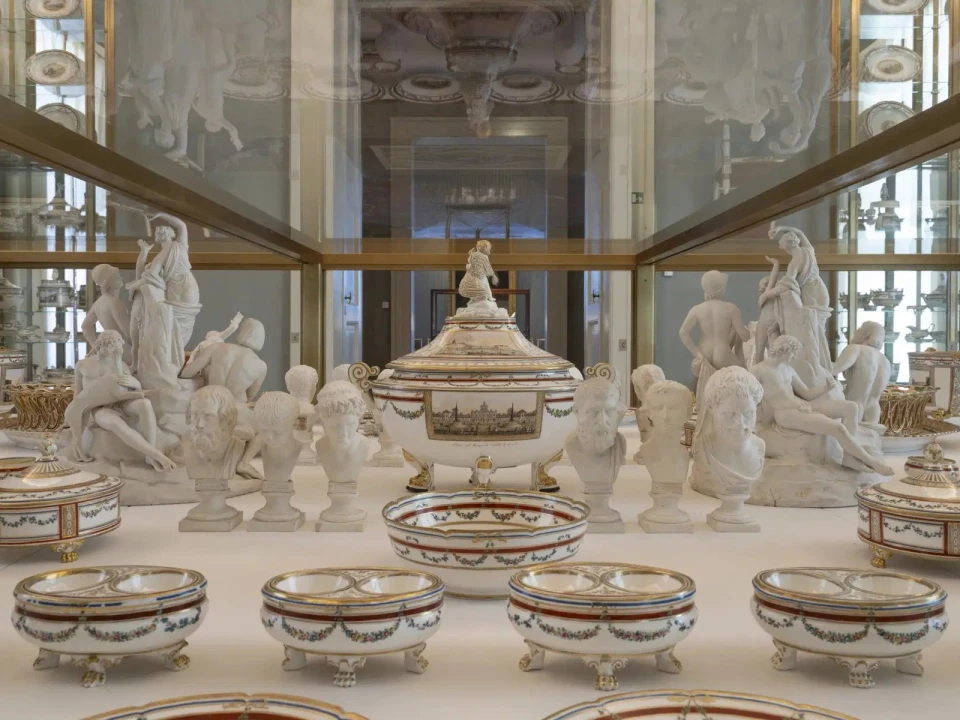

For centuries, the word “Capodimonte” has been synonymous with some of the finest porcelain ever created. Now, this extraordinary artistic heritage has finally received the grand showcase it deserves. The Museo e Real Bosco di Capodimonte in Naples has inaugurated a completely redesigned permanent Porcelain Gallery, opening 16 exhibition rooms that display more than 1,500 masterpieces selected from a collection of approximately 7,000 objects. The project transforms one of Europe's richest ceramic collections into a journey through nearly three centuries of Italian artistic excellence.
The story begins in 1743, when King Charles of Bourbon, later Charles III of Spain, established the Royal Porcelain Factory of Capodimonte. Inspired by the success of Meissen porcelain in Germany and supported by his wife, Maria Amalia of Saxony, the king sought to create an Italian porcelain that could rival the greatest European manufacturers. The ambitious project brought together leading artists, sculptors, chemists, and craftsmen, who developed a remarkably refined soft-paste porcelain distinguished by its luminous white surface, elegant modeling, and exceptional decorative quality. Within only a few years, Capodimonte had become one of Europe's most prestigious porcelain workshops.
The newly opened gallery traces this remarkable history while illustrating the evolution of European decorative arts. Visitors encounter magnificent dinner services commissioned for royal courts, exquisitely sculpted figurines, monumental vases, decorative objects, and intricate floral compositions. Many pieces belonged to the Bourbon royal collections, while others entered the museum through acquisitions and donations after the unification of Italy, creating one of the continent's most comprehensive collections of porcelain and earthenware.
The renovation itself represents a major cultural investment. Italy's Ministry of Culture allocated €1.1 million for the restoration and adaptation of the exhibition spaces, while private patrons contributed more than €700,000 toward the installation designed by renowned architect and designer Federico Forquet. The result is a contemporary exhibition that combines historical scholarship with elegant presentation, allowing visitors to appreciate not only the artistic beauty of each object but also the technological innovation behind 18th-century porcelain production.
Capodimonte porcelain occupies a unique place in the history of European craftsmanship. Producing porcelain during the 18th century required mastering one of the most closely guarded technological secrets of the age. Before European manufacturers learned how to create their own porcelain, luxury wares had to be imported from China at enormous expense. Royal factories such as Meissen, Sèvres, Vienna, and Capodimonte became symbols of scientific achievement, economic prestige, and political power. Naples distinguished itself through exceptionally naturalistic sculptures, refined figurines, and elaborate decorative compositions that continue to fascinate collectors and museums worldwide.
The reopening of the Porcelain Gallery is therefore much more than the unveiling of a museum renovation. It is a celebration of one of Italy's greatest artistic traditions and a reminder that Italian excellence extends well beyond painting, sculpture, and architecture. Every delicate cup, elaborate centerpiece, and exquisitely modeled figure demonstrates how creativity, craftsmanship, and scientific innovation came together to produce works of timeless beauty. More than 280 years after the first Capodimonte masterpieces left the royal workshops, Naples once again invites the world to discover why its porcelain remains among the crowning achievements of European decorative art.