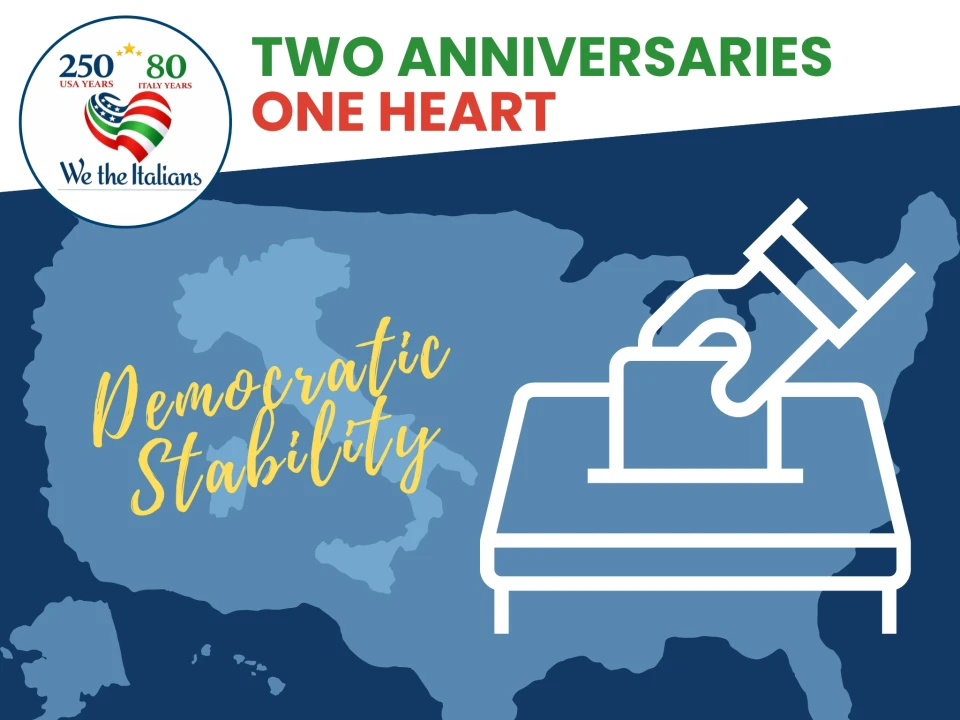
In 2026, We the Italians celebrates “Two Anniversaries, One Heart” – the 250th anniversary of the United States and the 80th anniversary of the Italian Republic. This article is part of the “Happy Birthday Italy” project, in which we explain why Italy is grateful to the United States for these past 80 years across 18 different sectors of our country’s life.
---
A Transatlantic partnership. The United States and the consolidation of Italian democracy
Over the past eighty years, one of the deepest reasons Italy can look to the United States with gratitude concerns the democratic stability achieved and consolidated in the postwar period. When World War II ended in 1945, Italy emerged materially and morally devastated: cities in ruins, infrastructure destroyed, an economy in collapse, and institutions compromised by twenty years of Fascist dictatorship. The birth of the Republic in 1946 and the entry into force of the Constitution in 1948 marked a historic turning point, yet Italian democracy remained fragile, exposed to internal tensions and to the intense international pressures of a world divided into opposing blocs.
It must also be remembered that Italy’s debt of gratitude to the United States predates the Republic itself. Between 1943 and 1945, American military intervention was essential in the Italian campaign that helped liberate the country from Fascism and Nazi occupation. Without the decisive contribution of Allied forces, led in large part by the United States – alongside the Italian Resistance and other Allies – the path to freedom and democracy would have been longer and more painful. The restoration of sovereignty and fundamental liberties was the very foundation upon which the Republic could later be built.
In the immediate postwar years, American support played a decisive role in anchoring Italy to the community of Western liberal democracies. This support was not limited to economic assistance – though that was crucial – but included a set of political, strategic, and cultural choices that helped consolidate the new republican institutions. Washington understood Italy’s geopolitical importance in the Mediterranean and Southern Europe: a frontline nation with a strong Communist party and a strategic position at the heart of the continent. Ensuring Italy’s democratic stability meant strengthening the broader European balance.
The first pillar of this support was political and institutional. The United States encouraged Italy’s integration into major Western international organizations, helping legitimize the young Republic on the global stage. Italy’s accession to NATO in 1949 was a pivotal moment: not only a military alliance, but a clear statement of alignment within the Atlantic democratic system. This international anchoring reinforced internal stability, providing a framework of security that reduced the risk of authoritarian or revolutionary drift.
A second key element was the economic support associated with the Marshall Plan. The material reconstruction of the country – infrastructure, industry, agriculture – directly contributed to political stability. A democracy plagued by hunger, unemployment, and extreme poverty would have struggled to survive. American aid helped revive production, contain inflation, and sustain employment. The economic growth of the 1950s and 1960s, often referred to as the “Italian economic miracle,” developed in part thanks to that initial boost. Widespread prosperity created a broad middle class, strengthening public support for the democratic system.
Within this broader framework, the role of the Italian American community should also be acknowledged. In 1948, during Italy’s crucial general election, many Italian Americans wrote to their families in Italy, encouraging them to support the country’s place within the free and democratic West rather than fall under the influence of the Soviet Union. At the same time, members of the diaspora advocated with their representatives in Congress to ensure that Italy was firmly included in the Marshall Plan. This dual commitment – to their ancestral homeland and to their adopted country – helped strengthen the transatlantic bond and provided tangible support for Italy’s democratic choice.
The cultural and symbolic impact of the American model should not be underestimated. In a country emerging from authoritarian rule, the example of a great constitutional democracy – with checks and balances, freedom of the press, and political pluralism – served as an important reference point. Through academic exchanges, cultural programs, scholarships, and university cooperation, a generation of Italian intellectuals, civil servants, and leaders engaged directly with American institutions and political culture. This dialogue contributed to the development of a democratic mindset grounded in respect for rules and peaceful political alternation.
During the Cold War, American support also served as a security guarantee against external pressures. Italy occupied a delicate position, with a strong Communist party and significant social tensions. Membership in the Western alliance system and the American presence on Italian soil provided a protective framework that helped prevent more serious destabilization. This does not mean that the history of the Republic was free of conflict – the Years of Lead stand as a painful example – but the international context contributed to preserving the institutional framework.
In the 1970s and 1980s, as domestic terrorism severely tested the Italian state, cooperation with the United States in the fields of security and intelligence-sharing strengthened Italy’s institutional response. Even in those difficult years, the democratic dimension remained central: the fight against terrorism unfolded within a constitutional system whose guarantees were not suspended. The resilience of the rule of law during such a complex period remains one of the Republic’s most significant achievements, and international collaboration played a supportive role.
After the end of the Cold War, the relationship with the United States continued to influence Italy’s democratic stability, albeit in different ways. European integration – encouraged and supported by Washington – further anchored Italy within a system of shared rules and democratic standards. Participation in international missions, diplomatic coordination, and multilateral cooperation reinforced Italy’s institutional culture within a global framework.
Gratitude does not imply an uncritical view or the denial of disagreements that have arisen over time. Italy and the United States have at times held differing positions on specific international issues. Yet, when considering the broader arc of the past eighty years, it is clear that American support – alongside the commitment of Italian Americans – contributed decisively to creating the conditions under which Italian democracy could take root and endure.
Democratic stability is never guaranteed. It is the result of choices, alliances, investments, and political culture. In the aftermath of war, Italy needed not only to rebuild bridges and factories, but also to restore confidence in its institutions and in its future. American support, preceded by its decisive contribution to the liberation from totalitarianism, provided a stable framework during a time of profound uncertainty. Today, eighty years later, the continuity of republican institutions, political alternation, freedom of expression, and Italy’s firm place within the community of Western democracies stand as consolidated achievements. In this long journey, the American contribution – political, economic, military, cultural, and civic – remains one of the most significant reasons Italy can look upon that relationship with historical gratitude.
Nel 2026 We the Italians celebra Two Anniversaries One Heart, i 250 anni degli Sati Uniti e gli 80 anni della Repubblica Italiana. Questo articolo fa parte del progetto Happy Birthday Italy, in cui raccontiamo perchè l'Italia è grata agli Stati Uniti per questi ultimi 80 anni in 18 diversi settori della vita del nostro Paese.
---
Una partnership transatlantica. Gli Stati Uniti e il consolidamento della democrazia italiana
Negli ultimi ottant’anni, uno dei motivi più profondi per cui l’Italia può guardare agli Stati Uniti con gratitudine riguarda la stabilità democratica conquistata e consolidata nel secondo dopoguerra. Quando nel 1945 il conflitto mondiale terminò, il nostro Paese usciva distrutto materialmente e moralmente: città bombardate, infrastrutture devastate, economia in ginocchio, istituzioni compromesse da vent’anni di dittatura fascista. La nascita della Repubblica nel 1946 e l’entrata in vigore della Costituzione nel 1948 segnarono una svolta storica, ma la democrazia italiana era ancora fragile, esposta a tensioni interne e alle forti pressioni internazionali di un mondo ormai diviso in blocchi contrapposti.
Va però ricordato che il debito di riconoscenza verso gli Stati Uniti precede la stessa nascita della Repubblica. Tra il 1943 e il 1945, l’intervento militare americano fu essenziale nella campagna d’Italia che contribuì alla liberazione del Paese dal fascismo e dall’occupazione nazista. Senza l’apporto decisivo delle forze alleate guidate in larga parte dagli Stati Uniti – accanto alla Resistenza italiana e agli altri Alleati – il percorso verso la libertà e la democrazia sarebbe stato più lungo e più doloroso. La riconquista della sovranità e delle libertà fondamentali costituisce il presupposto stesso su cui si è potuta edificare la Repubblica.
In questo contesto, il sostegno degli Stati Uniti nel dopoguerra ebbe un ruolo decisivo nell’ancorare l’Italia al campo delle democrazie liberali occidentali. Non si trattò soltanto di un aiuto economico – pur fondamentale – ma di un insieme di scelte politiche, strategiche e culturali che contribuirono a consolidare le nuove istituzioni repubblicane. Washington comprese l’importanza geopolitica dell’Italia nel Mediterraneo e in Europa meridionale: un Paese di confine, con un forte partito comunista e con una posizione strategica nel cuore del continente. Garantire la stabilità democratica italiana significava rafforzare l’intero equilibrio europeo.
Il primo pilastro di questo sostegno fu politico-istituzionale. Gli Stati Uniti favorirono l’inserimento dell’Italia nelle principali organizzazioni internazionali occidentali, contribuendo a legittimare la giovane Repubblica sul piano globale. L’adesione alla NATO nel 1949 rappresentò un passaggio cruciale: non solo un’alleanza militare, ma una scelta di campo che collocava l’Italia in modo chiaro nel sistema delle democrazie atlantiche. Questo ancoraggio internazionale rafforzò la stabilità interna, offrendo una cornice di sicurezza che riduceva il rischio di derive autoritarie o rivoluzionarie.
Un secondo elemento fu il sostegno economico legato al Piano Marshall. La ricostruzione materiale del Paese – infrastrutture, industria, agricoltura – contribuì in modo diretto alla stabilità politica. Una democrazia affamata, disoccupata e impoverita avrebbe avuto poche possibilità di consolidarsi. Gli aiuti americani permisero di rilanciare la produzione, contenere l’inflazione, sostenere l’occupazione. La crescita economica degli anni Cinquanta e Sessanta, il cosiddetto “miracolo italiano”, si sviluppò anche grazie a quel primo impulso. La prosperità diffusa creò una classe media ampia, rafforzando il consenso verso il sistema democratico.
In questo quadro va ricordato anche il ruolo della comunità italoamericana. Nel 1948, durante le decisive elezioni politiche italiane, molti italoamericani scrissero alle proprie famiglie in Italia, incoraggiandole a sostenere la permanenza del Paese nel campo dell’Occidente libero e democratico e a non cadere sotto l’influenza dell’Unione Sovietica. Allo stesso tempo, negli Stati Uniti, esponenti della diaspora si mobilitarono presso i loro rappresentanti al Congresso affinché l’Italia fosse inclusa con decisione nel Piano Marshall. Questo doppio impegno – verso la madrepatria e verso il Paese di adozione – contribuì a rafforzare il legame transatlantico e a sostenere concretamente la scelta democratica italiana.
Non va sottovalutato neppure l’impatto culturale e simbolico del modello americano. In un Paese che usciva da un regime autoritario, l’esempio di una grande democrazia costituzionale, con un sistema di pesi e contrappesi, libertà di stampa e pluralismo politico, rappresentava un punto di riferimento. Attraverso scambi accademici, programmi culturali, borse di studio e cooperazione universitaria, si formò una generazione di intellettuali, funzionari e dirigenti italiani che ebbero modo di confrontarsi con le istituzioni e la cultura politica statunitense. Questo dialogo contribuì a rafforzare una mentalità democratica, basata sul rispetto delle regole e sull’alternanza politica.
Durante la Guerra Fredda, il sostegno americano fu anche una garanzia di sicurezza contro eventuali pressioni esterne. L’Italia si trovava in una posizione delicata, con un forte partito comunista e tensioni sociali significative. L’appartenenza al sistema di alleanze occidentale e la presenza americana sul territorio offrirono una rete di protezione che contribuì a evitare destabilizzazioni più gravi. Ciò non significa che la storia repubblicana sia stata priva di conflitti – basti pensare agli anni di piombo – ma la cornice internazionale contribuì a mantenere saldo l’impianto istituzionale.
Negli anni Settanta e Ottanta, mentre il terrorismo interno metteva a dura prova lo Stato, la cooperazione con gli Stati Uniti nel campo della sicurezza e dello scambio informativo rafforzò la capacità di risposta delle istituzioni italiane. Anche in questo caso, la dimensione democratica rimase centrale: la lotta al terrorismo si svolse all’interno di un sistema di garanzie costituzionali che non vennero sospese. La tenuta dello Stato di diritto in un periodo così complesso rappresenta uno dei successi più importanti della Repubblica, e la collaborazione internazionale contribuì a sostenerlo.
Con la fine della Guerra Fredda, il rapporto con gli Stati Uniti continuò a incidere sulla stabilità democratica italiana, seppur in modo diverso. L’integrazione europea, sostenuta e incoraggiata da Washington, rafforzò ulteriormente l’ancoraggio dell’Italia a un sistema di regole condivise. La partecipazione a missioni internazionali, il coordinamento diplomatico e la cooperazione multilaterale consolidarono la cultura istituzionale italiana in un contesto globale.
La gratitudine non implica una visione acritica o la negazione delle divergenze che nel tempo non sono mancate. Italia e Stati Uniti hanno avuto, e talvolta hanno ancora, posizioni differenti su specifiche questioni internazionali. Tuttavia, guardando all’arco complessivo degli ultimi ottant’anni, appare evidente come il sostegno americano – affiancato dall’impegno degli italoamericani – abbia contribuito in modo determinante a creare le condizioni affinché la democrazia italiana potesse radicarsi e durare.
La stabilità democratica non è mai un risultato scontato. È il frutto di scelte, alleanze, investimenti e cultura politica. Nel dopoguerra, l’Italia aveva bisogno non solo di ricostruire ponti e fabbriche, ma anche fiducia nelle istituzioni e nel futuro. L’appoggio degli Stati Uniti, preceduto dal contributo decisivo alla liberazione dal totalitarismo, fornì un quadro di riferimento stabile in un’epoca di profonde incertezze. Oggi, a distanza di ottant’anni, la continuità delle istituzioni repubblicane, l’alternanza politica, la libertà di espressione e l’inserimento dell’Italia nel sistema delle democrazie occidentali rappresentano risultati consolidati. In questo percorso, il contributo americano – politico, economico, militare, culturale e civile – costituisce una delle ragioni più significative per cui l’Italia può guardare a quella relazione con riconoscenza storica.