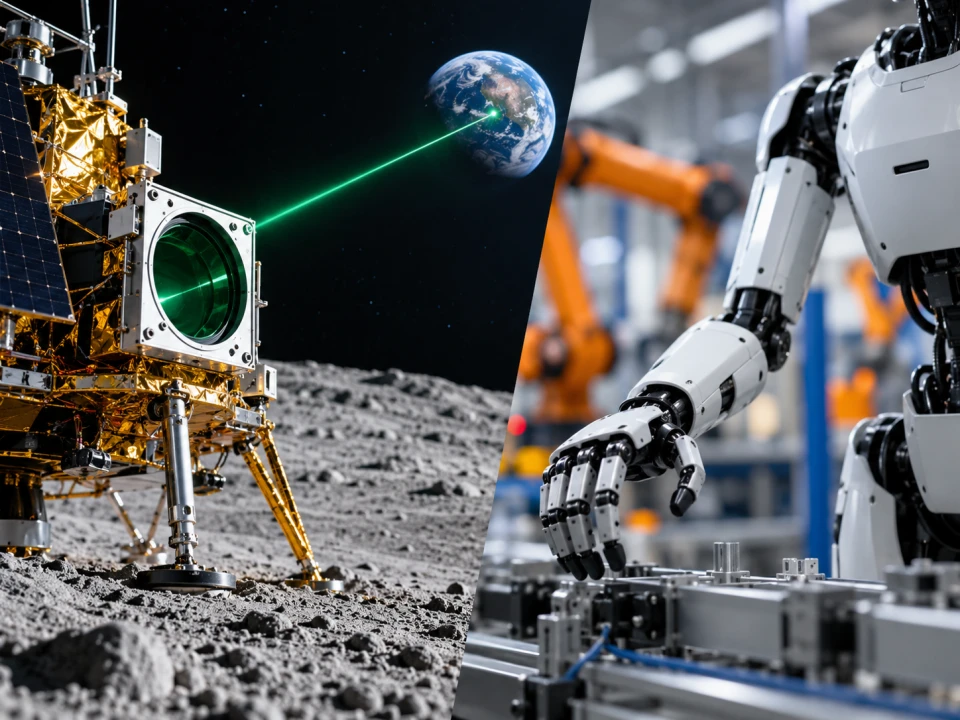
Two ambitious projects announced in October 2026 demonstrate how Italian research is helping shape the next generation of technology – from measuring the Moon with extraordinary accuracy to teaching humanoid robots to work safely in factories. Both highlight the importance of scientific and industrial cooperation between Italy and the United States.
In space, an Italian-designed laser reflector is preparing for a 2027 journey to the lunar surface aboard the IM-3 mission operated by American company Intuitive Machines. The instrument, known as MoonLIGHT, was developed by Italy’s National Institute for Nuclear Physics (INFN) in collaboration with the University of Maryland.
The mission will land in the Reiner Gamma region. A precision pointing mechanism called MPAc, supported by the European Space Agency, will orient the reflector toward Earth. Ground observatories will send laser pulses to the Moon and measure how long the reflected light takes to return.
The Moon is approximately 384,400 kilometers from Earth on average, and the laser round trip takes about 2.5 seconds. The objective is to improve measurement precision from centimeters to millimeters. Unlike the arrays of smaller reflectors installed during the Apollo missions more than 50 years ago, MoonLIGHT uses a single large reflector that produces a sharper return signal.
These measurements could reveal new information about the Moon’s internal structure and enable more precise tests of gravitational physics. Italy’s Matera Laser Ranging Observatory will participate alongside facilities in France, Germany, and the United States, continuing a remarkable tradition of transatlantic scientific cooperation.
Back on Earth, Italian company Generative Bionics has announced plans for a 5,000-square-meter facility designed to train humanoid robots for industrial applications. Presented at CES Unveiled Milan on October 21, the project is scheduled to become operational by the fourth quarter of 2027.
The facility will be the first in a planned network of 3 locations, followed by another European center and a third serving international markets. Its centerpiece will be GENE.01, an Italian-developed humanoid equipped with advanced sensors and artificial skin capable of recording movement, pressure, proximity, and physical contact.
Inside reconstructed industrial environments, robots will practice real tasks while collecting valuable information. Digital twins will reproduce those experiences through thousands of simulated scenarios, allowing engineers to refine performance, reliability, and safety before commercial deployment.
American semiconductor company AMD will provide technological support through its Helios artificial intelligence computing infrastructure. AMD Ventures also participated in Generative Bionics’ €70 million seed funding round, reinforcing the importance of American investment in Italian technological development.
The facility’s exact location and construction budget have not yet been announced. Nevertheless, the project represents an ambitious step toward industrial robotics that can operate alongside human workers.
Although these initiatives addre