
An evening of dance, young talent, and international artists culminated in the presentation of the Fini International Dance Awards at the Ailey Citigroup Theater.
These were the ingredients of the 16th edition of the Fini Dance Festival, which once again brought together international artists, emerging young dancers, and influential figures from the dance world for an evening dedicated to talent, opportunity, and the power of dance to bridge generations and cultures.
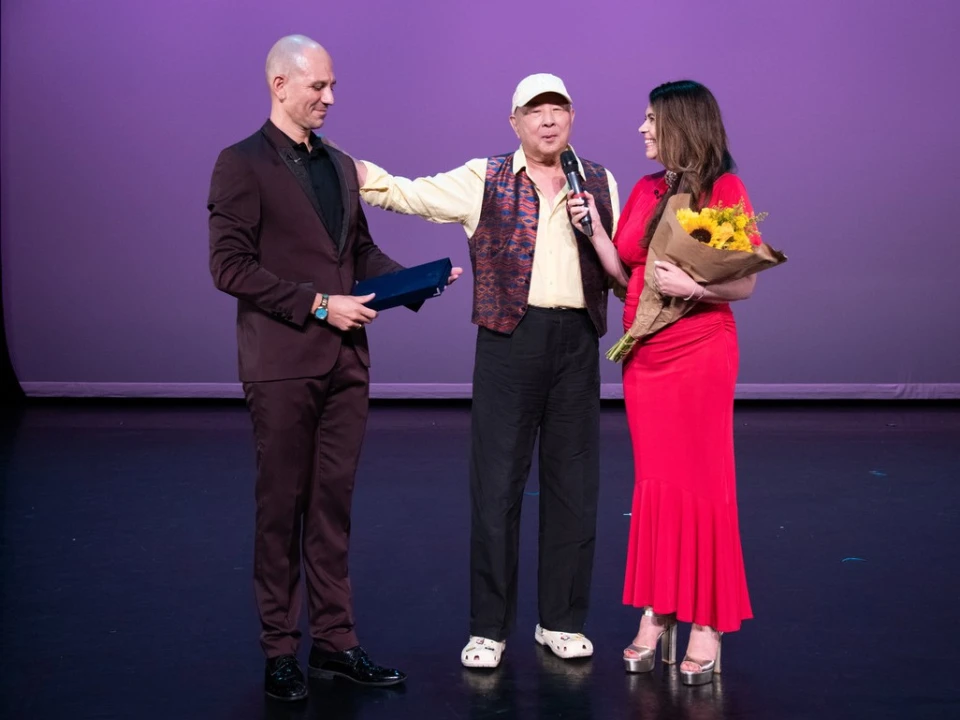
Hosted by founder and artistic director Antonio Fini alongside television host and producer Ornella Fado, the evening served as the highlight of Fini Dance’s summer journey between Italy and New York. The program featured performances ranging from classical ballet to contemporary dance, and from modern to urban dance styles, concluding with the presentation of the Fini International Dance Awards.
The curtain rose on an explosion of Italian energy: a contemporary Tarantella performed by dancers from the Fini Dance Summer Intensive. The piece blended Mirko Giordano’s urban movement style with the choreography of Gianni Santucci, an artist whose career spans ballet, opera, film, and television. Special guest Jillian Pizzi from the Staten Island Ballet joined the young dancers on stage, bringing to life an encounter between tradition and contemporary movement.
Fini, who chose not to dance during this year’s gala in order to focus on hosting duties, welcomed the audience alongside Ornella Fado, whose professional career as a dancer, television personality, and producer was introduced through a video tribute.
The program continued with Clutch, performed by Andrea De Giosa and Maddalena Sbaragli—two young dancers supported by MarcoBaleno, an organization that has helped young Italian artists travel to the United States for nearly a decade by funding their travel and educational experiences. Dressed in white, De Giosa and Sbaragli appeared almost as two conflicting angels, parting and reuniting through a contemporary duet built on tension, connection, and harmony.
The evening then addressed an important social issue with Tilted Glass, choreographed by Isaak Iska. Through contemporary movement and striking imagery, the piece offered a perspective on autism, bringing to the stage a theme that is still rarely depicted through dance. It was a work that reminded the audience how art can bring visibility to different ways of experiencing and perceiving the world.
The program also showcased the work of Italian choreographer Mirko Giordano. His piece, What No One Sees, tackled the sensitive issue of domestic violence. Giordano’s relationship with Fini Dance began several years ago when he became the first Italian artist brought to New York through Mare Nostrum Elements, directed by Nicola Iervasi.
This year, his work returned to the New York stage under unexpected circumstances: an injury prevented Giordano from performing live as originally scheduled. As a result, the audience viewed an art video directed by Christian Gargarelli, featuring makeup by Angie Valentino, and starring Serena Valentino and Giordano himself.
Following the screening, Ornella Fado presented Giordano with a traditional Neapolitan good-luck horn (cornetto), wishing him a speedy recovery and a prompt return to the New York stage.
Next came Dzul Dance, under the artistic direction of Javier Dzul, performing Shadow Water—a visually stunning piece combining sculpted bodies, contemporary movement, and mesh costumes. The interplay of fabric, lighting, and the dancers’ bodies cast ever-shifting shadows across the stage, heightening the physical and theatrical power for which Dzul’s work is known.
Humor then took center stage with Ballet Eloelle / Grandiva, showcasing their trademark combination of classical ballet technique and comedy. Behind the deliberately exaggerated personas, male dancers on pointe, and comic timing lies the rigorous classical technique that has garnered the company international acclaim.
The Fini Dance Junior Company followed with Black Madrigal Suite, choreographed by Michael Mao and performed by Antonio Caligiuri, Andrea De Giosa, Ediberto Maione, Raffaele Onisti, Vincenzo Vitiello, Serena Valentino, Martina Barone, Greta De Giosa, Debora Tateo, Maddalena Sbaragli, and Marta Didonna, with the participation of Gary Champi. The performance ushered the audience toward the concluding portion of the evening, dedicated to the awards presentation.
THE FINI INTERNATIONAL DANCE AWARDS
The first Rising Star Award went to Giuliano Ruocco, whose artistic journey has become closely intertwined with Fini Dance’s mission. Before accepting the award from Antonio Fini, Ruocco performed an excerpt from La Sylphide alongside Ayne Kim.
In his acceptance speech, the young Italian dancer expressed his gratitude to the teachers who have guided him along the way, as well as to America for welcoming him and allowing him to pursue his dream. He brought down the house with a closing joke, stating that he could not wait to begin his professional life—and to “pay taxes in America.”
The second honor went to Itzkan Dzul Barbosa, currently a dancer with BalletX, who received the Best Dancer Award. Dressed in a vibrant red gown with her hair down, Dzul Barbosa performed the solo Abandoned on pointe, demonstrating not only her technical prowess in ballet but also the dramatic and expressive depth that distinguishes her as an artist.
The award was presented by Julia Dubno, director of Ballet Academy East in New York.
One of the most moving moments of the evening featured Leslie Andrea Williams, Principal Dancer with the Martha Graham Dance Company, who performed Spectrum 1914 and received the Extraordinary Dancer Award.
The award was presented by Terese Capucilli, an iconic figure in the Graham world, whose own career is intimately tied to the work, having reconstructed its choreography in the 1990s. Capucilli spoke with deep emotion about the importance of opening doors for young dancers and how an opportunity seized at the right moment can help a young artist evolve into an extraordinary performer.
The evening culminated in the presentation of the Lifetime Achievement Award to Michael Mao, honoring a lifetime devoted to choreography, performance, and the mentorship of generations of dancers.
Prior to the award presentation, four dancers from Graham 2 performed Mao’s Weaving, an athletic and rhythmically compelling modern piece in which dancers continuously cross paths and separate through quasi-tribal movement patterns.
The piece carries personal resonance for Antonio Fini, who specifically requested that Weaving be included in the program. Having danced the choreography himself early in his career, Fini recalled the extraordinary physical sensation he felt as a performer: “When I danced Weaving, it made me feel like a god.”
That personal connection encapsulates the very spirit of this 16th edition of the Fini Dance Festival: established artists passing down their experience to new generations, young dancers given a stage on which to discover themselves, and dance serving as a universal language uniting Italy and New York.
From students arriving in the United States for the first time to internationally recognized performers and dance icons sharing the same stage, the evening reflected the mission that has driven Fini Dance since day one: creating opportunities, building bridges, and allowing talent to travel across borders.
A Cry for Help Through Dance
Last but not least, a special choreography was presented, born from the desire to give a voice to all women who are victims of violence—transforming pain into movement and silence into a cry for help. The project was spearheaded by Comites NY and brought to life through the Fini Academy.
Every gesture tells a story: fear, loneliness, anger, but also the strength to fight back and start anew. The dancers' bodies become words, while the score accompanies an emotional journey that navigates through anguish toward awareness and hope.
The dance does not simply depict suffering; it conveys the possibility of breaking chains, reclaiming one's freedom, and asking for help. The falls represent wounds; the restrained movements, a sense of oppression; and the final opening of the body symbolizes rebirth and the discovery of newfound strength.
This choreography is intended as a message to all women: you are not alone, violence is never your fault, and asking for help is an act of courage. Through the voice of dance, pain becomes a testament, and fragility is transformed into energy, resilience, and hope.