
The Statue of Liberty has graced Bedloe’s Island (now known as Liberty Island) since 1886. A shining symbol of freedom and opportunity, the iconic figure has been a welcoming sight for millions of immigrants.
In 1890, when Congress decided to replace Castle Garden with a federal immigration facility, Bedloe’s Island seemed the perfect place. So why was Ellis Island chosen instead?
Throughout the 1880s, American industry needed workers. Thousands of underemployed Italians were eager to help, but couldn’t afford to leave Italy. Padrones furnished a solution, offering free steamship tickets in exchange for a cut of the emigrants’ wages in America. The scheme, dubbed the contract labor system, enabled the arrival of large numbers of Italians. Alarmed by the massive influx, Congress passed the Alien Contract Labor Law in 1885. But the statute had little effect. Between 1885 and 1888, the growth rate of Italian immigration far outpaced that of any other nation.
Labor union complaints prompted the New York Herald to call for an investigation. In July 1888, Melbourne Ford spearheaded a House Select Committee to uncover violations of the 1885 law. The editor of the Herald noted he had, “at last induced Congress to take up the vast and urgent question of forced and fraudulent immigration. The system under which thousands upon thousands of Italians were lured to New York upon the representation that they could get work . . . has awakened Congress to a sense of the danger.” At the conclusion of the hearings, the members of Ford’s group unanimously agreed, “the enforcement of all acts designed to regulate immigration should be entrusted to the Federal Government, and not to the States.” Castle Garden, operated by the State of New York, would close.
Secretary of the Treasury William Windom was tasked with establishing the new bureau. In February 1890 he reviewed potential locations in New York Bay but rejected each in turn. Castle Garden, Staten Island and Governor’s Island: all discarded. He inspected Ellis Island but saw no advantage in using it. The Navy stored ammunition there, and shallow waters prevented the landing of ships, so it was removed from consideration. Windom chose Bedloe’s Island as the site for the new installation. “It did not seem inappropriate, that on the first landing of the immigrants upon our shores, the first thing they should see would be the Goddess of Liberty . . . as she lighted their way up the harbor and welcomed them to America.”
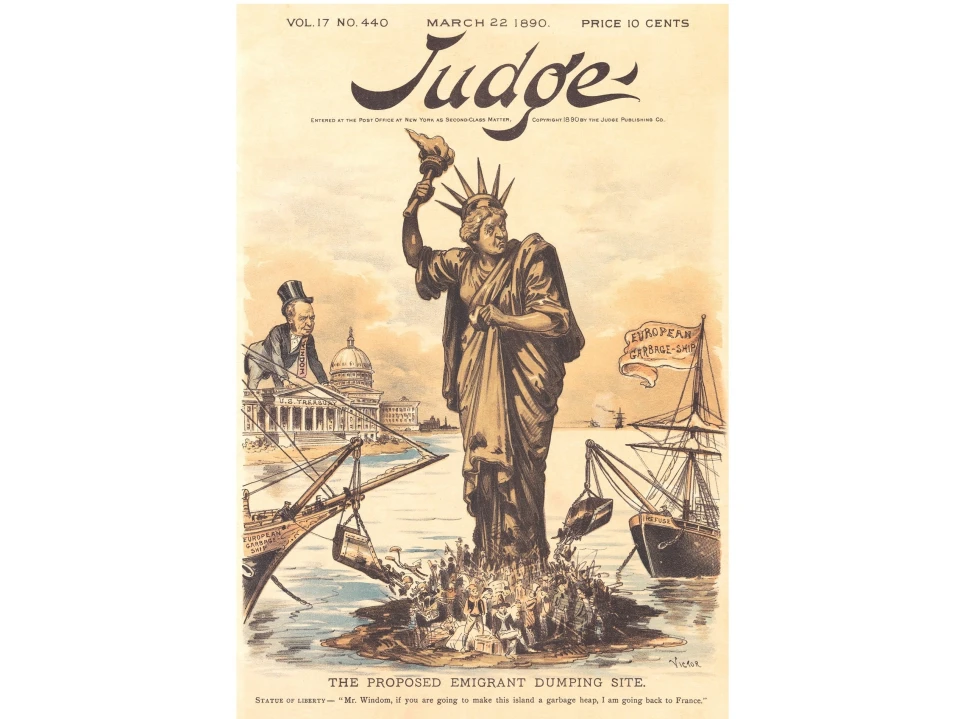
However, Windom’s choice sparked an uproar. One official suggested, “the Goddess of Liberty would gather up her skirts in disdain and contempt . . . and the arrival of the immigrants upon our shores would contaminate her.” Judge magazine depicted a disgusted Lady Liberty pulling her gown from a horde of immigrants swarming at her feet. A reporter at the New York World wrote: “Windom may be balked in his determination to establish an immigrant station on Liberty Island. The fact that the pretty island had been selected . . . has aroused every citizen of New York and the adjoining country to look upon the scheme as an outrage which should not be tolerated.”
When a group of congressmen resolved to survey the harbor, the editor of the New York World reported: “It’s dollars to doughnuts that they will unanimously agree to save the little island already consecrated to Liberty. They will be treated to an edifying spectacle also, for 1,600 Italian immigrants will be landed at the Garden that day.”
Windom bowed to pressure: “The careful examination we made of Bedloe’s Island induced me to think that it was entirely practicable and would be a very satisfactory place. I now find that, in the estimation of some people, I was very much mistaken.” Within weeks, Congress designated Ellis Island as the location of the proposed bureau. President Harrison endorsed their decision.
A jubilant New York World proclaimed: “Liberty Island is saved! The Goddess holds her own, and the touch of the vandal will not desecrate the tiny island where she has her majestic stand. Liberty and her island, forever!” Ellis Island became the home of America’s storied immigration center, and a half mile of open water kept foreigners from the Statue of Liberty. Congressional prejudice, union pressure and the “forced and fraudulent immigration” of Italians determined, in large part, the site of America’s historic gateway.