
Transatlantic Enlightenment explores the shared Enlightenment heritage linking Italy and the United States, from the eighteenth century to the present. Each article examines the ideas, people, institutions, that have shaped this enduring transatlantic dialogue. (Edited by Amedeo Arena)
What do the United States of America and the Republic of Venice have in common? The question was raised in Italy during the celebrations for the 250th anniversary of the Declaration of Independence, above all in the press. Many elements have aroused public curiosity. The Republic of Venice disappeared in 1797 as a result of Napoleon’s descent into Italy, in the very year in which George Washington’s presidency ended and John Adams’s began. Venice, ceded to Austria, remained under foreign occupation and soon turned into a myth: the myth of lost liberty. The system of government of the ancient republic, now defunct, seemed to evoke models of political virtue with a long tradition. The Doge, as head of state, had powers that were tightly constrained; internal equilibrium was secured by well-tested constitutional machinery, a mixed government in which Doge, Senate and Great Council checked and balanced one another, so that no single body could prevail over the others. This system exerted a certain fascination in the American colonies. There are even letters by Filippo Mazzei, the Tuscan Enlightenment figure who moved to Virginia in 1773, in which he discusses with Thomas Jefferson and James Madison the features of Venetian government and the method devised to prevent tyranny in a republican system, emphasising the rotation of offices, the complexity of electoral procedures and the mutual controls among the powers of the state.
The analogies, however, end there. The republicanism of the American founders has, in its principles, little in common with the ancient and oligarchic republicanism of the Republic of Venice. The fundamental principle proclaimed by the Declaration of Independence, that all men are created equal and endowed with unalienable rights, was unknown in Venice, where political liberties were reserved to a privileged body, namely the nobility; the cittadini originari, legitimately born Venetians whose families had abstained from manual trades for three generations, enjoyed reserved access to the ducal chancery and the state bureaucracy, but not to the Great Council. Liberty in the Serenissima was a regulated liberty, under the vigilance of the organs of government, and always conceived according to the ancient notion of liberty as independence from external interference, not as individual freedoms. Equality in Venice was conceived only within specific social groups, not as formal equality before the law. Even Voltaire, who described the city as an ‘asylum of liberty’ and defended its original independence, understood that liberty as freedom from any external power, rather than as a safeguard of personal freedoms.
The container, therefore, must never be confused with the content. The form of state and the internal mechanics of institutions are merely a shell, beyond which one must always inquire more deeply into the true founding features of republicanism. The great debate that arose from Enlightenment culture in the second half of the eighteenth century concerned precisely whether, and how, a republican experience of the moderns, distinct from that of the ancients, could be built, made recognisable and guaranteed through a written constitution. The discussion involving Jefferson, Madison and Mazzei, as they confronted the history of the Republic of Venice, reflects precisely this search for methods and solutions that would go beyond a mere mechanics of institutional balance within the republic and fill the subject with new content. This is also one of the reasons why so many Europeans and Italians, from Venice to Naples, followed events in the American colonies with curiosity and interest.
Italian Enlightenment culture was well aware that modern republicanism had to resolve important problems that the ancient republics, such as Venice, had failed to clarify. One of these was the tension between liberty and equality; alongside it stood the question of how to protect individual rights and how to give effect to the principle of political representation. All these aspects of modern republicanism, painstakingly worked out through the American Constitution, are absent from the Venetian tradition. Likewise, the republican tradition of the old Italian states still lacked the other cornerstone of modern republicanism: the idea of a written constitution capable of guaranteeing the inviolability of the rights of man.
It is therefore necessary, whenever we look at the ancient republics and compare them with the modern ones born in the wake of the Enlightenment, to ask what the true spirit of republicanism is. It is the content that defines the container, and this can be properly understood only from an authentically historical perspective, that is, through genuine knowledge of political and cultural contexts. Modern republicanism was born amid the profound transformations of the global context brought about by the economic changes of the late eighteenth century. The growth of international trade and the rise of the market economy generated new forms of inequality, deep social imbalances and a repositioning of moral values in the face of economic injustice, conflict and slavery. Confronted with these changes, many realised that the spirit of republicanism had to be strengthened, and that strong elements of novelty, such as the defence of the rights of the human person, had to be grafted onto the ancient republican tradition.
Although the Republic of Venice, too, was forced to reflect on its position within this economic cycle and tried to escape its relative marginality with respect to the growth of Atlantic trade, its internal political debate remained deadlocked throughout the eighteenth century between calls for reform and conservative pressures. The debate on the rights of man, the cornerstone of modern republicanism, found no fertile ground. The desire for economic and political reform clashed with the concern to preserve tradition. The last attempt to reform the ancient Venetian constitution took place in 1780, in the hope of going beyond a mere renewal of the mechanisms of government and of introducing the free circulation of property, civil equality and the abolition of fiefs. Its protagonists, however, among them Zorzi Pisani and Carlo Contarini, two prominent members of the Venetian aristocracy, were arrested and sentenced to imprisonment far from the city, in Verona, Bergamo or Cattaro in Dalmatia. This too became a prelude to the end of the Republic of Venice.
* Full Professor of Modern History, Ca’ Foscari University of Venice
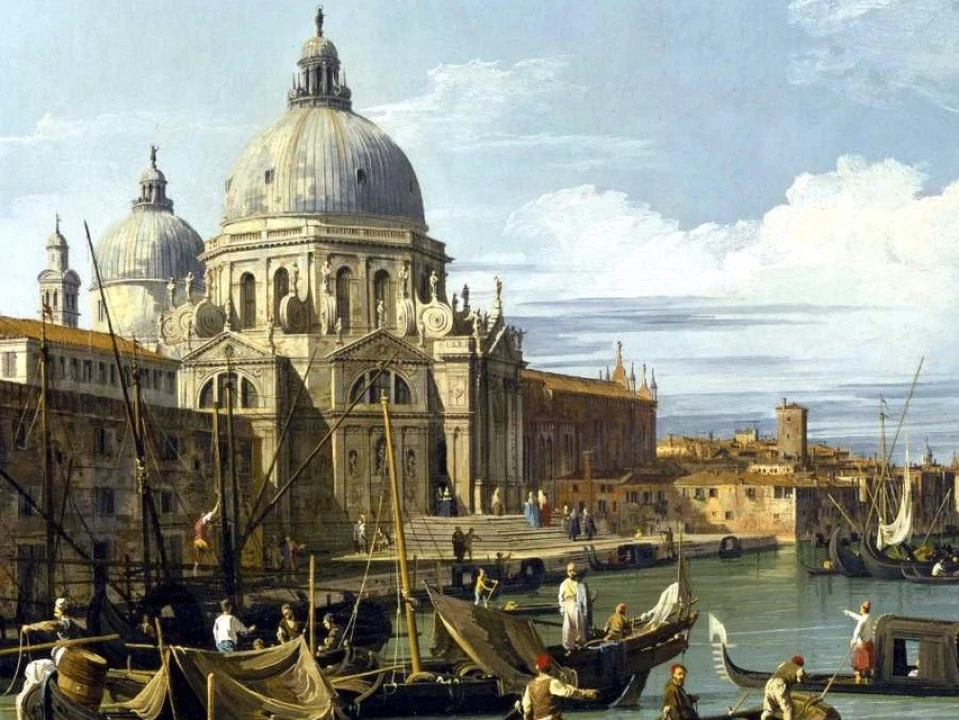
Image: Canaletto, The Entrance to the Grand Canal, Venice, c. 1730. Museum of Fine Arts, Houston. Source: Wikimedia Commons