

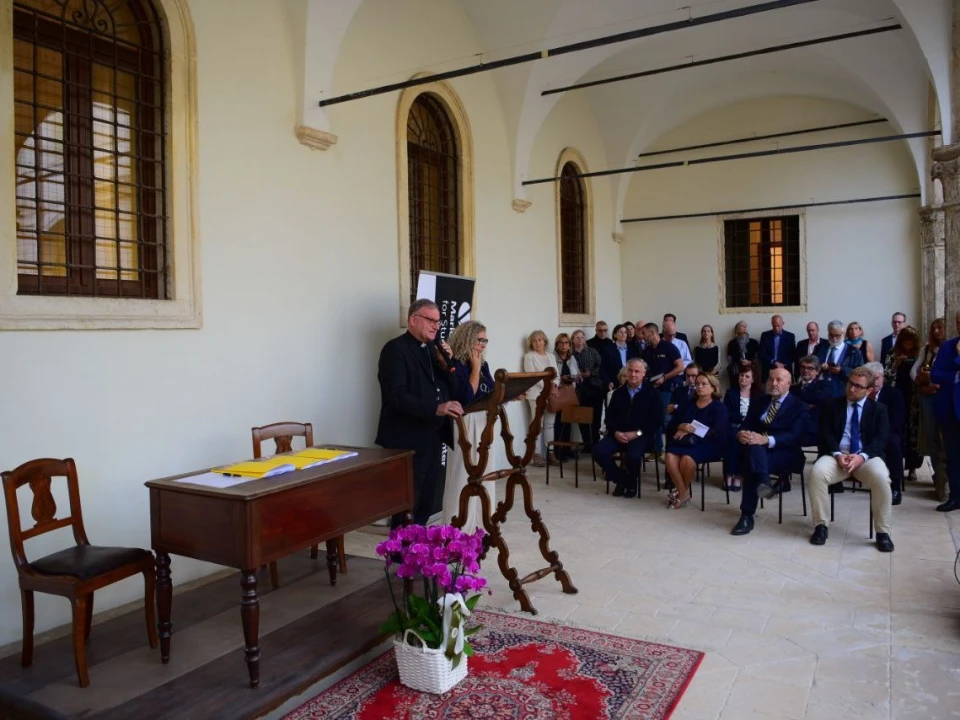
Vicenza is turning a page in its cultural and academic story. On Wednesday, September 24, the Diocese of Vicenza and the University of Virginia’s School of Architecture signed a lease agreement that transforms the former Bishop’s Palace into the first Italian campus of the American university.
The historic episcopal complex – for centuries a focal point of civic and religious life – will now host a permanent center for international education.
The launch carries special symbolism. Fifty years ago, Vicenza-born architect and UVA professor Mario Di Valmarana began leading groups of American students to study in the city. The new study center, dedicated in his name and directed by Professor William Sherman, will welcome rotating cohorts of 25 students.
For Bishop Giuliano Brugnotto, the arrival of the campus represents gratitude and optimism. He described the initiative as a sign of the times – a bridge across cultures, generations, and nations – set in a city forever shaped by the legacy of Andrea Palladio.
The dean of the School of Architecture, Malo A. Hutson, echoed this sentiment. He recalled how Professor Valmarana envisioned study abroad not as an add-on but as an extension of the university itself, built around experiential learning. The new campus, he said, continues that mission while strengthening global connections.
Sherman highlighted the significance of the Veneto as a living classroom. With Venice and Vicenza at its core, the region provides a unique crossroads of history, culture, and urban life – the perfect backdrop for immersive study.
Mayor Giacomo Possamai praised the opening as a milestone for Vicenza’s academic role. Students, he noted, will study in a city molded by Palladio – long celebrated in America as a father of its architecture. Beyond academics, the project reopens a remarkable site in the historic center. The Valmarana Center gives new life to the Bishop’s Palace, returning a place of profound cultural and symbolic value to the city and to the world. Vicenza opens, transforms, and grows — in the name of culture.