
Contrary to what is often assumed, the thirteen British colonies in North America did not proclaim their independence on July 4, 1776. They did so two days earlier, on July 2, when the Second Continental Congress approved the Lee Resolution, stating that the “United Colonies are, and of right ought to be, free and independent States.” What Congress adopted on July 4 was the text that, out of “a decent respect to the opinions of mankind,” set out “the causes which impel[led]” their separation from the British Empire.
The Second Continental Congress entrusted the drafting of that text to a Committee of Five: John Adams, Benjamin Franklin, Thomas Jefferson, Roger Sherman, and Robert R. Livingston. The first draft fell to Jefferson, the thirty-three-year-old Virginia delegate. It was then revised by the other members of the Committee and, more substantially, by Congress, which altered or removed roughly a quarter of Jefferson’s original words.
And yet one phrase remained unchanged from beginning to end, as if it expressed something already established, already nonnegotiable, already beyond dispute: “Life, Liberty and the pursuit of Happiness.” Jefferson himself later explained that the Declaration had not been written to proclaim “new principles, or new arguments,” but to offer “an expression of the American mind”, to reaffirm ideas already widely shared in the thirteen colonies.
The eighteenth-century American mind, however, had not developed in splendid isolation. The ideas expressed in the Declaration and, as John Adams put it, “hackneyed in Congress for two years before”, belonged to a broader Atlantic conversation about natural rights and the purposes of government, shaped also by European thinkers, especially Italians. A few emblematic figures reveal the richness of the Italian contribution.
Filippo Mazzei, a Tuscan patriot who settled in Virginia and became a friend of Jefferson, has been credited by the U.S. Congress as a source of inspiration for the Declaration’s statement that “all men are created equal.” Cesare Beccaria’s On Crimes and Punishments, widely read by the American Founders, helped form the legal culture behind early American debates on criminal reform. Pasquale Paoli, educated in Naples and admired by the Sons of Liberty and other American patriots, had placed the “happiness of the nation” at the heart of the Corsican Constitution of 1755. Gaetano Filangieri, the great voice of the Neapolitan Enlightenment, made “public happiness” the “supreme law” of his comprehensive treatise The Science of Legislation, a work that Benjamin Franklin read, marked, and shared with other American intellectuals.
These shared Enlightenment ideas did not remain confined to the eighteenth century. They resurfaced, in new forms, in education, cultural diplomacy, and international exchange. The Fulbright Program, created in 1946 on the initiative of U.S. Senator J. William Fulbright, gave a powerful twentieth-century expression to that inheritance. For Fulbright, America had been linked to Europe since the eighteenth century by “powerful bonds of commerce and of culture.” After nationalism, tyranny, and war had shaken those bonds, educational exchange became a way to renew that Atlantic community. In Naples, in 1962, only weeks after the Cuban Missile Crisis, Fulbright described academic exchanges as “one of the greatest forces” of progress toward the formation of the West, and culture as “the crucible” in which that Atlantic community had to be forged: “a community of shared values and purposes, of trust and faith among peoples.”
This is the spirit of Transatlantic Enlightenment, a regular column hosted by We the Italians. It will explore the shared Enlightenment heritage of Italy and the United States across law, history, diplomacy, art, architecture, music, literature, education, science, civic culture, and public life. Its purpose is to illuminate the deeper roots that connect the two countries, beyond the changing circumstances of politics, governments, and geopolitical balances. That transatlantic dialogue belongs to the shared heritage of America and Italy. Let us keep that conversation going.
*This contribution is based on the speech delivered at the Italian Ministry of Foreign Affairs and International Cooperation on June 30, 2026, on the occasion of the meeting celebrating the 80th anniversary of the Fulbright Program.
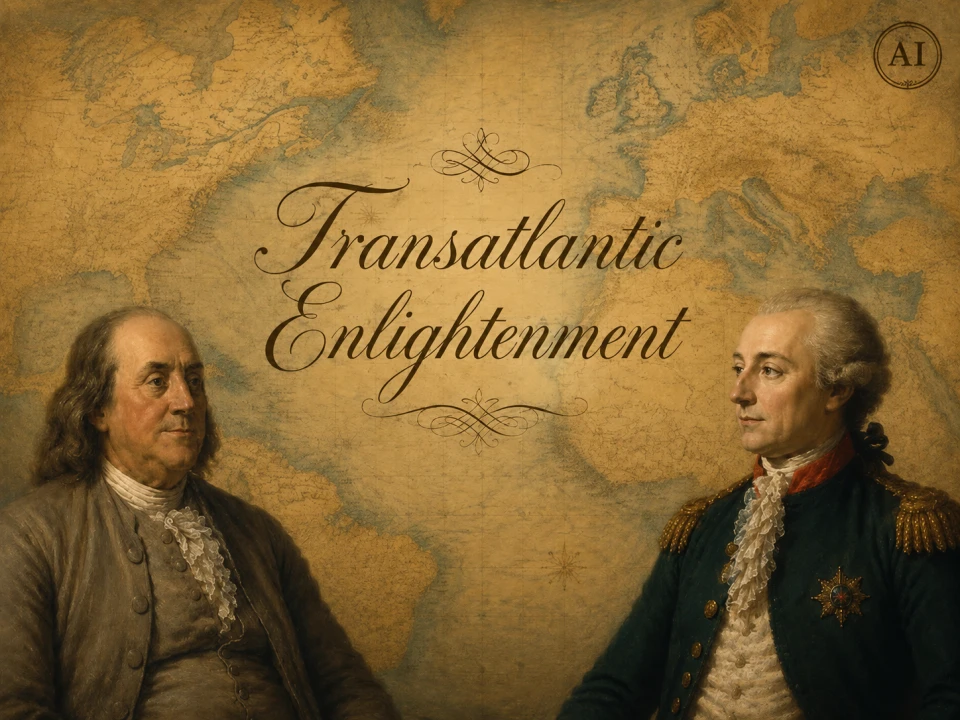
The illustration accompanying this contribution is an AI-generated representation of Benjamin Franklin and Gaetano Filangieri.