
There is a story that crosses the ocean without making a sound. It is not written in great monuments, nor in the glittering signs of New York’s streets. It is a story made of thin threads, injured fingers, and whispered dreams. It is the story of Italian women who emigrated to America and of their daughters. And it is also the story of Concettina Franco.
Tina – as everyone called her – was born on August 16, 1895, in an apartment at 342 East 11th Street, above the historic Veniero’s Pasticceria. She was the eldest of eight children, and as often happened in immigrant families, her childhood ended far too soon.
Her father, Carmelo Franco, had left Santo Stefano di Camastra, in Sicily, chasing a promise called America. Like his father-in-law, he was a shoemaker, an ancient trade built on patience and hard work. Her mother, Camelia Carito, who had arrived from Castronuovo di Sant’Andrea (Potenza) when she was still a child, carried within her another journey: the silent one of women who do not choose, but follow, endure, and build.
In 1894, Camelia and Carmelo were married in New York – a New York that was not yet the city we know today, but a living, growing organism shaped also – and above all – by the hands of Italian immigrants. Hands that dug, sewed, built, and cared. Women’s hands, often invisible, yet essential.
March 25, 1911, was supposed to be Tina’s first day of work at the Triangle Shirtwaist Factory. She was still a teenager. She would have been a seamstress, like her grandmother in Italy. She was proud of that continuity, of that thread connecting generations and continents.
It was not just a job. It was responsibility. It was love.
Her mother was expecting her ninth child and could not work. Her father’s wages were not enough. Tina knew it – and she also knew what she had to do.
But that morning, someone tried to stop her. Her aunt Rosa rushed in from the apartment upstairs: she had dreamed of a fire, had seen Tina dying in the flames. Camelia tried to convince her daughter to stay home. She told her it was not necessary for her to work, that they would manage somehow. But Tina wanted to help her family, and she went out anyway into that cold spring morning.
Because the daughters of immigrants learn early that love sometimes has the face of sacrifice.
The Triangle occupied the top three floors of the Asch Building, near Washington Square Park, in the heart of Manhattan. It was one of the largest and most sought-after factories. But behind that promise lay a brutal reality: exhausting hours, nonexistent safety measures, locked fire exits, and inspections.
On that March 25, at 4:30 p.m., just as the workday was ending, the fire broke out.
Inside those rooms worked hundreds of young women, mostly Italian and Jewish immigrants from Eastern Europe. Young, poor, but full of dreams. According to historical accounts and testimonies of the time, fourteen engagement rings were found on a single floor of the Triangle Shirtwaist Factory among the bodies of the victims of the fire.
The fire on the eighth floor spread within minutes, fueled by fabric and wood. On the tenth floor, many managed to escape across the roof, but on the ninth floor, where Tina was, no one was warned in time. The exits were locked. The fire escapes were inadequate. The air turned to smoke.
New York watched, helpless.
From the windows, the girls began to jump into the void.
Journalist William Gunn Shepherd, a United Press reporter who happened to be there by chance, witnessed the scene firsthand and described it in words that still wound today: one after another, those young lives fell, turning the sky into an abyss.
Firefighters arrived, but their ladders could not reach above the sixth floor. The elevators, operated with courage by Joseph Zito and Gaspare Mortillaro, saved dozens of lives. But it was not enough.
Amid the smoke and panic, someone saw Tina. She was not fleeing. She was trying to help others.
Then she disappeared.
Camelia arrived among the crowd gathered at the scene of the tragedy. Her daughter was among the missing. The journey to the morgue, set up along the East River, was a journey into absolute grief. Men and women filed past unrecognizable bodies, searching for a sign: a shoe, a piece of fabric, a weekly pay envelope with a name hidden among the clothes.
It was her uncle, Patrick Carito, who identified her the next day.
Concettina Franco was fifteen years old.
The wake was held in the same narrow room where she had been born. More than a thousand people followed her small white coffin; she, too, had been dressed in white. There were flowers, bands, carriages. There was an entire community. Because Tina was not just a daughter: she was the symbol of them all.
Two weeks later, her mother gave birth to a baby girl. She named her Concettina… to honor once again her first daughter after that great sacrifice.
In the Triangle fire, 146 people died (123 women and 23 men). Until September 11, it was the deadliest workplace disaster in New York’s history. The owners did not truly pay for what had happened. The families received humiliating compensation.
But something changed…
From the ashes, a new awareness was born. New laws were enacted, safety regulations introduced, and rights for workers – especially women workers – began to take shape. Above all, a labor and women’s movement emerged that would no longer accept silence.
For years, it was mistakenly said that International Women’s Day was born from that fire. That is not true. But it is true that in those flames something was ignited that still burns today: the demand for dignity.
The story of Concettina Franco is the story of Italian immigration seen through the eyes of a girl born in America as the result of her grandparents’ and parents’ great dream of a better life. It is the story of those who did not build skyscrapers, but made them possible. It is the story of women who stitched not only garments, but the very fabric of an entire city.
New York would not be what it is without them. And perhaps, among its streets, its lights, and the constant noise of life, that invisible thread still exists – Tina’s thread, and that of the others.
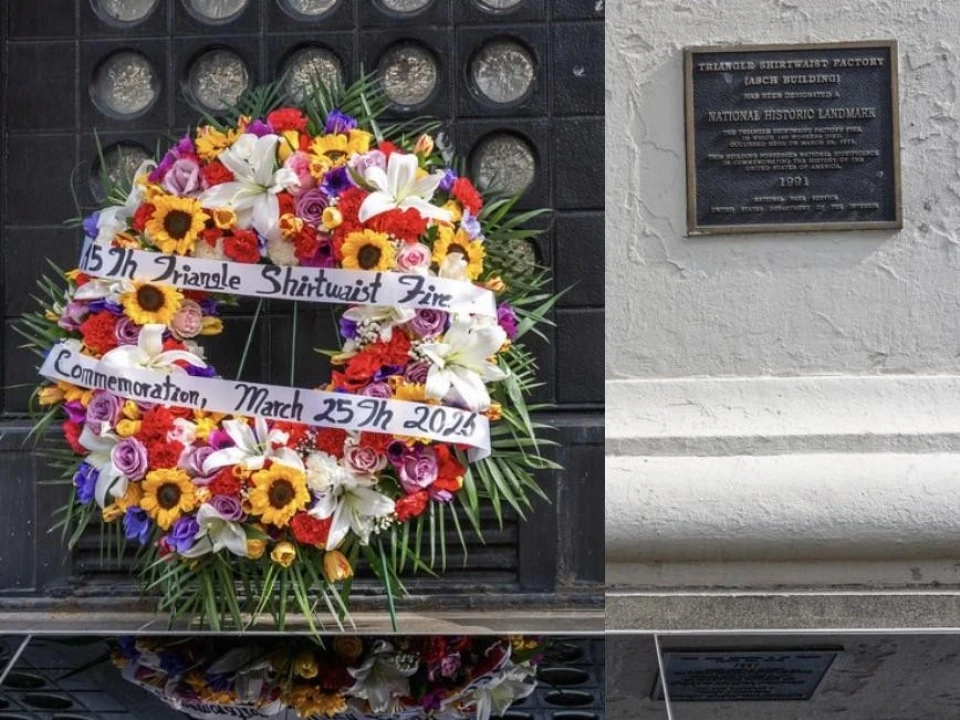
On March 25, 2026, as every year, New York commemorated the victims of the Triangle Shirtwaist Factory fire. The ceremony took place in front of the building that housed the factory, now part of New York University.
During the event, attended by descendants of the victims, workers, and representatives of immigrant communities, the names of the 146 victims were read aloud, accompanied by the tolling of a bell. White roses were laid at the permanent memorial inaugurated in 2023, which runs along the nine floors of the building and recounts the tragedy in multiple languages: English, Italian, and Yiddish – the languages spoken by the victims.
Among the most significant moments were the presence of the cast of the musical Camicette bianche, created by Marco Savatteri and inspired by the tragedy, as well as the “Chalk” initiative, which since 2004 has written the victims’ names in front of their homes. The commemoration renews the commitment to workplace safety and to keeping alive the memory of a tragedy that changed the history of workers’ rights.