
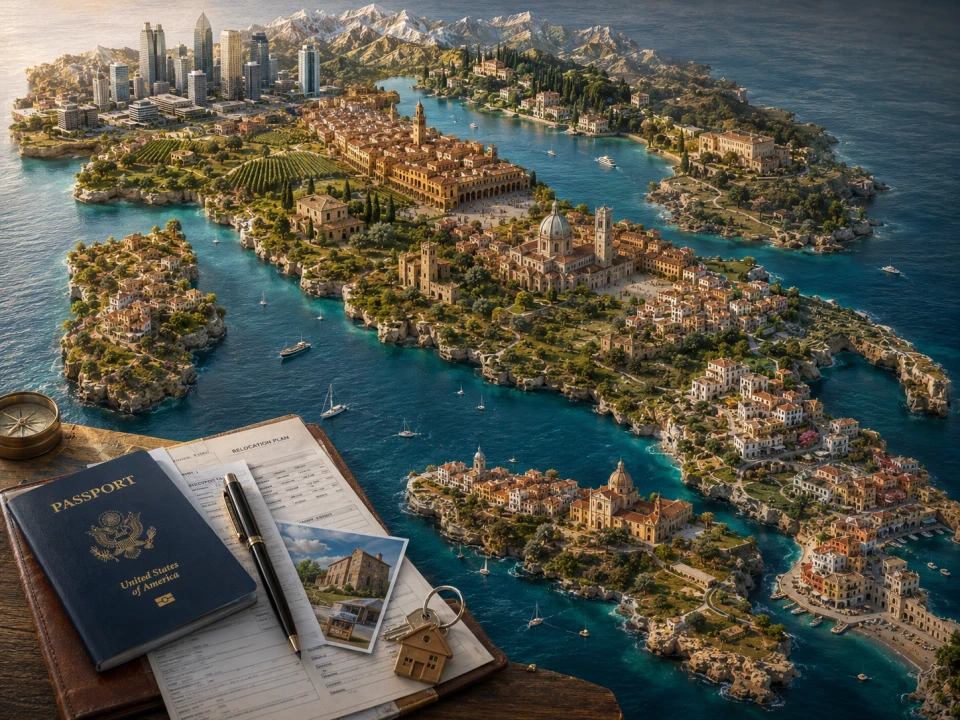

For many Americans and Italian Americans, the idea of moving to Italy begins with a familiar image. A stone farmhouse among the vineyards of Tuscany. A colourful village suspended above the Mediterranean. A quiet piazza where life appears to move at a gentler pace than back home. Perhaps it comes from a family story, a holiday, a film, or increasingly from Instagram, where Italy often seems like an endless sequence of sunsets, pasta dishes and charming historic centres.
There is nothing wrong with that. Italy is beautiful, and much of what people fall in love with is very real. The problem begins when those images become the basis for major life decisions.
Every year, I meet people who have already decided where they want to live before they have considered what their life in Italy will actually look like. They know they want a house overlooking vineyards, but have not checked how far the nearest hospital is. They dream of a medieval village, but have not considered that the nearest railway station may be thirty kilometres away. They imagine long lunches in the sunshine, but have not spent a single February there.
My first suggestion to anyone considering a move to Italy is therefore quite simple: choose Italy based on your real life, not on your holiday memories.
The good news is that Italy offers an extraordinary range of options. Unlike smaller countries, where lifestyles tend to be relatively similar from one region to another, Italy changes dramatically as you move across the peninsula. Climate, property prices, public services, transport infrastructure, taxation, demographics and even social habits can vary enormously.
In practice, this means that there is genuinely something for almost every budget, profession and lifestyle.
One of the biggest mistakes foreigners make is assuming that Italy has a single property market. In reality, it has dozens of them.
A small apartment in central Milan can easily cost as much as a detached villa in many parts of Southern Italy. In prestigious areas of Florence, Venice, Rome or Lake Como, prices may rival those of major international cities. Meanwhile, in parts of Calabria, Molise, Basilicata, Sicily or inland Sardinia, properties can still be purchased at prices that would seem almost unimaginable in many American metropolitan areas.
The famous "one-euro house" initiatives have attracted considerable international attention, and while they are certainly real, they are often misunderstood. Nobody is giving away a fully renovated dream home overlooking the sea. These programmes usually involve properties requiring substantial investment and renovation. Yet they are also a useful reminder that Italy's less publicised regions often offer remarkable value for those willing to look beyond the obvious destinations.
The same applies to the cost of living.
Many Americans arrive expecting Italy to be universally inexpensive. The reality is more nuanced. Milan, for example, has become one of Europe's most expensive cities, particularly in terms of housing. Living comfortably in central Milan may cost significantly more than living in many provincial American cities.
On the other hand, a family living in a medium-sized city in Southern Italy may find that housing, utilities, dining out and everyday expenses are considerably lower than what they were accustomed to in the United States.
Even within the same region, costs can vary dramatically. A property near the Amalfi Coast and a property thirty minutes inland may have completely different price tags. The same applies around Lake Garda, Lake Como, Tuscany and many coastal destinations.
This is why the question should never be "How much does life in Italy cost?" but rather "Which Italy are we talking about?"
Transport is another factor that deserves far more attention than it usually receives.
Many Americans are surprised to discover that living in Italy without a car is entirely realistic in some areas and almost impossible in others.
If you live in Milan, Bologna, Turin, Florence or Rome, high-speed rail connections, public transport systems and walkable city centres can make daily life remarkably convenient. Italy's high-speed rail network connects many major cities efficiently and often more comfortably than domestic air travel.
Move into rural areas, however, and the situation changes considerably. Public transport may become infrequent, services may be concentrated in larger towns, and daily life can quickly become car-dependent.
Neither option is necessarily better. Some people actively seek a slower rural lifestyle and are perfectly happy driving everywhere. Others discover after a few months that they miss the convenience of urban living far more than they expected.
The same principle applies to services.
A picturesque village with three hundred inhabitants may look wonderful in photographs, but practical questions still matter. Is there a doctor nearby? How reliable is internet connectivity? Are essential shops open year-round? How far away is the nearest airport? What happens outside the tourist season?
These questions may sound unromantic, but they often determine whether people remain in Italy happily for decades or leave after a few years.
One aspect that is frequently overlooked abroad is taxation.
For all the criticism that Italy's tax system sometimes receives domestically, foreigners are often surprised to discover just how attractive some Italian tax regimes can be.
Successive governments have introduced a variety of measures designed to attract investment, retirees, professionals and new residents. The details evolve over time, and professional advice is always essential, but the general principle remains clear: Italy has made significant efforts to compete internationally for talent and capital.
Retirees moving to certain municipalities in Southern Italy, for example, have in recent years benefited from highly favourable flat-tax regimes on foreign income. Individuals relocating substantial wealth or business activities may find dedicated programmes designed to encourage investment. Certain internal areas suffering from population decline actively welcome newcomers. Various incentives have been created over the years to support economic development in less populated regions.
In simple terms, Italy is often much more interested in attracting new residents to Calabria than to central Milan, and much more interested in repopulating small towns than adding further pressure to Venice or Florence.
The result is a situation that occasionally causes some raised eyebrows among local residents. It is not unusual for newcomers to discover that, under certain circumstances, they may access tax arrangements that many long-term Italian taxpayers view with a degree of envy.
Naturally, these incentives should never be the sole reason for moving. Tax advantages can change, while quality of life is something you experience every day. Yet they are often an important part of the overall equation and deserve careful consideration.
Perhaps the most important point of all is that Italy is not one lifestyle.
The Italy experienced by a retired couple in a Sicilian coastal town has very little in common with the Italy of a technology entrepreneur in Milan. The daily life of a family in Bologna differs greatly from that of someone restoring a farmhouse in Umbria. A remote worker living near Lake Garda will have a completely different experience from an Italian American returning to a village in Abruzzo where their grandparents once lived.
And that is precisely the country's greatest strength.
Too often, people arrive searching for the Italy they have seen in films. What they should be searching for is the Italy that matches their own priorities.
If your priority is international connectivity, there are cities perfectly suited to that. If your priority is affordability, there are regions where your budget may stretch much further than expected. If your priority is climate, culture, food, outdoor living, history, entrepreneurship or retirement, there are places specifically suited to each of those goals.
The real opportunity is not choosing the most famous destination. It is choosing the destination that makes sense for your life.
Because moving to Italy is not about extending a holiday indefinitely. It is about building a sustainable everyday life in one of the world's most diverse and fascinating countries.
And for those willing to look beyond the clichés, beyond Instagram and beyond the postcards, there is indeed an Italy for almost every taste, every ambition and, perhaps most importantly, every budget.