
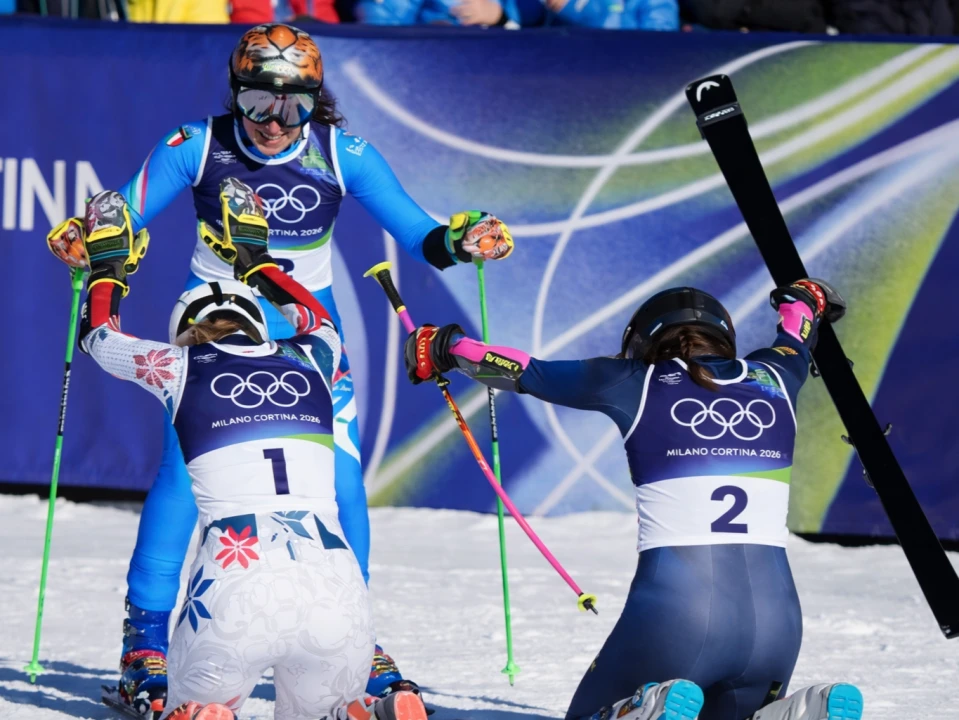
The photo symbol of the Winter Olympics, in our opinion, is the one of the Norwegian and Swedish athletes who finished yesterday in the giant slalom ex aequo in second place, bowing to Federica Brignone, who had just passed them to win another gold medal.
In that photo there is everything: Federica’s courage, the respect of her fellow athletes, the enormity of her achievement, just 10 months after an accident that seriously risked preventing her not only from winning gold, not only from winning a medal, not only from skiing at a competitive level, not only from skiing at all, but even simply from walking.
At the Milano Cortina 2026 Winter Olympics, Italy has rewritten its own sporting history. The Azzurri have surpassed the long-standing national record of 20 medals set at the Lillehammer 1994 Winter Olympics, establishing a new all-time high for total podium finishes at a single Winter Games. The symbolic barrier was broken over an extraordinary weekend, confirming Milano-Cortina as the most successful Winter Olympics ever for Italy.
Yesterday’s competitions played a decisive role in pushing the medal count beyond that historic threshold. Federica Brignone delivered one of the defining performances of the Games by winning gold in alpine skiing, dominating the giant slalom after already claiming gold in the super-G earlier in the week. Her victories on home snow in Cortina d’Ampezzo became emblematic of Italy’s strength in technical and speed events.
In biathlon, Lisa Vittozzi captured a historic gold medal in the women’s pursuit, marking Italy’s first Olympic title in that discipline. Competing in front of an enthusiastic crowd in Antholz, Vittozzi combined flawless shooting with tactical precision on skis, adding a landmark achievement to the country’s growing biathlon tradition.
The men’s cross-country relay team added a bronze medal after a gritty, coordinated performance that highlighted teamwork and endurance. Their podium finish demonstrated that Italy’s competitiveness extends beyond individual stars to collective events requiring depth and strategy.
Another important medal arrived in snowboard cross, where the Italian mixed team earned silver after a thrilling final. The result confirmed Italy’s progress in snowboard disciplines, which have become increasingly central to the country’s Winter Games ambitions.
Earlier in the Games, Francesca Lollobrigida had already contributed significantly to the medal haul in speed skating, winning gold and reinforcing Italy’s presence on the ice. Meanwhile, short track legend Arianna Fontana once again climbed the Olympic podium, adding another medal to her extraordinary career and underlining her enduring impact on Italian winter sports.
This diverse medal distribution – alpine skiing, biathlon, cross-country skiing, snowboard, and speed skating – explains how Italy managed to move beyond the 20-medal mark achieved in Lillehammer. It is not simply a matter of isolated triumphs, but of broad competitive strength built over years of investment in athlete development and high-performance programs.
With additional events still on the schedule, the medal total could climb even higher. Regardless of the final tally, Milano-Cortina 2026 will be remembered as the Games where Italy set a new record, expanded its horizons across multiple disciplines, and delivered unforgettable victories on home soil.