
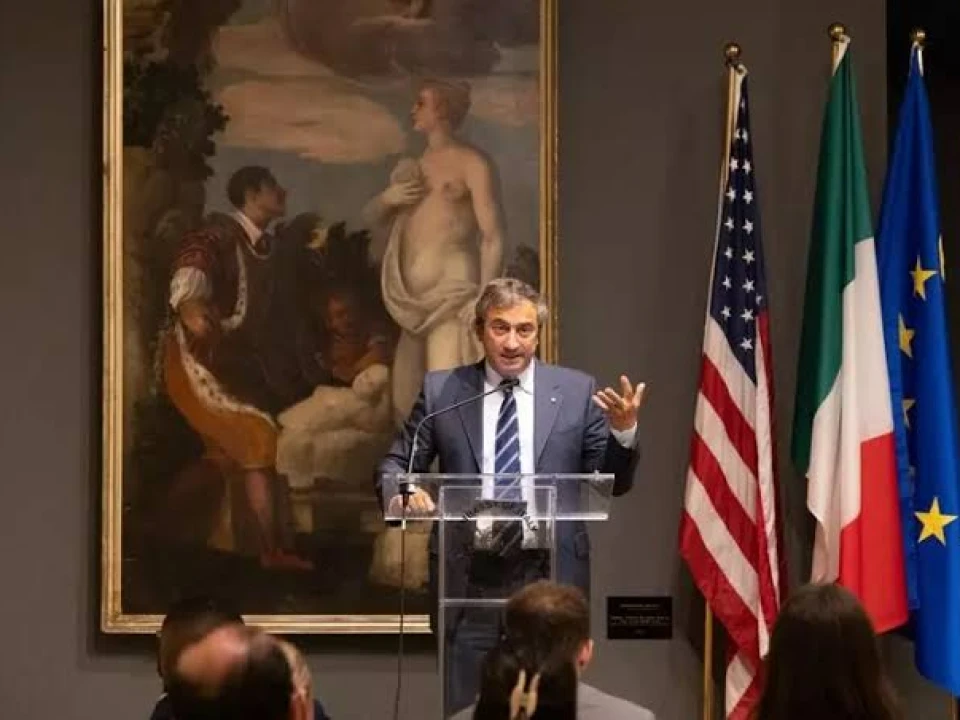
As part of the third U.S.-Italy Dialogue on Trusted Technologies for Democracies, the Embassy of Italy in Washington, together with the Transatlantic Harmonic Foundation and the Krach Institute for Tech Diplomacy at Purdue University, launched the U.S.-Italy Trusted Tech Accelerator, an initiative designed to strengthen technological cooperation between Italy and the United States.
The event brought together numerous government officials, researchers, and representatives of 90 companies from both countries.
In addition to Italy's Ambassador to the United States, Marco Peronaci, participants included Giorgio Mulè, Vice President of the Italian Chamber of Deputies; Attilio Fontana, President of the Lombardy Region; Francesco Rocca, President of the Lazio Region; and Barbara Cimmino, Vice President of Confindustria. Anna Maria Bernini, Italy's Minister of Universities and Research, and Alessio Butti, Undersecretary of State to the Presidency of the Council of Ministers with responsibility for innovation and technology, also participated through video messages.
On the American side, participants included Jacob Helberg, U.S. Under Secretary of State for Economic Affairs, and David Fogel, Assistant Secretary of Commerce.
Hosted at the Embassy of Italy in Washington, the event, now in its third edition, was also developed with the support of Professor Roberto Baldoni, advisor on cybersecurity and technology and honorary professor at Sapienza University of Rome.
The initiative comes at a particularly favorable moment for Italy-U.S. relations in the technology and economic sectors. On September 21, Italian Deputy Prime Minister and Foreign Minister Antonio Tajani and U.S. Secretary of State Marco Rubio signed an agreement on critical minerals in New York. In July, Italy joined Pax Silica.
Italian companies are also making significant investments in the United States. Pirelli will expand its facility in Georgia; Prysmian, in addition to acquiring an American electrical company, will invest in North Carolina; Angelini has acquired a U.S. pharmaceutical company; and Enel Green Power has made a similar move in renewable energy through the acquisition of Excelsior Energy Capital.
"The United States and Italy have a longstanding partnership in the technology sector. Our collaboration is already highly advanced, for example, in space exploration: Italy is one of the main partners in Artemis and will contribute to the lunar exploration program by participating in the development of habitation modules. Consider that NASA has valued Italy's contribution to the lunar exploration program at $5 billion.
"Cooperation is also advanced in fundamental physics and quantum technologies. At Fermilab, for example, Italian and American researchers are working together on neutrino physics through a project called the Deep Underground Neutrino Experiment (DUNE). We are also making significant progress in quantum technologies through the Superconducting Quantum Materials and Systems Center.
"The project launched today represents another important milestone in technological cooperation between Italy and the United States. The Accelerator offers our companies, research institutions, investors, and government agencies a concrete way to connect and explore new opportunities in artificial intelligence, energy, and life sciences. By creating greater opportunities for our businesses, the program will benefit both sides of the Atlantic," said Marco Peronaci, Italy's Ambassador to the United States.
"Lombardy is ready to play a leading role in strengthening technological cooperation between Italy and the United States," emphasized Regional President Attilio Fontana. "The region's businesses, universities, and research centers are centers of excellence, thanks to their high-level technical and managerial expertise. This leadership can gain further momentum through international partnerships of this kind."
"Artificial intelligence, clean energy, and life sciences are key sectors in which it is essential to connect knowledge, investment, and talent," he added. "These productive synergies can accelerate technology transfer and create value for the business community. Initiatives such as the U.S.-Italy Trusted Tech Accelerator move precisely in this direction: they encourage dialogue between research and industry and help strengthen the competitiveness of our companies, generating new development opportunities for local communities," Fontana continued.
"Italy and the United States have done more than talk about trusted technology: they have begun building real tools to make it possible. In the fields of technology, energy, and life sciences, the decisive question is not simply who innovates first, but whom we can trust. And trust is built between nations that share the same values and place technology at the service of people," said Francesco Cicione, Founding President of Harmonic Innovation Group and creator of the Harmonic Innovation paradigm.
"Strengthening transatlantic cooperation on strategic technologies means turning collaboration between Italy and the United States into investments, industrial projects, and new market opportunities. Our economies have complementary strengths: American leadership in research and artificial intelligence is matched by Italian manufacturing excellence and our specialized supply chains. The challenge is to turn innovation into large-scale industrial applications through concrete partnerships capable of strengthening the competitiveness of businesses on both sides of the Atlantic," said Barbara Cimmino during her remarks at the U.S.-Italy Dialogue on Trusted Technologies for Democracies.
The Accelerator will run for 18 months and focus on three strategic sectors: artificial intelligence and advanced technologies, energy, and life sciences.
The initiative aims to connect Italian and American companies, startups, universities, research centers, and investors to develop transatlantic partnerships, joint research and development projects, technology transfer, new products, and investments.